



Hagerstown’s Mayor, City Council, and city administrator are asking residents to comment on an annexation tied to data center development while operating under the City’s nondisclosure agreement with Diversified Capital, the company behind the project. As we previously reported, the City has refused to provide that agreement to us, despite our Maryland Public Information Act request.
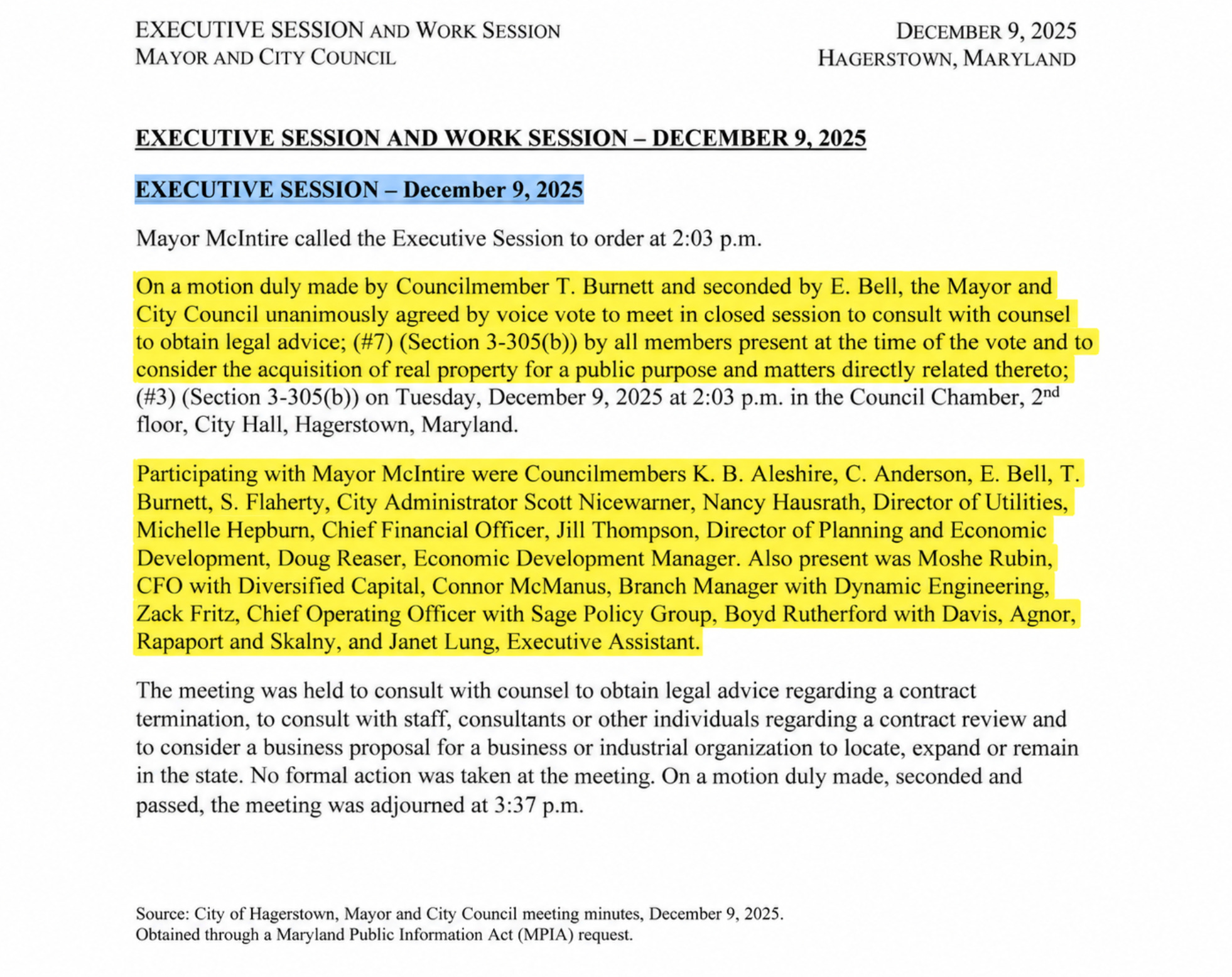
Both Washington County and Hagerstown officials met privately with Diversified Capital CFO Moshe Rubin on December 9, 2025, in separate closed-door meetings. As we documented in our reporting, Hagerstown’s minutes place Diversified Capital CFO Moshe Rubin with the Mayor, City Council, and senior City staff. The County’s minutes identify Rubin and other project representatives at its confidential presentation, which officials said was covered by an NDA.
Now, at the Tuesday, October 27 hearing, residents are being asked to weigh in while the City continues withholding its agreement with the developer, and officials cannot get their story straight about who is responsible for keeping it from the public. That meeting also includes approximately $30.6 million in proposed wastewater contracts that sewer customers would help fund. Residents should be able to examine the City’s commitments and understand the potential costs before officials make further decisions. We reviewed the 567-page agenda packet and identified ten things residents should know. Page numbers below refer to that packet.
1. The agenda leaves the final annexation vote date undetermined
The proposal would bring 171.88 acres at 12440 Burkholder Lane and 12660 McDade Road into Hagerstown with Industrial Mixed-Use zoning. The annexation plan anticipates extending City water to the Burkholder parcel. Staff scheduled a November 10 follow-up discussion, but the proposed resolution leaves its passage and effective dates “To be determined.”
Why it matters: Annexation would put the properties under City land-use rules and advance plans to provide City water. Residents need a clear voting schedule and answers about the data center’s demands before that decision is made. November 10 is listed as a discussion, not a confirmed final vote.
2. Data center development drives this annexation, but only one of 567 pages mentions data centers
On page 97, the packet reproduces the hearing ad placed through a local news outlet with a paywalled website. It describes the acreage and proposed zoning without mentioning the data center development or its anticipated use of City water. The only page we found mentioning data centers is page 247, a Fidelity Power Systems sales sheet advertising “Data Center Cleaning.” Someone searching for an explanation of the development would find a contractor’s marketing material.

Why it matters: Residents should not have to follow our reporting to understand why these properties are being brought into Hagerstown. Leaving the development out of the notice and annexation explanation makes it harder for people to recognize what is at stake and prepare informed comments.
3. The sewer spending could matter as much as the annexation
The hearing shares an agenda with major wastewater spending. A five-year, $52.9 million improvement program lists $49.5 million in planned borrowing and $3.4 million from the wastewater fund. Sewer customers’ payments would help repay the borrowing. The plan also notes $3 million in loan forgiveness within the state financing, so that portion would not need to be repaid.
Why it matters: Borrowing lets the City pay for work now and repay it over time through the sewer system’s revenues, including customers’ bills. Residents need to know what these upgrades would cost them and whether any work would accommodate data center development. The funding page provides no household bill estimate.
4. The wastewater funding plan lists no developer contribution
The five-year wastewater program lists $0 under “Grant or Devel”, the category for grant or developer funding. Its listed sources are borrowing and the wastewater fund, with $3 million in loan forgiveness noted separately within the state financing. No direct developer contribution is budgeted in that table.
Why it matters: If any upgrades are needed to serve data centers, existing sewer customers need protection from paying costs those developments create. Officials should identify the projects these investments would serve and explain what developers would contribute. Any developer payments through connection fees or separate agreements should also be disclosed.
5. Major wastewater contracts could pass together without separate discussion
The Council could authorize approximately $30.6 million through one consent agenda vote, which groups purchases together unless a councilmember requests separate discussion. Page 101.
The proposed authorizations include Carl Belt: $27.73 million, including a $3 million reserve for unexpected costs, and Black & Veatch: $2.84 million for construction engineering and oversight through an amendment to its existing treatment plant contract. The City proposes adding that work without a new competition, citing the firm’s knowledge of the plant. Pages 311–315 and 351.
As we previously reported, Black & Veatch’s January 22, 2026 master-plan proposal included additional “Data Center Owner’s Advisor” services for Hagerstown and Washington County, addressing water demand, cooling wastewater, electricity and siting. The March 24 agenda presented the $2,790,365 master-plan project with that proposal attached. By July, City paperwork said the project had begun.
Our reporting also documented Washington County consultant Greg Murray billing for a meeting with a Hagerstown representative and reviews of Black & Veatch materials. His invoice does not identify the documents or discussions. Black & Veatch also advertises private data center work, including two 300-megawatt substations, and campus services covering water and power.
Why it matters: The City moved forward with a master-plan project whose proposal explicitly included data center advice. It should identify which services it purchased, release the approved scope and explain whether the October plant work reflects data center demand. Those answers deserve public discussion before another multimillion-dollar commitment passes with a list of purchases.
6. The City claims enough water is available without showing the development’s demand
The proposed annexation covers 171.88 acres overall, but the annexation plan identifies the Burkholder parcel at issue for water service as 148.77 acres. For the 148.77 acre Burkholder parcel, the annexation plan states: “Sufficient capacity exists to serve the property.” But the annexation materials do not provide a project-specific estimate of water use, cooling assumptions, or calculations showing how the anticipated development fits within available capacity.
Why it matters: That assurance is hard to evaluate without knowing how many gallons per day the City assumed or how much water is already committed elsewhere. The City should publish the study behind its conclusion and explain whether it accounts for the scale and cooling design of the proposed data center.
7. A 172 acre data center could use more electricity than all Washington County households combined
The annexation plan identifies Potomac Edison, a FirstEnergy company, as the property’s electricity provider and the plan would not move the development onto Hagerstown’s electric system.
The Burkholder Lane property listing advertises a one-million-square-foot industrial building and identifies data centers as a potential use. That raises an obvious question: how much electricity would this development require? An October 19 Forbes article describes hyperscale data centers as having power ratings above 100 megawatts. The City’s annexation packet does not disclose this project’s expected demand.
If the development averaged 100 megawatts around the clock, it would consume approximately 876 million kilowatt-hours annually, equivalent to roughly 83,000 average American homes. Washington County has approximately 60,000 households, according to Census estimates. At 100 megawatts of continuous use, this development would add electricity demand equal to approximately 140% of the annual electricity used by all Washington County households combined, based on average U.S. household consumption.
This is an illustration of the potential scale, not a confirmed estimate for the development.
Why it matters: Adding a major electricity user increases demand on the same regional grid that serves our homes and businesses. When demand grows faster than supply, prices rise. Meeting that demand can also require expensive power lines and substations. Maryland’s Office of People’s Counsel says data center demand is already driving up Maryland customers’ electricity costs. Even if the developer pays for its connection, the increase in demand for energy would drive up rates for residents. Officials should disclose the project’s power request and explain how other customers would be protected before moving the annexation forward.
8. The developer’s reported plans cover more than nine times the land being considered for annexation
The Herald-Mail reports that Diversified Capital is proposing to develop approximately 1,600 acres west of Hagerstown and is seriously considering a data center as a potential use. That is more than nine times the approximately 172 acres covered by this annexation request.
Why it matters: Residents need to know whether this annexation is one part of a much larger data center development plan. The public deserves to understand the full potential demand on electricity, water and sewer systems before decisions are made one parcel at a time.
9. Another developer could receive substantial sewer fee credits
A proposed agreement with Currwood DH, LLC at 1912 Day Road would provide sewer-charge credits worth up to 85 percent of qualifying improvement costs, plus up to 25 residential sewer unit credits for qualifying right-of-way acquisition costs. The development includes approximately 66 detached homes, 446 townhouses, 276 apartments and commercial sites. The developer would pay for construction first, then apply credits against sewer benefit charges for the primary residential development. Completed sewer improvements would transfer to the City after one year in service.
Why it matters: For example, $1 million in eligible costs could produce up to $850,000 in fee reductions. The sewer system would collect less from the developer while acquiring infrastructure. The City should explain whether the credits leave costs for other customers and how this approach compares with the terms it would offer a data center developer.
10. Hagerstown’s planning chair raised a data center moratorium in July. We found no recorded follow-up.
At the July 8 Planning Commission meeting, Chairperson Christina Davis raised the possibility of a City data center moratorium similar to Washington County’s. According to the approved minutes, Deputy Planning Director Stephen Bockmiller said the topic would need to be added to a future agenda. At that same meeting, the commission voted 4–0 to recommend the approximately 172-acre Burkholder-McDade annexation plan with Industrial Mixed-Use zoning. No formal motion or vote on a moratorium was recorded.
Why it matters: Washington County’s moratorium does not cover Hagerstown, so Davis was raising a question about protections the City would need to consider itself. The subsequent Planning Commission records we reviewed show no follow-up discussion, and the published October 28 agenda does not list a moratorium either. City officials should explain what happened to Davis’s inquiry, whether it reached the Mayor and City Council, and why residents have no recorded answer while the annexation continues moving forward.
11. Hagerstown City Administrator Scott Nicewarner opposed Governor Wes Moore’s statewide data center moratorium.
In a January 13 report from Tri-State Alert, Scott Nicewarner opposed legislation that would pause data center construction, saying, “I don’t think that’s a good bill.” He argued that Hagerstown should control its own resources and that a data center could generate tax revenue that otherwise might need to come from taxpayers. Speaking personally, Nicewarner said he had not yet discussed his position with the Mayor or Council. Confusingly, these comments came just over a month after he joined them in a private December 9 meeting with data center developer Diversified Capital.
Residents concerned about higher utility bills deserve more than a general argument about tax revenue. Nicewarner should explain what analysis supports those anticipated benefits, what infrastructure costs a data center could create, and how he would ensure those costs are paid by the developer rather than existing customers.
As we have since reported, Hagerstown officials are bound by a nondisclosure agreement with Diversified Capital. The City denied our Maryland Public Information Act request for the agreement, and we have taken that denial to the Maryland Public Information Act Ombudsman for mediation. Residents are being asked to assess the benefits of development while the City continues withholding the agreement governing its confidential dealings with the developer.


Why it matters: Governor Wes Moore later said he would sign a statewide data center moratorium if lawmakers sent him one. Nicewarner’s earlier opposition makes it fair to ask why he opposed a pause, what enforceable protections he supports, and what recourse or compensation residents would have if data center costs increase their utility bills.
12. The City has published conflicting instructions for speaking at the hearing
The hearing notice says people may sign in at City Hall beforehand and receive three minutes. The City’s online form instead requires registration 24 hours before a regular session or public hearing, making the deadline Monday, October 26, at 7 p.m. Register online by that deadline and arrive at 6:45 p.m. to sign in. The meeting begins Tuesday, October 27, at 7 p.m., City Hall, 1 East Franklin Street. Pages 1, 7 and 97.
Why it matters: Nobody should lose the chance to speak because the City published two sets of instructions. This hearing is residents’ opportunity to question a development that could affect their neighborhoods and utility bills.
The City Owes Residents Answers Before Moving Forward
Before Hagerstown moves this annexation forward, officials need to explain what they have discussed with Diversified Capital, what commitments they have made, and what accommodating this data center development could cost the rest of us. They should release the NDA and related records we requested, publish the assumptions behind their water-capacity assurances, and explain whether the wastewater investments would support the development. Residents should be able to evaluate those answers before the Council makes decisions that could affect their utility bills for decades.
The Mayor and Council had their private meeting with the developer. Washington County officials had theirs. The public deserves a meaningful opportunity to examine what happened in those rooms and influence what happens next. Asking residents to decipher 567 pages while withholding records about the developer is an inadequate basis for public participation. If officials cannot provide the information people need to assess this proposal, they should postpone the decisions until they can.
Show up Tuesday, October 27, at Hagerstown City Hall, 1 East Franklin Street. Arrive at 6:45 p.m. for the 7 p.m. meeting, and register to speak by Monday, October 26, at 7 p.m. Sign the petition at StopTheNDAs.org, share this information with your neighbors, and ask officials to explain what they know before they commit the public to paying for it.