



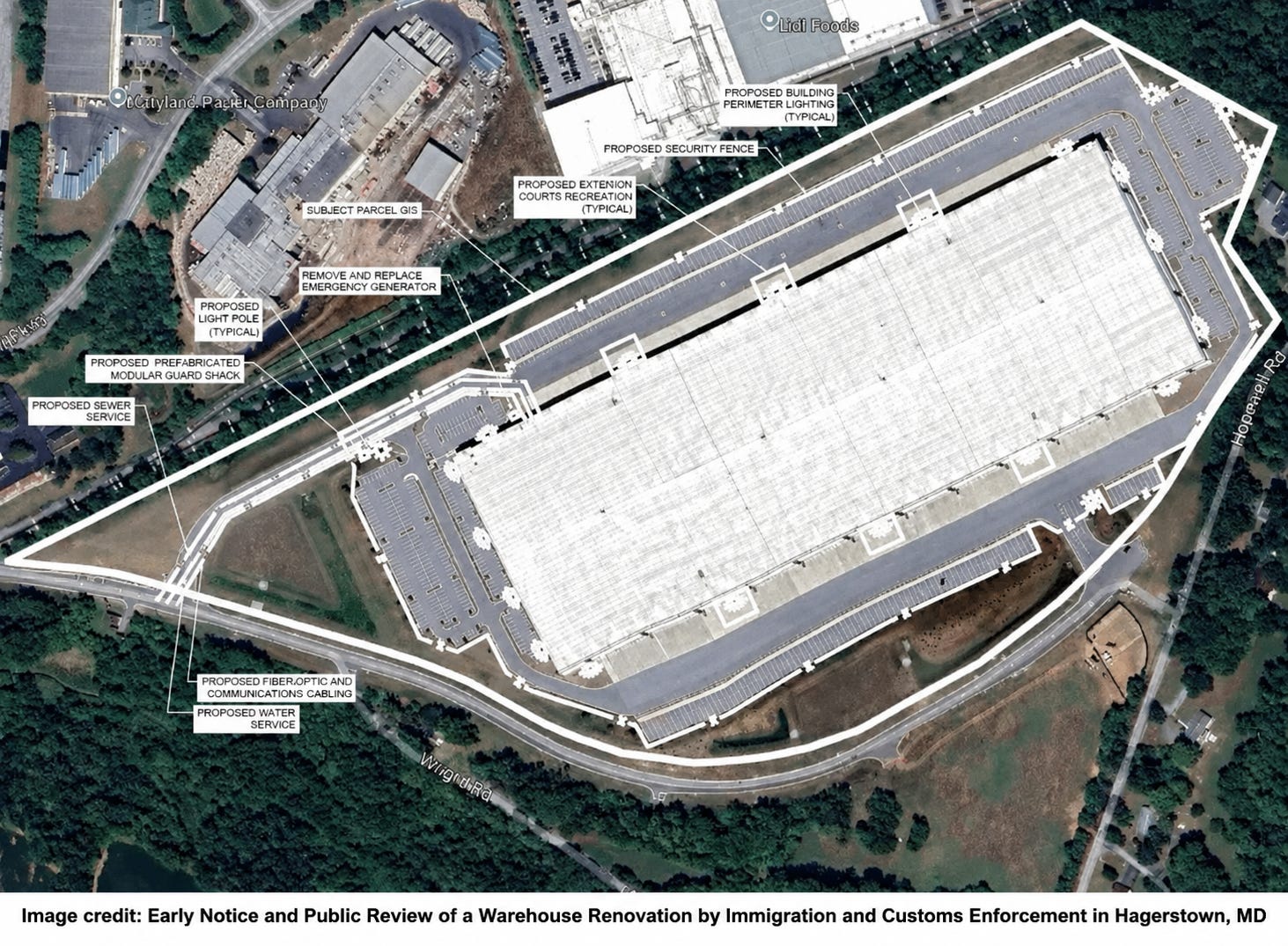
Federal contractors working with the U.S. Department of Homeland Security rely heavily on careful language when describing the 825,000-square-foot facility planned for Williamsport, Maryland. Terms like “operational footprint” and “site management” show up repeatedly, as if the choice of wording can soften what is actually being proposed.
But nothing about this project is theoretical for the people who live here. It connects directly into the systems that keep this community running. Water, sewer, stormwater, and local infrastructure are not side details. They are the foundation.
The federal notice lays out enough technical detail to make the scale of the project impossible to ignore. What is being proposed is a massive, resource-heavy facility being inserted into a system that already operates near its limits.
The Numbers in the DHS Blueprint
For months, local officials stayed largely quiet while federal planning moved forward. Now, with the public comment window open until July 1, the details are finally visible in a way the public can actually respond to. And the details matter.
The plan includes a 750,000-gallon on-site water storage tank. That is more than an Olympic-sized swimming pool. It is not a minor backup system. It is a core requirement to keep the facility running at the scale being proposed.
The facility is also designed to hold up to 1,500 people, which immediately translates into sustained demand on sewer systems, pump stations, and treatment capacity. The required modifications are not routine upgrades. They are structural changes to how local utilities function on a daily basis.
On top of that, the site work extends into floodplain-adjacent areas, where large-scale paving and grading will increase stormwater runoff. That runoff does not stay contained on a site plan. It moves downstream into surrounding land and waterways that are already sensitive to changes in flow and volume.
A System Built in 1928 Being Asked to Carry a Modern Industrial Load
Washington County, Maryland depends on a water system first built in 1928. It was designed for a small population and steady municipal use. It was never designed to support a high-volume federal detention operation running continuously at this scale.
Local infrastructure is already serving homes, schools, and small businesses under real constraints. There is no hidden surplus capacity waiting to absorb a project of this magnitude. Every additional demand placed on the system forces tradeoffs somewhere else.
That is the part that often gets lost in official language. Capacity is not flexible just because it is discussed in planning documents. It is physical. Pipes carry only so much. Treatment plants process only so much. Pump stations move only so much. And once that limit is reached, something else gives.
And when systems are pushed past their intended range, the costs do not disappear. They shift downward into long-term maintenance, emergency repairs, and accelerated infrastructure upgrades that local ratepayers are left to cover. The federal government does not carry those costs over time, and private contractors have no stake in what happens after construction is complete.
A Sudden Standard That Is Not Being Applied Consistently
Just last week, county leadership signaled hesitation around large-scale data center development, citing concerns about water usage, wastewater capacity, and overall infrastructure strain. And those concerns are real.
But that raises a straightforward question. If infrastructure limits are serious enough to justify pausing one category of development for further study, why do those same limits not trigger the same caution when it comes to a federal detention facility with comparable or greater utility demands.
The standard cannot shift depending on the project. Either the infrastructure constraints matter, or they do not.
The Public Comment Window Is Now Open
Because litigation has forced a formal environmental review process, the federal government is now required to accept public comments on infrastructure, environmental, and community impacts.
That comment window is open until July 1, and it becomes part of the official administrative record used in future review and potential legal proceedings.
This is not a procedural formality. It is one of the only opportunities the public has to force the real-world constraints of this project into the record that regulators and courts must consider.

Make Your Voice Part of the Official Environmental Record
This project is not just an infrastructure question. It is an environmental one.
A facility of this scale would place sustained pressure on local water systems, sewer capacity, stormwater controls, and surrounding watershed conditions. Those systems are not separate from the environment. They are part of it. When they are overwhelmed, the impact does not stay on paper or within utility lines. It moves into streams, floodplains, groundwater, and downstream ecosystems.
Because Maryland successfully challenged the attempt to fast-track this project without a full environmental review, the federal government is now required under law to collect public comments on these impacts. That includes water usage, wastewater discharge, stormwater runoff, and the broader environmental consequences of stressing aging municipal systems.
That comment window is open until July 1.
This is the moment to make the environmental record specific. General objections are easy to dismiss. Concrete documentation of environmental strain is not.
When you submit your comment, focus on how the proposed 750,000-gallon on-site water system, combined with sustained high-volume use, affects local watershed health and utility discharge capacity. Ask how increased wastewater output and stormwater runoff will impact floodplains, downstream water quality, and already constrained treatment systems.
These are environmental questions, and they belong in the official record

Take Action Now
Submit your public comment here:
https://actionnetwork.org/letters/tell-dhs-stop-the-ice-warehouse-in-washington-county
It takes two minutes or less. We have created a system that allows you to customize your submission and ensure that DHS receives it directly as part of the official environmental record.
The most important thing is to submit your comment before the July 1 deadline so these environmental impacts are formally documented and cannot be ignored.



Processing water in an on-site,750,000-gallon system is one thing, and it is a major concern. But where would this water to service potentially 1,500 people come from? Ground water from wells? River water from the Potomac River? Maryland has been suffering from a drought, where both have been negatively affected. Ground water is precious and disappearing. I would like to see, in detail, where this water would come from, as well as how its discharge would affect the environment. Thank you.