



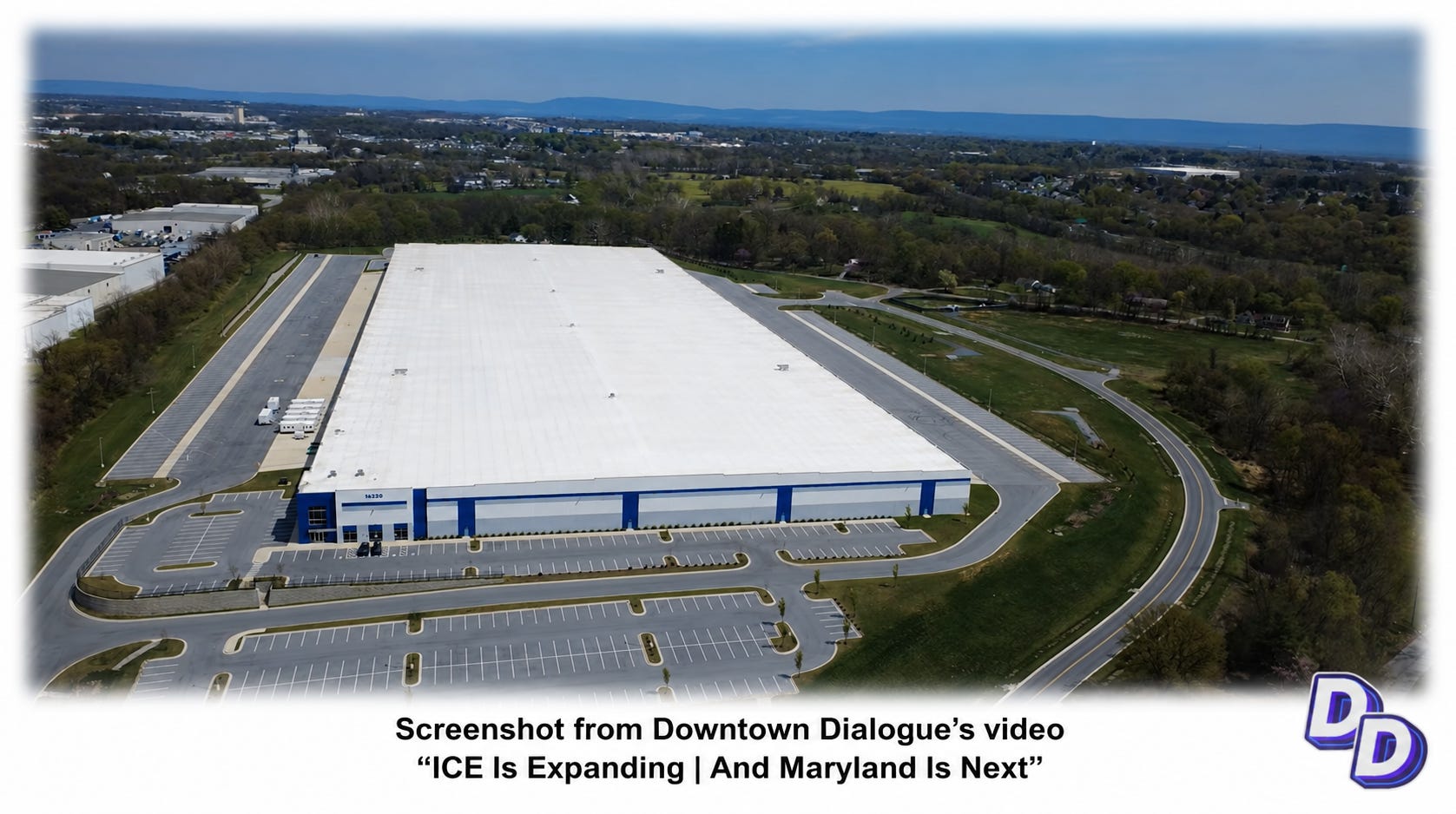
A new episode of Downtown Dialogue, hosted by Tony Forame, puts a national spotlight on what Hagerstown Rapid Response, Washington County Indivisible, and our neighbors have been warning about from the beginning. Downtown Dialogue is a YouTube channel focused on political, social, and community issues, with Forame using on-the-ground reporting and long-form interviews to dig into stories that deserve more attention. In this episode, he comes to Washington County to examine the proposed ICE detention warehouse in Williamsport and the local movement fighting to stop it.
The video begins outside the massive warehouse the Department of Homeland Security wants to turn into an ICE detention center for up to 1,500 people. Before it became the center of a federal lawsuit and public outrage, this building was meant for storage and shipping. It was not built to house human beings. It was not designed for medical care, legal access, family visitation, or the basic dignity people are owed when they are in government custody.
What the video captures so clearly is the contrast between Washington County’s people and Washington County’s power structure. Residents have marched, protested, filed public records requests, attended hearings, watched county meetings, tracked vehicles, and demanded answers. Meanwhile, the public was given almost no meaningful say before the federal government tried to drop a detention center beside a small town of roughly 2,000 people.
That is the story here. Not just a warehouse. Not just zoning. Not just politics. It is a test of whether a community can be treated like an afterthought while the federal government and its contractors attempt to build a detention machine in its backyard.
One of the strongest parts of the video comes when Tony Forame breaks down what happened in federal court in Baltimore and why the project was temporarily stopped. Forame also walks viewers through the role of the National Environmental Policy Act, or NEPA, which requires federal agencies to study the environmental impact of major projects before moving forward. The federal judge ultimately appeared deeply skeptical of DHS’ position, especially given that the agency was simultaneously planning large scale modifications involving fencing, water systems, toilets, offices, and detention infrastructure while insisting the impact would somehow be minimal. The video does a particularly effective job showing how absurd the government’s argument can sound when stripped of bureaucratic language and explained plainly to ordinary people.
The episode also zooms out, and that matters. Experts interviewed in the video explain that immigration detention is not simply a government function. It is an industry, with private contractors, subcontractors, food vendors, transportation companies, medical providers, and local governments all finding ways to profit from confinement. The warehouse model being pushed in Maryland is part of something larger, faster, and more dangerous.
This video is a reminder that this fight is about Williamsport. It is about Washington County residents who were told almost nothing, then expected to quietly accept everything. And it is about the people who could one day be locked inside a warehouse that was built for freight and storage, not human beings.
The video ends with a simple truth: this project was paused because ordinary people refused to roll over and accept it. The pressure worked. The scrutiny worked. The protests, the organizing, the public records requests, the court challenges, and the relentless attention worked. But DHS has made clear it still wants this detention center, which means this fight is far from over. Washington County residents now face a choice: allow this community to become nationally known for a massive ICE detention complex, or continue making this project so politically toxic, publicly scrutinized, and logistically difficult that the federal government is forced to rethink whether it can build this here at all.
Once again I'm curious... Who is on the take here?