


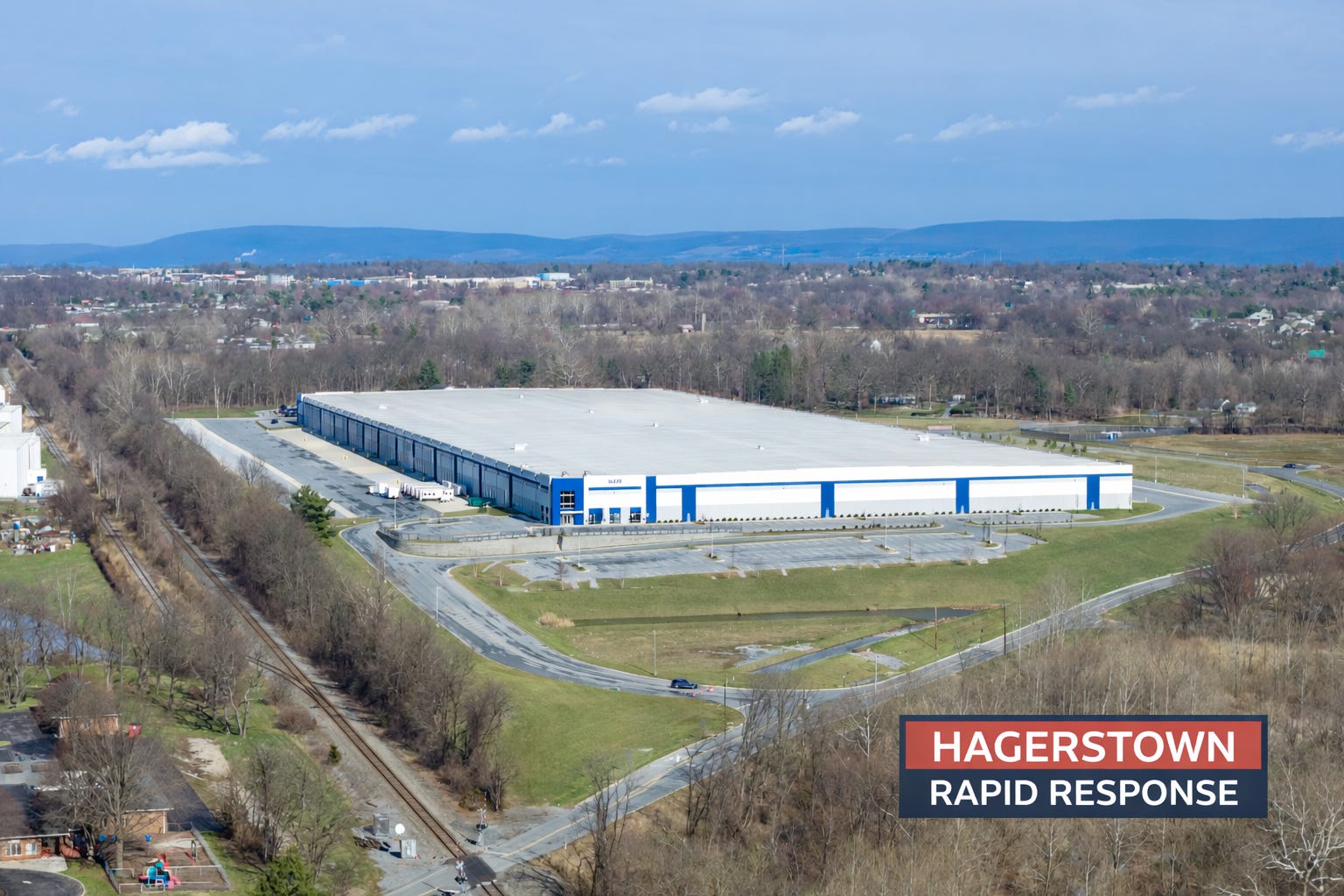
On a quiet stretch of land outside Hagerstown, Maryland, plans are moving forward to convert a warehouse into a large-scale ICE detention facility. To some local officials, it’s a federal project already in motion. To a growing number of residents, it’s a source of concern.
But to dozens of health care providers in Washington County, it’s something else entirely.
It’s a public health warning.
In a document titled “An Open Letter from Washington County Health Care Providers,” a coalition of local doctors, nurse practitioners, and physician assistants lays out a sobering case against the facility—not in political terms, but in clinical ones. Their argument isn’t about ideology. It’s about what happens when large numbers of people are held in crowded conditions with inconsistent access to care, sanitation, and basic resources.
And they’re clear about the stakes.
Conditions inside ICE detention centers, they write, are already “a set up for significant impacts to individual and public health.” Federal oversight reports have documented failures in medical care, sanitation, and staffing. Since then, the detained population has grown—and with it, reports of worsening conditions: overcrowded spaces, inadequate temperature control, limited access to sinks and toilets. In some cases, detainees have described environments where overflowing toilets leave floors contaminated with waste.
That kind of setting doesn’t just make people uncomfortable. It makes them sick.
Outbreaks of influenza, COVID-19, hepatitis A, and tuberculosis have already been documented in detention facilities. More recently, measles and mumps have spread in similar environments. And as the letter points out, those illnesses don’t stay contained. Staff move in and out. Patients are transported to hospitals. What begins inside a detention center doesn’t necessarily end there .
For Dr. Kate Sugarman, a family physician and leader of Doctors for Camp Closure, and also a key member of Maryland Coalition to Stop the Camps, these risks aren’t abstract—they’re already unfolding.
“People are continuing to die while in ICE custody because ICE is denying detainees the medical care they need in order to live,” she said. Sugarman reviews ICE medical records for detained individuals, documenting what she describes as a pattern of neglect. “I see how ICE is denying them the medical care that they are begging for. ICE has admitted that they are no longer paying for specialty medical care.”
In other words, even when serious conditions are identified, treatment may not follow.
Sugarman’s work has taken her from reviewing case files to standing outside the Washington County Commissioners’ building, where she joins weekly protests organized by Hagerstown Rapid Response and Washington County Indivisible, demanding that Washington County Commissioners finally address questions and concerns from the community. The demonstrations have become a steady presence, drawing attention to a project that many residents say has moved forward with more speed than transparency.
For Sugarman, the connection between what she sees in medical records and what’s being proposed in Hagerstown is impossible to ignore. A new facility doesn’t mean a new system—it means an expansion of an existing one.
And that system, she argues, is already failing.
The open letter from local providers echoes that concern, but widens the lens. It’s not just detainees who could be affected—it’s the entire county. A facility housing up to 1,500 people will generate medical emergencies, requiring ambulance transport, emergency room capacity, and ongoing care. Yet local resources are already stretched thin. The nearest EMS unit relies on just eight volunteer paramedics, and Meritus Medical Center is struggling to keep up with demand.
In that context, the arrival of a high-need detention population doesn’t just add pressure. It risks tipping the balance.
Doctor Judy Stone, an infectious physician, has raised similar concerns in a separate letter, focusing on the fundamentals that often go overlooked: water, sanitation, and disease control. Without sufficient access to clean water for drinking, bathing, and hygiene, she warns, detention settings become fertile ground for infections—conditions that can quickly escalate from manageable to life-threatening .
These are not new problems. But they are problems that, according to the providers, have not been adequately addressed as plans for the facility move forward.
What makes this moment different is who is speaking out. These are not outside advocates or distant observers. They are local clinicians—people who treat patients in this community every day, who understand the limits of the system because they work within it.
Their warning is grounded in that reality.
The question now is whether anyone will listen.
Because if they’re right, the consequences won’t be confined to a single facility on the outskirts of town. They’ll be felt in emergency rooms, in clinics, and in communities across Washington County—long after the doors of the detention center open.
And by then, the conditions they’re warning about won’t be theoretical anymore.