



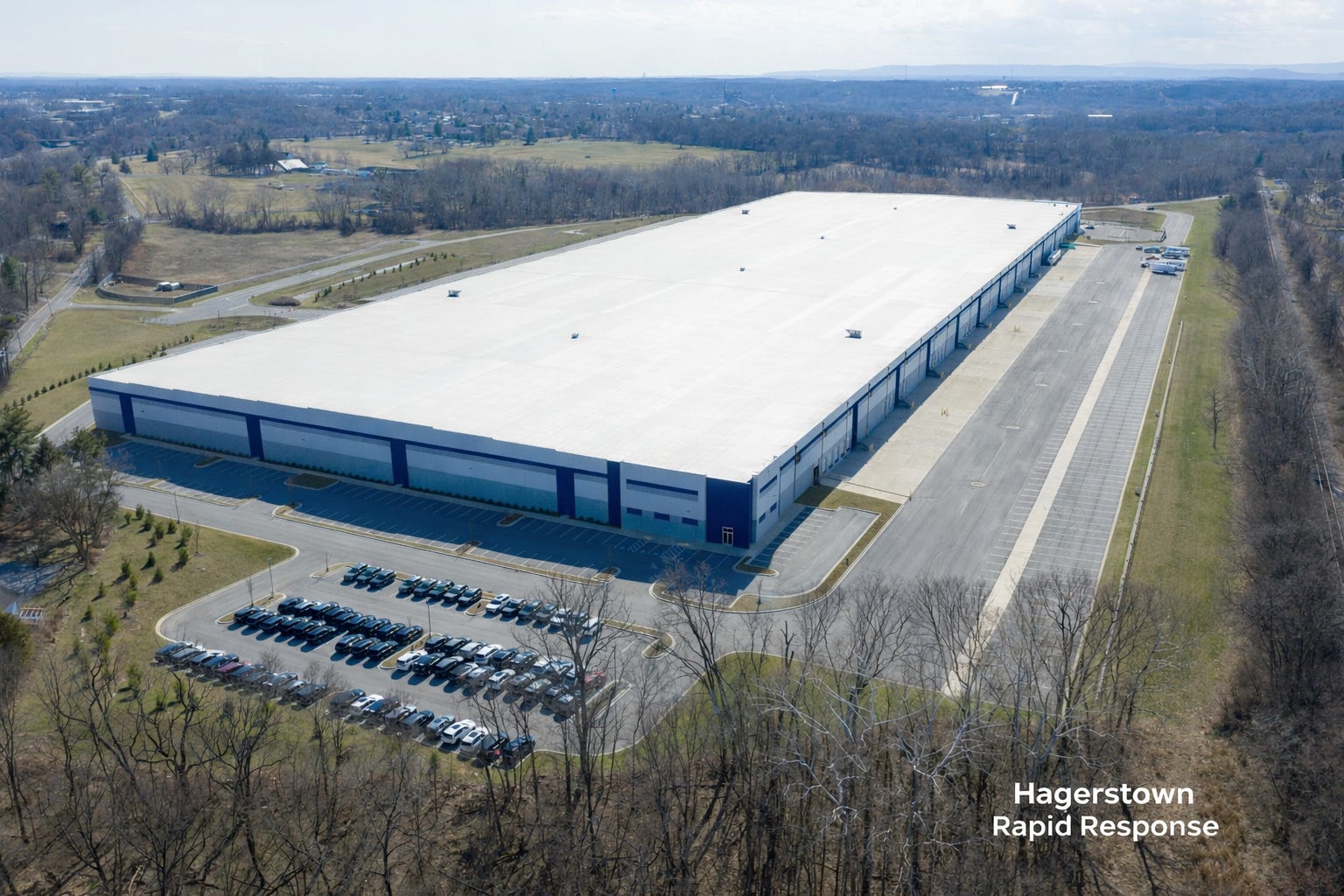
For a brief moment, Washington County was invited to exhale. The Department of Homeland Security told a federal judge it would not “imminently” pursue retrofitting the Williamsport / Hagerstown warehouse for detention purposes, and predictably, some people rushed to interpret that language as progress, perhaps even a victory. It is neither. What DHS offered this week was not a concession, not a reversal, and certainly not a moral awakening. It was a carefully engineered legal maneuver designed to cool the temperature in federal court while preserving as much of the project as possible outside it.
The most important thing to understand is that DHS has not stepped back from the facility itself. In the same filing where its lawyers assured Judge Hurson that detention retrofitting was not imminent, the agency made clear that work on the site is still continuing. Roof repairs are still moving forward. HVAC upgrades are still underway. A perimeter fence is still being built. Cables for security cameras are still being laid. Administrative office space for ICE is still being constructed on the property. That is not the behavior of an administration abandoning this plan. It is the behavior of an administration trying to continue every piece of work it believes it can justify while litigation is pending.
That distinction is not semantic. It goes directly to the heart of what DHS is doing. This is a litigation tactic, not a policy shift. The agency is trying to preserve its investment in the site, continue hardening the physical infrastructure, and buy time while public attention risks drifting elsewhere. Federal agencies understand better than almost anyone that time itself can become strategy. If the headlines dwindle, if the protests thin out, and if the community begins to interpret carefully hedged legal language as genuine retreat, then DHS has already gained ground.
The same dynamic is at work in the sudden emergence of the 542-person capacity figure. For months, the 1,500-detainee number has defined public understanding of what this facility could become. Now, without any meaningful public explanation, DHS has quietly completed an initial environmental review based on a capacity of 542. Nothing about this number inspires confidence. It did not emerge from community consultation. It was not the result of local concerns being taken seriously. It was not announced as a formal reduction in scope. Instead, it appears to be a conveniently smaller figure that happens to align with an already completed environmental review, narrowing the immediate legal exposure of what DHS has already done while preserving ample room for future expansion.
There is no reason to read this as an act of good faith. If anything, it should be read as legal positioning. The smaller number allows DHS to defend a narrower project footprint in court while retaining flexibility later. And even if one were inclined to accept 542 as a genuine operational cap, ICE’s own record in Maryland makes clear why that would be naïve.
The Baltimore holding facility offers the most obvious warning. That facility was designed for short stays and an official capacity of just 56 people. Yet in 2025, a federal judge found that it exceeded double that number multiple times, reaching 123 detainees in a single day. Nearly 900 people were held beyond ICE’s own 72-hour limit. Human beings slept on concrete floors under foil blankets. Reports described denial of food, water, and medical care. A federal court had to intervene simply to force compliance with basic constitutional standards. Even then, ICE denied that overcrowding was occurring. That is the same institution now asking this community to trust that 542 represents a meaningful limit. Why should anyone believe that this number is a ceiling when history strongly suggests it is closer to a floor?
What makes this even more concerning is what DHS has been doing outside the courtroom. On March 27, in the same week it was using soothing legal language about future review and procedural caution, the agency quietly published a notice in the Federal Register adopting five new categorical exclusions under the National Environmental Policy Act. The technical language obscures the practical consequence: fewer environmental reviews, less public scrutiny, and a dramatically easier path to construction.
One of the new exclusions, borrowed from the USDA Farm Service Agency, covers an extraordinarily broad range of construction and ground disturbance activities, including excavation, grading, roads, access roads, and related site work. DHS explicitly stated that it intends to use this authority for a broad range of such activities. In plain English, this means substantial work could move forward without an environmental assessment, without an environmental impact statement, and without public input.
That Timing is Impossible to Ignore
At the precise moment DHS is telling the public that further review will come before significant development, it is simultaneously equipping itself with new tools that could allow it to bypass much of that review altogether. The promise of future oversight is being made at the same time the agency is quietly weakening the mechanisms that would require it.
What is even more striking is the way this was done. DHS did not publish a proposed rule. It published a notice, meaning the change took effect immediately, with no public comment period whatsoever. No hearings. No local input. No opportunity for community opposition to be formally registered. Under a provision tucked into the 2023 Fiscal Responsibility Act, agencies are permitted to adopt another agency’s existing categorical exclusions simply by notifying the public. DHS used that loophole exactly as intended.
The irony here is almost too sharp to ignore. Maryland’s lawsuit against DHS is fundamentally about the lack of public review, environmental analysis, and consultation surrounding the Hagerstown area acquisition. Yet while that lawsuit is actively pending, DHS has moved to codify additional tools for bypassing precisely those same public processes. This is not an agency learning from legal challenge. It is an agency institutionalizing the very conduct now under scrutiny.
That is why this should not be mistaken for victory. The broader pause on future warehouse acquisitions under new Secretary Markwayne Mullin does not change that reality. Every incoming cabinet secretary pauses inherited initiatives to assess contracts, liabilities, and political exposure. This is standard bureaucratic transition procedure, not a concession to public pressure. The Hagerstown area warehouse was purchased well before this review process, and DHS officials have already confirmed that development of already acquired facilities continues to move forward. This pause was never really about the Hagerstown area facility.
The danger now is complacency. Institutions often survive controversy not by defeating opposition head-on, but by waiting for momentum to dissipate. The cameras leave. The headlines dwindle. Coalitions lose urgency. People begin to assume the threat has passed. Then the work resumes under diminished scrutiny.
That is why this moment demands more pressure, not less. The response cannot be celebration. It has to be escalation: continued presence at every Washington County Commissioners meeting, aggressive use of Maryland Public Information Act requests, sustained legal pressure, direct communication with elected officials, and relentless engagement with the press. The coalition that has brought the fight this far has already demonstrated what local organizing can accomplish. The town halls, the protests, the legal strategy, and the records requests have all mattered.
But this is not the finish line. It is the moment that determines whether this community forces an actual cancellation or merely mistakes a procedural pause for progress. Anything short of a written cancellation and the death of this facility as a project is not a win.
DHS appears to be counting on silence and confusion to make the public believe the threat has passed. Some may have been duped by that narrative, but we have not. We see exactly what is happening, and we are ready to fight harder than ever.