



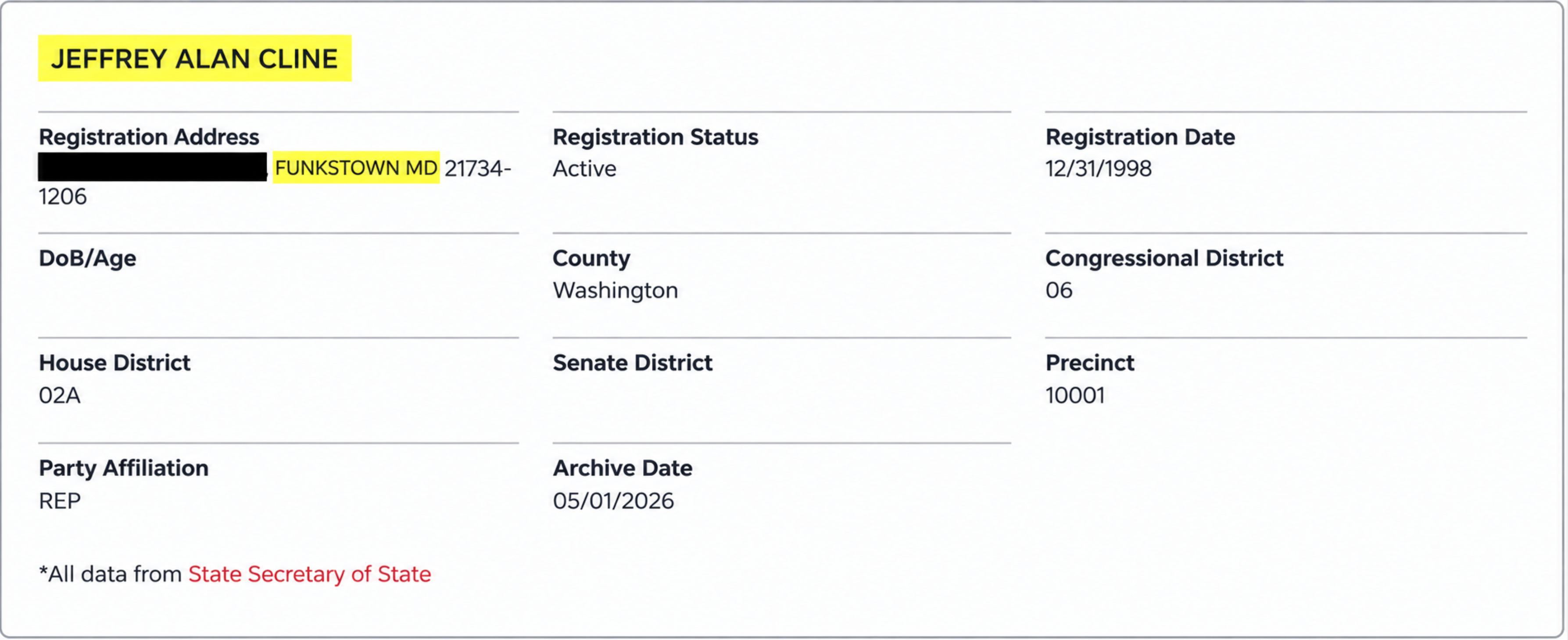
We verified that Washington County Commissioner Jeff Cline lists his residence at an apartment in Funkstown, Maryland, in a building owned by a company belonging to his largest campaign donor, Paul Crampton Jr. Publicly available voter registration information places Cline at the property, and we independently verified the building’s ownership. We are withholding the exact address for privacy reasons, but his financial disclosures leave the housing arrangement unexplained.
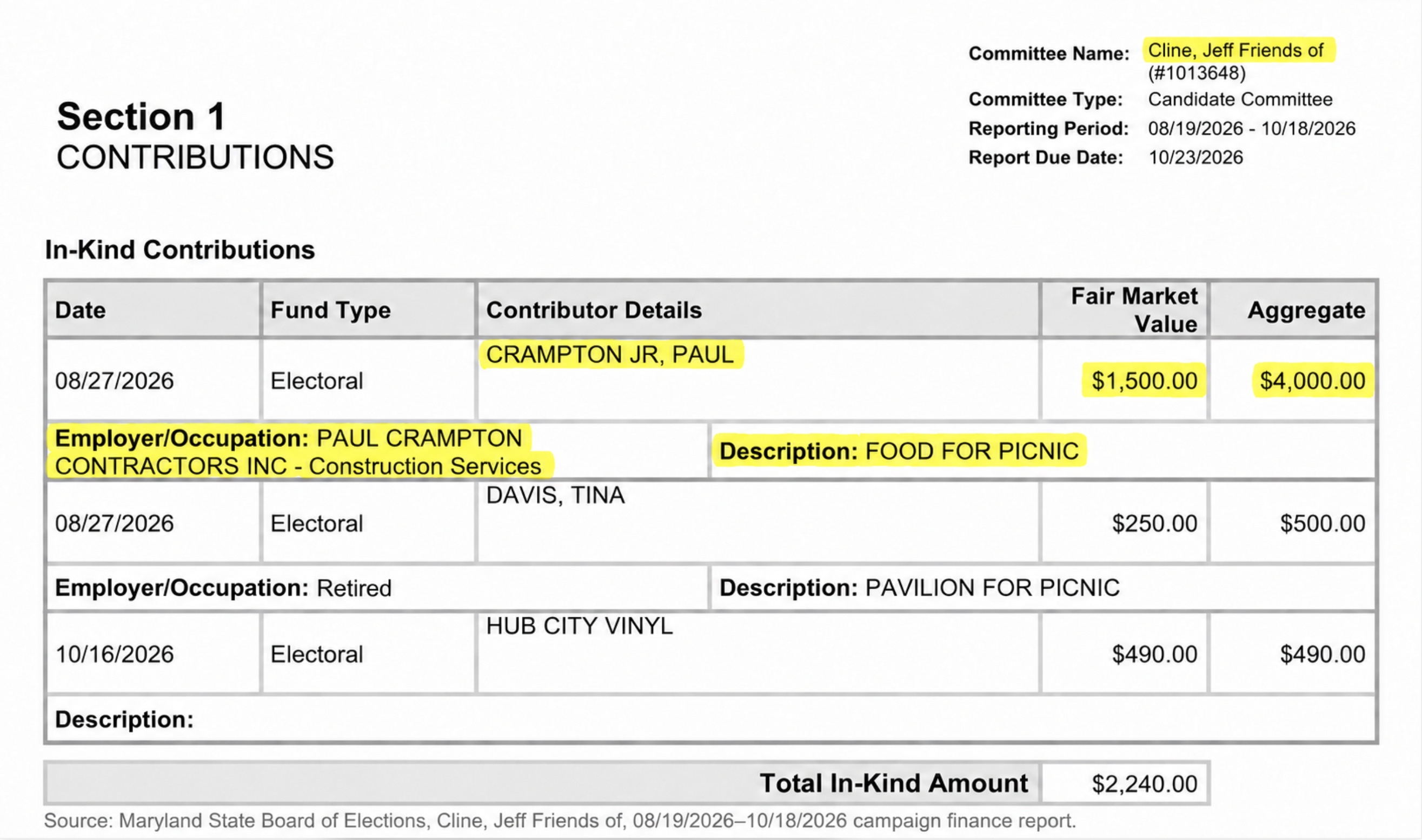
Crampton has provided Cline’s reelection campaign with $4,000 this year alone, making him the single largest contributor. The developer helping finance Cline’s campaign also owns the company behind the apartment building where Cline lists his home.
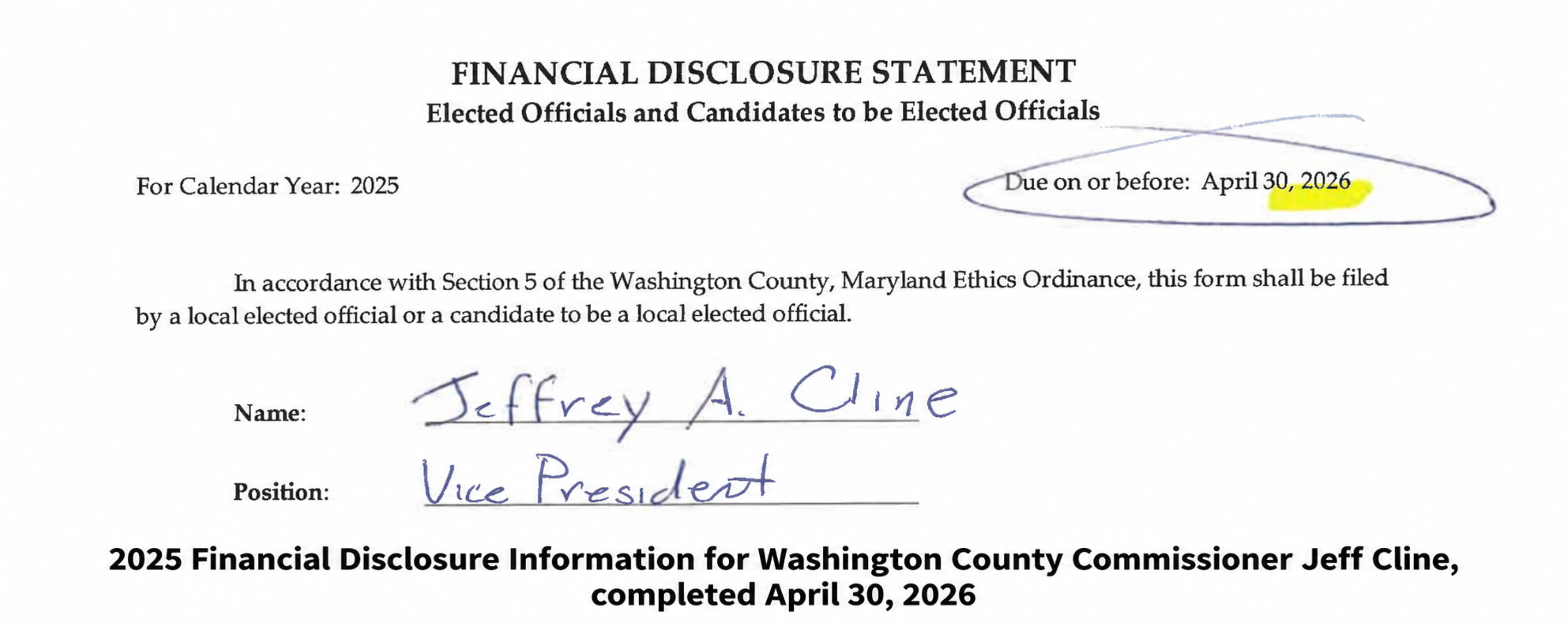
For thirteen years, Cline’s financial disclosures have reported no earned income outside his county commissioner position and identified no conflicts of interest. His 2025 disclosure also denies having any real property interest, even though the question expressly asks about interests “as an owner or a tenant.” Cline checked “No” on Schedule A and again on the summary checklist on page 6. The section for explaining conflicts or potential conflicts is blank, and he checked “No” to reportable gifts from the sources covered by the form.
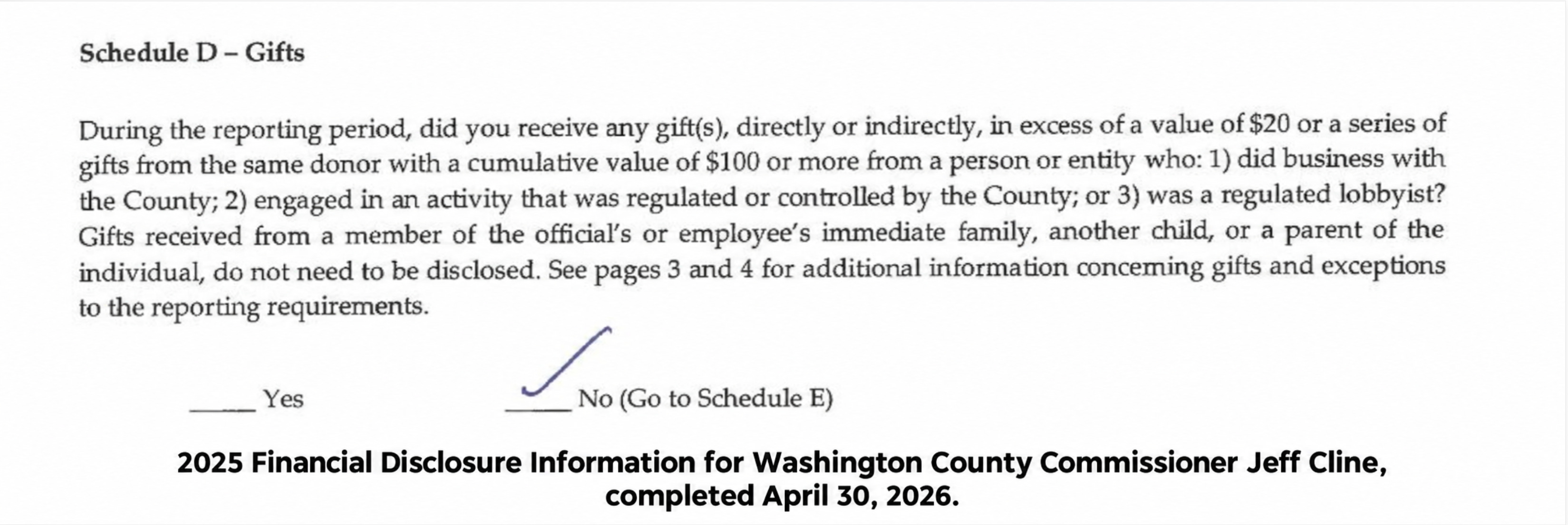
If Cline rented the apartment during 2025, not owning the building would not explain his answer. Tenants are expressly included, and the form provides separate spaces to identify whether the filer is an owner or tenant. His answers leave residents without an explanation of when he moved in, what his arrangement was during the reporting year or why he checked “No.”
The Same Day: $200,000 Forgiven, $250 Contributed
Cline and Crampton’s history of county dealings stretches back well before this year’s campaign contributions. On April 9, 2013, Cline made the motion to approve an agreement for the county to acquire 4.53 acres from Paul Crampton Jr. and Pamela Crampton for Southern Boulevard intersection improvements. The agreed purchase price was $135,690, and the motion passed unanimously.
Crampton also appeared before the commissioners as Funkstown’s mayor. In November 2016, he presented the town’s proposal to borrow money for the purchase of the Artz Farm and another property to expand its parkland. Cline joined the unanimous vote approving a loan of up to $1 million from county general fund reserves, repayable over ten years at 1% interest.
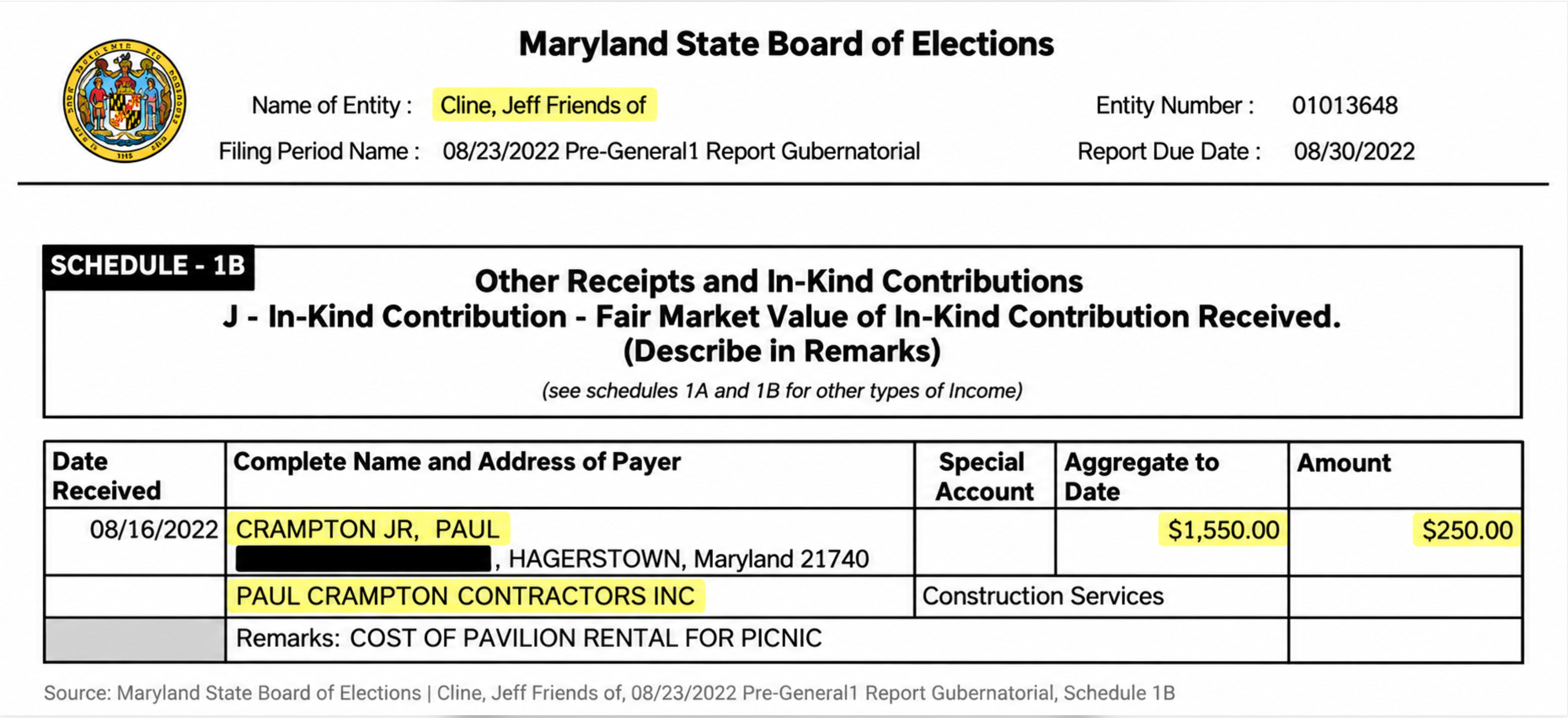
Six years later, Crampton returned to ask the county to forgive part of that debt. On August 16, 2022, Cline joined the unanimous vote approving $200,000 in Artz Farm loan forgiveness for Funkstown. That same day, Crampton made a $250 in-kind contribution to Cline’s reelection campaign, according to Maryland State Board of Elections campaign finance records.
The paperwork offers little help to residents trying to understand the decision. The agenda report identified the request as $200,000 in loan forgiveness but listed its fiscal impact as “N/A.” The approved minutes used the $200,000 figure in the heading, then left “$XX” where the amount should have appeared in the narrative. The motion approved the forgiveness “as presented.”
Forgiving $200,000 in public debt has a fiscal impact. Residents should not have to piece it together from a heading, an unfinished paragraph and an agenda report that says “N/A.”
Paul Crampton, John Barr, and Greg Snook’s Company Got Half a Million Dollars While Cline Served on the Funding Board
The county votes are only part of the history. Hager 5 LLC was also approved for a $500,000 award through the Senator George C. Edwards Fund while Cline served on the board overseeing the money.
The fund’s 2024 annual report identifies Cline as a voting member of the Western Maryland Economic Future Investment Board. It lists Hager 5’s award for renovation of the Antietam Paper Building in downtown Hagerstown as approved, pending disbursement.
Hagerstown’s meeting minutes identify Paul Crampton Jr., John Barr and Greg Snook as doing business as Hager 5 LLC. Barr is the current president of the Washington County Commissioners, and Snook is a former commissioners’ president. That puts Cline’s largest donor and two fellow current or former commissioners behind the company approved for the funding.
Cline is recorded as present at every 2024 meeting with posted minutes, including when Hager 5 was discussed as applying for the grant. What remains unexplained is his role in its approval: whether he participated in discussions or voted, whether he abstained, and whether he disclosed a relationship with any of the company’s principals.
The annual report documents his board membership and the award, but his financial disclosure offers no explanation of the housing relationship. Residents need to know whether he was living in the Crampton-owned building when Hager 5’s application was considered and, if so, how he handled that relationship.
Free or Discounted Rent Could Raise Three Separate Legal Issues
Renting from a campaign donor is not itself an ethics violation. Receiving free housing, waived payments or a personal rent discount could raise additional issues, depending on the terms and circumstances.
Even a rental at market rates can raise questions about participation in matters involving the landlord. Section 4(c)(2)(vi) restricts participation in matters involving a business that is a “creditor or obligee” positioned to directly and substantially affect the official’s interests. A landlord could occupy that position.
If Cline has received housing concessions, investigators should examine three additional issues:
Accepting a prohibited gift. Section 4(h)(3) of Washington County’s Ethics Ordinance restricts knowingly accepting gifts from specified sources, including people doing or seeking business with the relevant county body, regulated by it, or whose financial interests could be substantially and materially affected by the official’s duties. A rent concession from a covered source could violate that restriction unless an exception applies. A prohibited-gift violation does not require proof that a particular vote was purchased.
Failing to disclose the benefit. Section 5(f)(4) requires disclosure of covered gifts exceeding $20, or a series totaling at least $100, from a person doing business with or regulated by the county. If Cline received reportable rent concessions and omitted them from his disclosure, that could constitute a separate violation. Reporting a gift would not make an otherwise prohibited gift permissible.
Possible bribery under Maryland criminal law. If housing concessions were provided and knowingly accepted to influence Cline’s official duties, the arrangement could implicate Maryland Criminal Law §9-201. The statute covers county officers and prohibits both giving and receiving bribes connected to official duties. Investigators would need to establish the purpose of any housing benefit and any understanding connecting it to official action or inaction.
The first two issues fall under the county’s ethics ordinance; bribery is a separate state criminal matter. A housing benefit need not take the form of a cash payment to have value, and charging a token amount of rent would not, by itself, settle whether Cline received a gift.
The unanswered questions start with the lease: what does Cline pay, when did the arrangement begin, and has the company waived payments or given him a discount? If there were concessions, what were they worth and why were they offered? Has he obtained an Ethics Commission opinion or made separate disclosures or recusals concerning his landlord or related businesses?
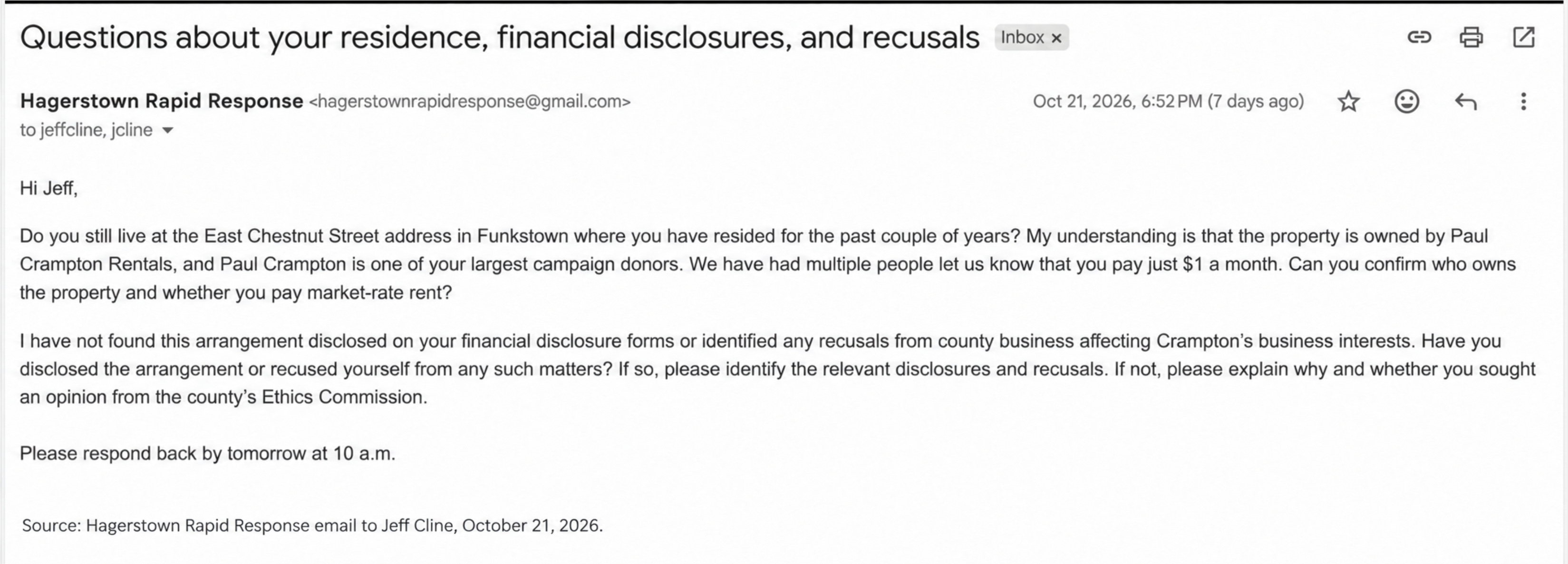
We asked Cline about the property, whether he pays market-rate rent, whether he disclosed the arrangement and whether he recused himself from county business affecting Crampton’s interests. We also asked whether he sought an Ethics Commission opinion. More than a week later, he has not responded.
An independent investigation should obtain the lease, payment records, records of any waived or forgiven rent, written ethics advice and communications concerning the arrangement. Those records should be examined alongside Cline’s official actions to determine whether a developer has been subsidizing his housing and whether any benefit was lawfully accepted and properly disclosed.
The Commissioners Pick the Ethics Commission. Two Members Have Helped Fund Their Campaigns.
Any complaint would enter a system in which the commissioners appoint the people responsible for reviewing ethics complaints against them.
Section 3 of the county’s ethics ordinance establishes a five-member Ethics Commission appointed by the Board of County Commissioners. It handles complaints alleging violations of the ordinance and provides advisory opinions, with the County Attorney serving as its adviser.
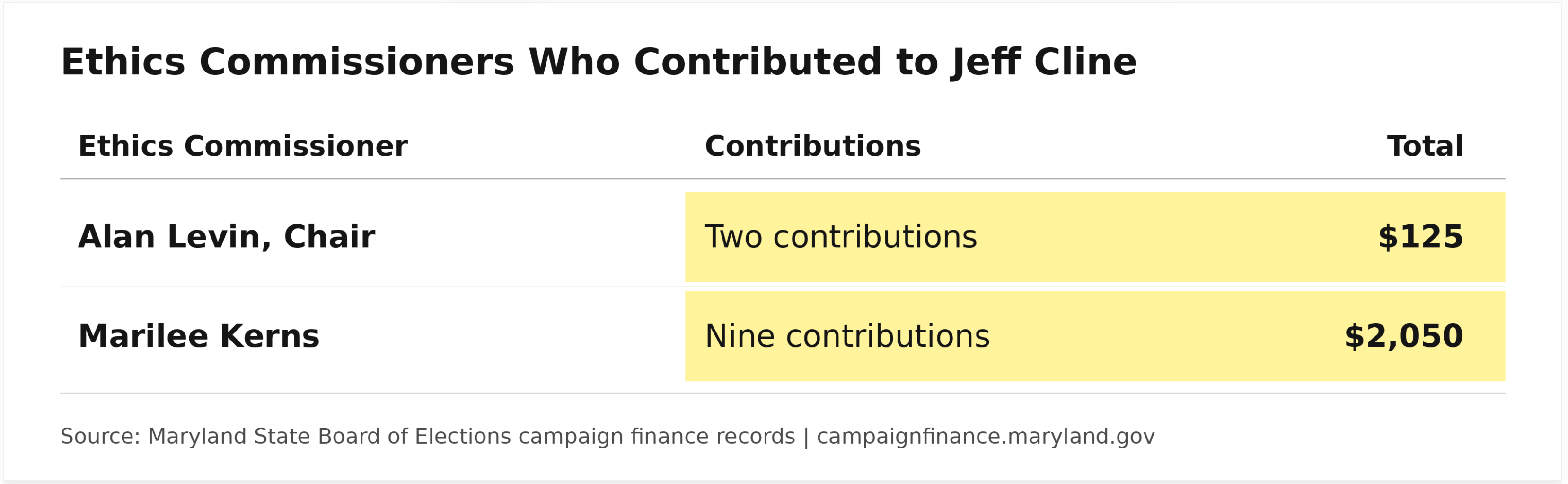
Two current members have contributed to Cline’s campaigns: Marilee Kerns and commission chair Alan Levin. Between them, they have also supported Commissioners Randy Leatherman and Randall Wagner.
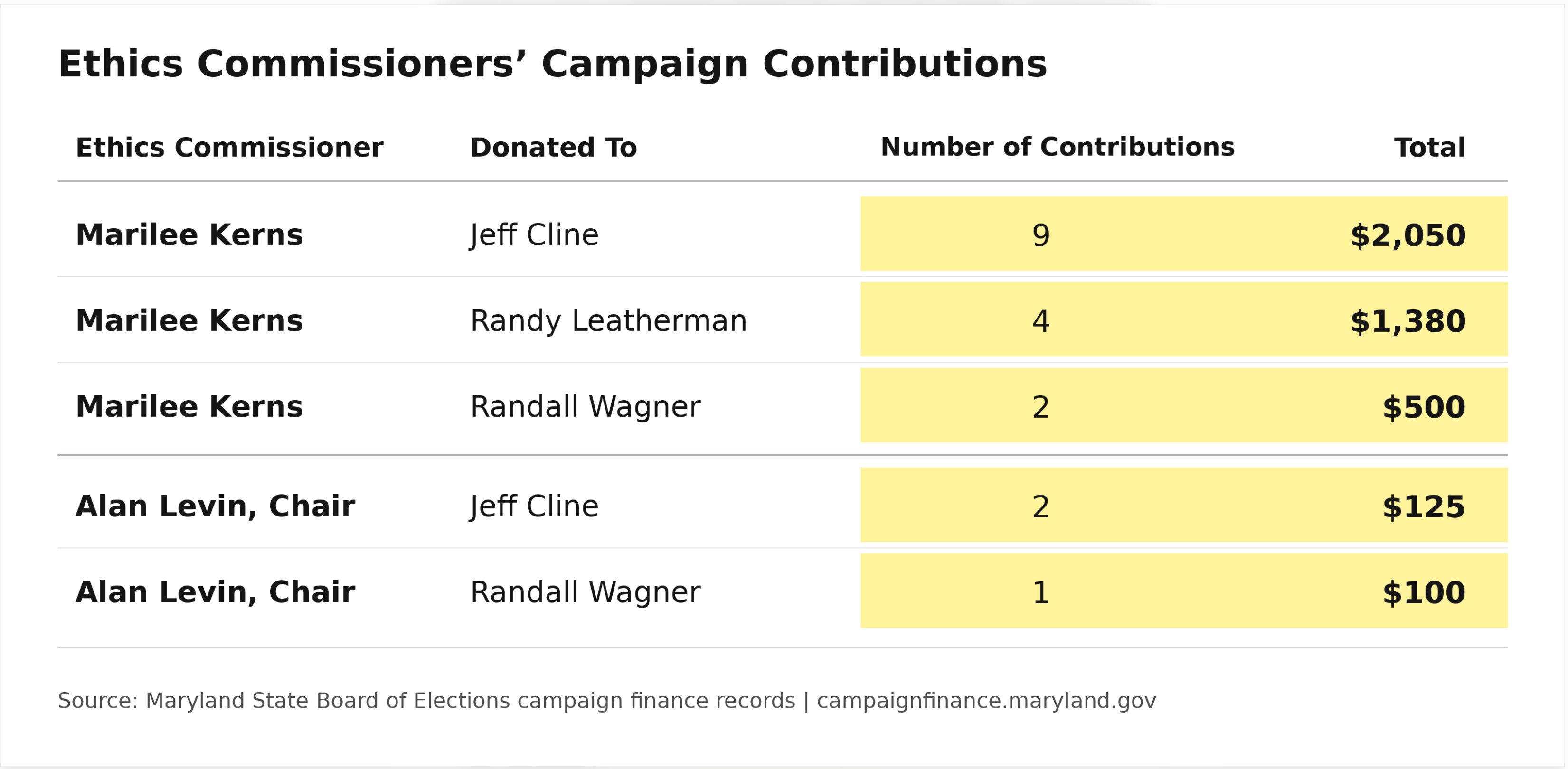
Cline received $2,175 across eleven contributions from Kerns and Levin. Kerns made nine contributions, while Levin made two. Their contributions to the three commissioners total $4,155.
Those relationships matter when considering who would review a complaint. Would Kerns and Levin participate in a case involving a commissioner they have financially supported? Would they disclose the contributions and step aside, and who would decide? The county should explain how it handles those circumstances before asking residents to trust the process.
How Residents Can Submit Complaints
Residents with relevant information or supporting records can request review through the county’s ethics process or report suspected criminal conduct to the Maryland State Prosecutor.
For possible violations of the county’s ethics ordinance: The Washington County Ethics Complaint Form asks for the official’s name, the specific ordinance provisions involved, supporting facts and witnesses with personal knowledge. Attach relevant records, then sign and date the affirmation under penalty of perjury. The county does not accept anonymous complaints. Use of the form is optional, but the requested information must be provided.
Send the signed complaint to Washington County Ethics Commission, c/o Office of the County Attorney, Washington County Administration Building, 100 W. Washington Street, Suite 1101, Hagerstown, MD 21740. Questions about submission procedures can be directed to 240-313-2776.
For suspected bribery or other criminal misconduct: Submit information through the Maryland Office of the State Prosecutor’s online complaint form. The office investigates state bribery offenses involving public officials, misconduct in office and certain related offenses. Anonymous complaints are accepted, although providing contact information allows investigators to follow up.
The form accepts supporting attachments. People unable to complete it electronically can submit a complaint by telephone at 410-321-4067. A useful submission should include supporting records, identify what the person knows firsthand and explain what still needs investigation.
The Public Deserves an Independent Investigation
Residents should be able to find out whether a developer is subsidizing a commissioner’s housing, whether the arrangement was properly disclosed and whether it affected his handling of public business. Getting those answers should not depend on a complaint process overseen by people who have donated to the official under scrutiny.
Cline’s undisclosed housing arrangement with his largest campaign donor warrants an independent investigation conducted by people who haven’t helped finance his reelection.