



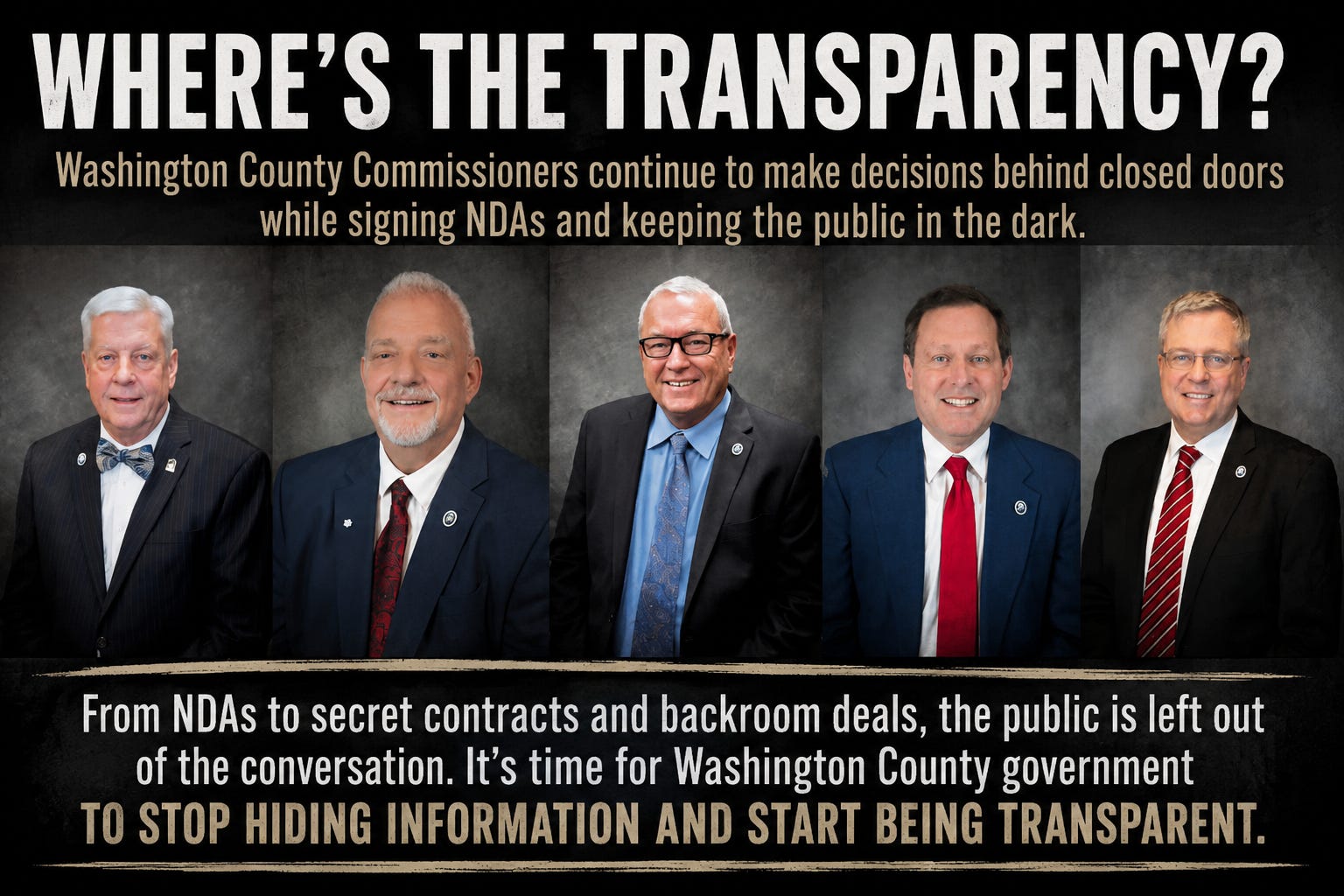
For months, people across Washington County have been asking why so many major decisions connected to the proposed ICE detention warehouse seem to happen behind closed doors. Between reports of non-disclosure agreements, private discussions, canceled meetings, sealed negotiations, and ongoing litigation, public trust around this project has steadily eroded. Now another confidentiality agreement has surfaced, this time tied directly to sewer infrastructure, utility planning, and future county development.
Buried inside the Washington County Board of County Commissioners agenda packet for a May 21 special meeting is a consulting contract between Washington County government and GDMS, LLC, a private consulting company managed by former longtime Washington County Administrator Gregory B. Murray. Murray is not some random outside consultant being brought in from another state. Before becoming County Administrator, he also served as director of the County’s Water Quality Department, which makes his reappearance especially notable given that sewer and wastewater capacity have become some of the biggest unresolved issues surrounding the proposed ICE detention facility near Williamsport.
The contract gives GDMS broad authority to provide consulting and support services related to public utility adequacy, including sewer infrastructure, future growth projections, infrastructure readiness, regional service capacity, and identifying “critical areas of immediate need.” The agreement is written broadly enough that the work could potentially touch almost any major infrastructure issue the County wants reviewed. The consultant is also authorized to evaluate water and sewer deficiencies, analyze future growth impacts, coordinate with regional service providers, and even perform “other tasks not identified” if directed by the County.
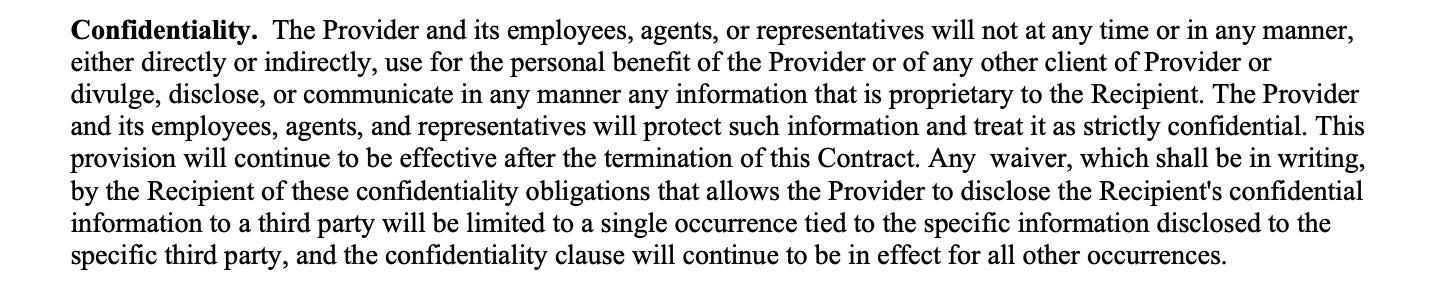
What immediately caught our attention, however, was the confidentiality language embedded in the agreement. Under a section titled “Confidentiality,” the contract states that the consultant and its representatives may not “divulge, disclose, or communicate in any manner” any proprietary County information. The agreement further states that all such information must be treated as “strictly confidential,” and those confidentiality obligations continue even after the contract ends.
Under ordinary circumstances, that language might not stand out much. Governments use confidentiality clauses in consulting contracts all the time. But these are not ordinary circumstances. The proposed ICE warehouse has already triggered lawsuits from Maryland Attorney General Anthony Brown, protests, environmental disputes, public records fights, and growing concerns about secrecy surrounding the project. One of the central questions in the legal battle has been whether existing infrastructure can safely support a large-scale detention facility and the significant wastewater demands it could generate. Sewer and wastewater capacity have become some of the most politically sensitive aspects of the entire controversy.
That is why this contract raises so many questions. Washington County is now quietly approving a confidential consulting arrangement focused specifically on water, sewer, and infrastructure issues while those exact same issues remain at the center of the ICE warehouse fight. The agreement also allows the consultant access to County employees and County data, permits the use of subcontractors with “specific subject matter expertise,” and states that all work produced under the contract becomes the “exclusive property” of Washington County government.
The political context surrounding Greg Murray also matters here. According to publicly available reporting summarized in the history section for Fort Ritchie, Washington County officials traveled to South Korea in connection with JGBLI and ultimately transferred roughly 63 acres connected to the redevelopment project. The process became highly controversial and generated allegations involving secrecy and possible violations of Maryland open meetings laws. Murray was County Administrator during much of that period, meaning he was part of the senior leadership structure overseeing County operations and redevelopment efforts at the time. Whether fair or not, many residents still associate that era with opaque negotiations and insider-driven development politics.
Murray also has longstanding ties to current Washington County leadership, including commissioner John Barr, after years serving in senior Washington County government roles.
That is what makes the timing of this agenda packet difficult to ignore. The same packet that approves a confidential consulting contract with Murray’s company also includes another Fort Ritchie infrastructure amendment involving JGBLI and sewer improvements. In other words, Washington County is rehiring a former top official connected to one of the County’s most controversial redevelopment disputes under a confidentiality agreement to advise on sewer and infrastructure matters while simultaneously advancing another infrastructure agreement tied to the same Fort Ritchie redevelopment history.
It also raises another obvious question: is this contract really limited to general county utility planning and Fort Ritchie infrastructure issues, or could it also position GDMS and Greg Murray to quietly work on infrastructure problems connected to the proposed ICE warehouse itself? Publicly, County officials can describe the agreement as broad county utility consulting and Fort Ritchie-related infrastructure work. Internally, however, the same consultant could potentially advise on sewer and wastewater issues tied to the detention facility without the County ever needing to issue a separate contract explicitly labeled as an ICE warehouse infrastructure project.
That possibility becomes even more notable given Murray’s background running the County’s water department, the broad scope of the contract itself, and the fact that sewer capacity remains one of the biggest legal and political vulnerabilities facing the detention facility proposal. To be clear, there is no direct evidence in the contract explicitly stating that GDMS is being hired to work on the ICE warehouse. But the overlap in timing, subject matter, infrastructure focus, and political context is difficult to ignore.
At minimum, the document confirms that County leadership is actively engaged in confidential infrastructure planning involving water, sewer, and utility adequacy while the future of the ICE warehouse project remains under intense public scrutiny. For many residents, that is unlikely to calm concerns that major decisions are still being shaped outside public view.
More relevant reading
Washington County, Maryland, Commissioners Signed Non-Disclosure Agreements on a Secret Land Deal. Weeks Later, an ICE Facility Was Revealed

There is a difference between protecting sensitive information and deliberately keeping the public in the dark. What we have uncovered in Washington County could point squarely to the latter.
If they are doing all of this NDA stuff and everything behind closed doors, you can bet they are up to something that they know the community is not going to l ike. They already did it with the original ICE plan. They are obviously planning more.
How soon can these crooks be voted out of office?
Demonstrations and lawsuits need to continue.
Democracy dies in darkness