



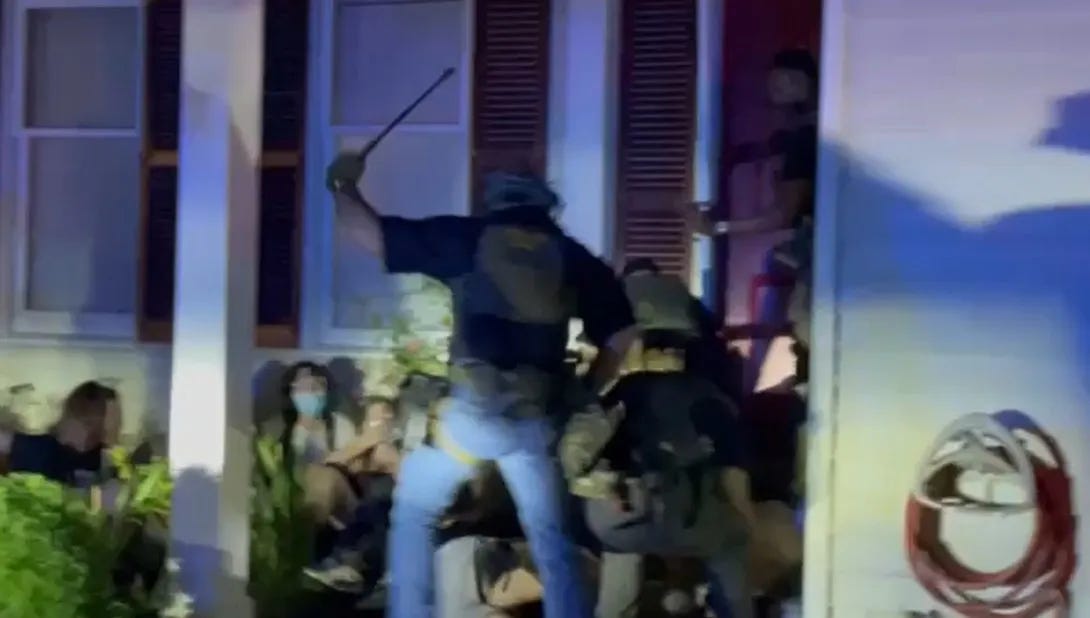
Masked federal agents are occupying residential streets. People are being held in rooms built for twelve-hour stays, sleeping on concrete under foil. Warehouses are being converted into detention centers in small towns.
The response from most of the Democrats in power? A strongly-worded statement. Every fucking time.
The playbook is fixed and I can call it from a mile away. It starts with a statement calling it deeply concerning. It’s followed by an oversight letter sent to someone who doesn’t give a shit. Then there is a monitoring update, a roundtable, and a survey link sent to constituents to ask how they feel. It ends with a video shot somewhere pretty, thanking the people who actually showed up and shared their feelings.
Have you ever watched that video? They thank the city. They thank the neighbors. They thank the protestors and local officials who physically stood in harm’s way. But it’s meaningless platitudes, packaged to make you feel like they’re doing something that earns your vote come November.
Sincere gratitude comes when you have skin in the game. Most of them don’t really want to fight, but I’ll get to that later.
This piece began as angry word vomit following the violent assault on protestors by ICE agents in Frederick recently. It evolved into a story about cowardice as I watched the performative response from Maryland politicians. I thought the answer was that they’ve confused process for a plan, that the letter had become the deliverable because the letter is the only thing a member of the minority can produce on demand. The ineffectiveness never registers as information, so nothing changes, and what is their incentive to do so?
Then I went and looked at what they actually tried.
The answer is worse than cowardice.
The rider
The Congressional Research Service traces the provision to the FY2019 DHS appropriations act, in a slightly different form. Members citing it in their own letters tend to start from the Consolidated Appropriations Act, 2020, where it appeared as Section 532. In the FY2024 act it was Section 527, which is the number the litigation runs on. In the law signed this April it is Section 546.
The number moves but the substance has held. Every DHS appropriations act since has carried the same bar. The department cannot use that act’s money to keep Members of Congress out of the places where it detains immigrants. No advance notice required from a Member, though staff can be made to give twenty-four hours. It also forbids DHS from making temporary modifications that alter what a visiting Member would otherwise see. Congress wrote that second part because it knew exactly what would happen if the tour was scheduled.
But in June 2025, ICE issued a policy requiring seven days’ notice anyway. Twelve Members were later denied entry for showing up without.
So they sued. Neguse et al. v. U.S. Immigration and Customs Enforcement, D.D.C. No. 1:25-cv-02463. The plaintiffs are not backbenchers: Assistant Democratic Leader Joe Neguse, Congressional Hispanic Caucus Chair Adriano Espaillat, Homeland Security ranking member Bennie Thompson, Judiciary ranking member Jamie Raskin, Oversight ranking member Robert Garcia, and Reps. Correa, Crow, Escobar, Goldman, Gomez, Morrison, Ruiz, and Torres.
They won in December 2025. Judge Jia Cobb held the policy contrary to law and beyond the department’s authority.
Secretary Kristi Noem then reinstated the notice requirement through a memorandum she failed to disclose. Shocker, I know. It surfaced in January 2026 only because Members of the Minnesota delegation were turned away from a federal building while holding a valid court order.
Back to court.
TRO granted February 2. Cobb ruled against DHS again in March. The administration appealed. On May 8, the D.C. Circuit unanimously refused to stay the order.
Four rounds. Fourteen months. Ranking members of three committees.
But ICE is still doing it. They’re also still getting away with it.
The loophole
The mechanism is not an inference. It is three words in the enacted statute.
Here is Section 546(a) of the Department of Homeland Security Appropriations Act, 2026, as signed on April 30: none of the funds appropriated or otherwise made available to DHS ”by this Act” may be used to prevent a Member of Congress from entering, for the purpose of conducting oversight, any facility operated by or for the Department used to detain or otherwise house aliens.
By this Act — not by any Act and not by appropriations generally. By this specific act.
The provision has no independent force. It is a condition attached to a specific pot of money, and it reaches exactly as far as that pot does. The One Big Beautiful Bill Act gave ICE and CBP an enormous separate stream of funding through a process known as reconciliation. It’s important to understand that reconciliation is not an appropriations bill so it never went through the appropriations committees. It carries none of their conditions, and Section 546 does not touch it.
Noem’s January 8, 2026 policy is built on precisely that reading.
The memo recites that the district court stayed her June 2025 guidance. It says she disagrees with that decision. Then it turns around and cites the same opinion — page 9 of Judge Cobb’s December 17 memorandum — for the proposition that funds deriving from the One Big Beautiful Bill Act ”are not subject to Section 527’s limitations.”
She lost the case but found the loophole and exploited it to her advantage.
From there the instruction is mechanical. ICE is to implement and enforce the seven-day notice policy exclusively with OBBBA money. Any time or resources spent on activities otherwise subject to Section 527’s limits must be logged and funded from OBBBA. Given how much OBBBA money ICE has, she anticipated more than enough for the purpose. And in an abundance of caution, the Chief Financial Officer and General Counsel are to make sure the promulgation of the policy itself is paid for the same way.
The stated justification is safety: unannounced visits pull officers off duty, and she describes a growing tendency to swap real oversight for publicity stunts. Thirteen members had by then spent months in federal court to get in the door. Judge Cobb would later note the government could not produce one concrete instance of a safety problem caused by an unannounced visit.
The memo closes by asserting that all of this effectuates the clear intent of Congress not to subject OBBBA funding to Section 527. Whether Congress intended that, or simply never thought about it, is the only genuinely open question in this piece.
Now read what Congress did in the same law. Section 4 of P.L. 119-86 strips the explanatory statement’s contents for ICE and Border Security Operations of any force or effect, and provides that the amounts in the Final Bill column for both shall be $0.
Zero. Congress passed a Department of Homeland Security appropriations act in which the line for Immigration and Customs Enforcement is zero dollars, because ICE is running on reconciliation money. Sections 108 and 545 of the same act are housekeeping for that fact — quarterly Inspector General reports and obligation plans covering the components receiving funds from Public Law 119-21.
So the access guarantee is attached to an Act that appropriates nothing to the agency doing the detaining. That is the whole damn trick.
One more thing worth noting, because it goes to whether anyone actually meant to fix this. The House-reported bill would have broadened the provision to cover any facility used to hold aliens, not just those operated by or for DHS — language aimed squarely at the field offices where ICE holds people for days and which ICE insisted were outside the statute.
That expansion is not in the enacted text. Section 546 carries the old formulation.
The lapse
There is a second version of the same argument, and it tells you the theory is a theory and not an improvisation.
DHS appropriations lapsed at 12:01 a.m. on February 14, 2026. Justice Department lawyers told the court that the access provision had lapsed along with them, and therefore could not be used to enjoin anything.
They lost. Cobb’s March 2 order held that Members retained the authority to conduct unannounced oversight, including during a lapse, and found DHS could not plausibly segregate its funding streams, since the resources used to devise and enforce the notice policy had already come from restricted appropriations.
But look at what the government was willing to argue. Not that Congress lacks oversight power. That this particular oversight power is an artifact of a spending condition — alive while the money flows, gone when it stops, and limited to the pot it rides on. That is the identical theory as the OBBBA workaround, but aimed at a different gap. One says access doesn’t reach reconciliation money. The other says it doesn’t survive a missed deadline. It’s the same premise underneath.
At least they lost this one. But the premise is still standing, because the premise is an accurate description of how Congress built the thing. Which means every gap has to be litigated separately, on its own schedule, while the facilities keep operating. Members who won in December were back in court in February and again in March, holding ground they had already taken.
The severance
The shutdown was a fight about ICE and CBP funding, and Democrats fought it. Two and a half months, well past any previous record. Whatever you want to say about the party — and there is a lot that I can say — the statement, “they refused to use the appropriations lever” is not available as a criticism.
But look at how it ended. The bill signed April 30 funds most of the Department of Homeland Security and leaves out ICE and Border Security Operations, which keep operating on OBBBA money. Congressional Research Service calls this unprecedented — partial funding of the department, with operating funds for the two enforcement agencies provided by a reconciliation measure that never went through the appropriations committees.
Then they made it permanent. On June 9, the House passed the Secure America Act, S. 2, by 214 to 212, on party lines; the Senate had passed it 52-47 four days earlier; Trump signed it June 10. Yet another reconciliation bill. Roughly $69.5 billion for ICE and CBP, available through September 30, 2029 — on top of the $170.7 billion OBBBA already provided, and running through most of the next president’s first year.
The American Immigration Council puts the consequence plainly: funding these agencies outside the regular process strips out the tools Congress normally uses to direct and oversee how the money is spent, because reconciliation bills carry no explanatory statements, no committee reports, no guidance establishing priorities or reporting duties. NPR reported the same concern as the bill passed: funding the agency this way means the provisions that tell it how to do its work simply aren’t there.
So the agencies conducting the raids are funded outside the appropriations process entirely, and will be until at least 2029.
Which means the access guarantee is still on the books, still enforceable, still being litigated, and attached to a stream of money that no longer pays for ICE.
The lever and the load got disconnected. But anyone can still pull it.
Where it stands
Here is the state of the thing today.
Members can walk in unannounced — their staff cannot. The January policy requires seven calendar days’ notice, routes requests through ICE’s Office of Congressional Relations, treats nothing as actionable until that office acknowledges receipt, requires the date, location, duration, and the names and titles of every participant, reserves to the Secretary personally any decision to shorten the seven days, and permits only Members and congressional staff scheduled and confirmed in advance to participate. Which means a Member arriving without notice arrives without a translator. Chris Deluzio and Summer Lee ran an unannounced visit at the Moshannon Valley Detention Center in May and their staff were kept outside. Madeleine Dean visited Moshannon in June on an announced basis, was allowed to bring staff, and was blocked from speaking directly with the people detained there.
Every piece of the guarantee that survived litigation has been narrowed at the edges until what’s left is a Member of Congress standing in a room where they cannot talk to anyone.
On August 17, 2026, Deluzio, Dean, Lee, Mary Gay Scanlon, and Dwight Evans introduced the Oversight Access Act of 2026 to fix the staff problem. We have to look at what it is, though, and not just what it does. The bill text opens “The Secretary of Homeland Security may not” — not “none of the funds.” No appropriations hook at all. It bars preventing entry, bars requiring prior notice from a Member or an accompanying employee, bars temporary modifications, and directs the Inspector General to report to the Judiciary Committees within 30 days of any material failure to comply. A freestanding permanent prohibition, enforceable regardless of which pot pays for what.
Somebody in that delegation understands the mechanism. Kudos to them.
You and I both know it will not pass this House. But that doesn’t make it uninteresting. It makes it the only proposal anyone has floated that would take congressional oversight of ICE off the money and put it in permanent law.
What’s left
There is a difference between a serious issue and an emergency.
You can work a serious issue on a normal schedule with normal tools. You can be proud of the letter you sent. But for the family whose door came off the hinges, for the person being beaten with batons in the street, it is not a serious issue.
It’s a fucking 5-alarm fire.
Thirteen members went to court. When the case was filed there were 212 House Democrats. Thirteen out of 212 is six percent. The other ninety-four percent produced statements, and most of them are still producing statements, and this is the part where the ivory tower is real. It isn’t just about money — it’s insulation from the cold, harsh reality. If none of this can reach your street, your kids, your status, then process feels like progress. You can perform procedure indefinitely because it carries no risk. You can pat yourself on the back and sleep soundly in your bed feeling accomplished, and nothing changes outside.
That’s why the anger is real. Nobody is honestly expecting them to win. Winning may not even be available — the thirteen won four times and the conditions inside those facilities are what they were. The bar is lower than that. Hold the fucking line and keep it from getting worse. Make somebody spend something to take the next thing.
Ninety-four percent are not clearing that bar either.
But I can’t hold that against Neguse and Raskin and Thompson, and neither can you. They at least used the tool. They used it four times. They won every round and the conditions inside those facilities did not improve. It is because the money has been moved out of the room that can hold those rooms accountable.
So I don’t know what the effective thing is. I can’t even begin to posit that I have a solution. I’m suspicious of anyone who claims they know. But “we don’t know what works” is not a reason to keep doing the thing that demonstrably doesn’t, and it is definitely not a reason to keep using tools somebody already unbolted from the machine.
Congress’s power over immigration enforcement was built almost entirely out of riders on appropriations. That worked for as long as the appropriations were the money. They aren’t anymore.
The standard is not whether you said the right thing. It’s whether anyone was safer that night. Each day in this country, they’re getting worse, and the fight has been moved into a room where nobody currently has a key.
Sources
Primary government data
Homeland Security and Further Additional Continuing Appropriations Act, 2026, Pub. L. No. 119-86 (Apr. 30, 2026), Division A §§ 4, 108, 109, 545, 546, 549; Division B § 102. The spine of this piece. Section 546 is the access provision and the “by this Act” limitation is the finding. Note that congress.gov blocks automated retrieval; the PDF has to be downloaded by hand.
Kristi Noem, Memorandum for Todd M. Lyons and Holly C. Mehringer, Congressional Access to Alien Detention Facilities — Access Policy and Use of Appropriations for Enforcement (Jan. 8, 2026). The central document. Read in full for this piece. Note that dhs.gov blocks automated retrieval, so it has to be downloaded by hand. A February 2, 2026 ratification memo with the same subject line also exists in the court record as an exhibit; do not confuse the two.
Neguse v. ICE, No. 25-2463, Memorandum Opinion (D.D.C. Dec. 17, 2025), particularly pages 9, 66, and 72. Not yet read directly. Page 9 is the load-bearing page.
D.C. Circuit order denying stay pending appeal, Neguse v. ICE, No. 26-5072 (May 8, 2026).
Legislation and testimony
CRS, Department of Homeland Security Appropriations: FY2026 State of Play (R48874). Shutdown timeline and the “unprecedented” characterization of ICE and CBP reconciliation funding.
CRS, Department of Homeland Security Appropriations: FY2026 Provisions (R48705). Traces the access provision to FY2019 and describes the House expansion that did not survive. Its projected renumbering to Section 547 is wrong as against the enacted law — cite the statute, not the report, for the section number.
Secure America Act, S. 2 (signed June 10, 2026). The second reconciliation bill funding ICE and CBP, and the provision that makes the severance durable through FY2029.
Oversight Access Act of 2026, introductory text as circulated by Rep. Deluzio’s office. A pre-introduction draft; confirm the introduced version against the Congress.gov entry.
American Immigration Council, explainer on the Secure America Act. Advocacy organization, but its account of what reconciliation funding strips out — explanatory statements, committee reports, reporting requirements — is a structural description that can be checked against the bill itself, and should be.
Legal and academic
Democracy Forward, case page for Neguse et al. v. ICE. Full plaintiff list and procedural history. Plaintiffs’ counsel — treat as an advocacy source and confirm dates against the docket.
Levin Center for Oversight and Democracy, Neguse v. ICE case file. Filing-by-filing index, the fastest route to the underlying documents.
Press
Roll Call, on the January re-imposition of the notice policy.
Newsweek, on the DOJ position that the provision lapsed with appropriations. Secondary; the underlying court notice is the better citation if it can be pulled.
Georgetown Government Affairs Institute, on the DHS funding timeline and the politics of ICE funding outside the appropriations process.
If federal money is used for a thing reps and their staff should be able to inspect the thing. Not a lawyer but it seems obvious to me this needs to be fixed. Thank you for your research as always.
just feels like peaceful protest aint cutting it. these hitler turtles get guns and weapons meanwhile we havr to be "non violent"