



Maryland State Senator Paul Corderman seems awfully comfortable asking the public to help finance other people’s business plans. He introduced the legislation that authorized $60 million in public financing for Hagerstown’s new stadium, now owned by a private nonprofit led by one of his campaign donors. His support for the data center industry deserves the same scrutiny, especially from the people he represents in Washington and Frederick counties who could face the costs of accommodating it.
We asked Senator Paul Corderman whether he would support requiring data center developers to pay the full cost of the electricity, water, sewer, and other infrastructure their projects require. We also asked what specific protections he would put into law to keep those costs off household bills. His entire response: “Yes, Data Centers should be self-sufficient.” He named no specific protections and offered no explanation of how he would require developers to cover those costs. His legislative record gives residents more to evaluate than that brief assurance, including votes for data center tax breaks and easier approvals, followed by a vote against legislation containing protections for other electricity customers. He has been specific about the benefits he supports for developers. The households being asked to accommodate them deserve more than a sentence.
Senator Corderman voted to make it cheaper and easier for data centers to operate in Washington and Frederick Counties at the cost of residents and the environment
Corderman’s support for data center tax breaks goes back to 2020, when he was still a state delegate. On March 17, he voted for Senate Bill 397, a law specifically giving data centers tax advantages. The bill gives tax breaks for data center developers, especially in Washington County and a few other “tier 1” counties.
The law exempts qualifying data center equipment from state sales and use taxes. That covers servers, software, cooling systems, generators, transformers and electrical infrastructure. Companies can receive years of relief on equipment essential to running their facilities, including qualifying replacement purchases. The exemption requires annual renewal, generally for up to ten years, with up to twenty years available for companies investing at least $250 million. The law also lets counties and municipalities reduce or eliminate the taxable assessment of qualifying equipment, opening the door to additional local property tax breaks. Those local reductions require local action.
Washington County received a particularly attractive deal. The 2020 fiscal analysis lists it among the Tier I jurisdictions, where companies could qualify with $2 million in eligible equipment investment instead of the $5 million required outside Tier I areas. That is a 60 percent lower investment threshold for the same state tax exemption. Both require just five qualifying new, permanent full-time jobs, paying at least 150 percent of the state minimum wage, with the investment and job requirements met within three years of applying. One hundred and fifty percent of the state minimum wage would be just $22.50 an hour.
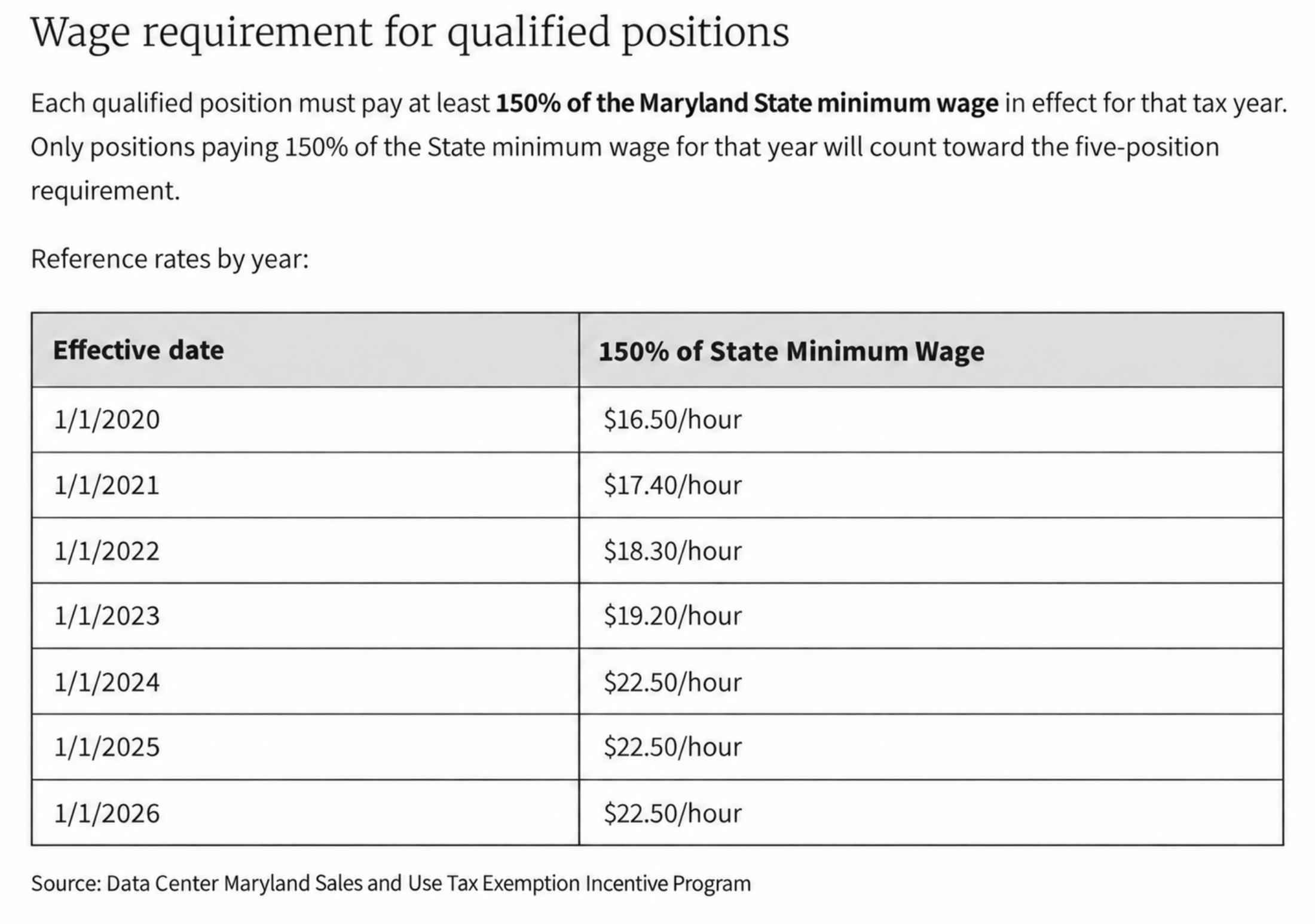
The state’s own analysts warned of potentially significant revenue losses and estimated that $150 million in qualifying purchases would mean $9 million in forgone state revenue. Corderman voted for the incentive anyway. Years before the latest development pitches, he had already helped offer data center companies years of tax relief with a lower investment requirement here and only five qualifying jobs required paying a minimum of $22.50 an hour in return. Residents deserve to know why the public’s concessions are so specific while the promised economic payoff remains so vague.
In Frederick County, Corderman also helped remove an approval requirement that stood in the way of a specific data center development. In 2024, he co-sponsored Senate Bill 474, the Critical Infrastructure Streamlining Act, and voted for its final passage. The law allows qualifying emergency backup generators at data centers and other critical infrastructure facilities to bypass the Maryland Public Service Commission’s approval process. Environmental permits and applicable noise and testing requirements remained, but developers no longer needed the commission’s approval for generators meeting the law’s conditions.
The legislature’s own analysis explains the Frederick County connection. Aligned Data Centers wanted to install 168 diesel generators, each rated at three megawatts, at its proposed Frederick County campus. Those generators would provide 504 megawatts of backup capacity to keep the company’s facilities running during power outages. The commission raised environmental concerns and granted only a provisional exemption for 70 megawatts. Aligned announced it would abandon the project, then urged lawmakers to pass SB 474, explicitly telling them the change would allow it to revisit its Frederick County plans. After the bill became law, the company announced it would move forward again. When a developer objected to the state’s regulatory decision, Corderman helped change the law governing the approval it had failed to obtain.
Ten years of tax relief at Mount Aetna
Corderman first pursued the Mount Aetna exemption in 2025 as SB 698. That bill failed, so he brought it back in 2026 as SB 193, which became law. It grants a ten-year state sales and use tax exemption which, as Senator Corderman says will “enhance the region’s ability to attract high-tech industries.”


The exemption is presented as relief for construction expressly including computer systems and equipment. Residents could be forgiven for wondering why a bill promoted around warehousing offers such a convenient benefit for a site being evaluated for data centers and why the county has spent over $18 million in infrastructure upgrades to the property.
As we previously reported, Hagerstown Washington County Industrial Foundation chief executive Greg Snook - a Corderman campaign contributor himself - acknowledged that brokers representing potential data centers had asked about Mount Aetna’s land, zoning, and utilities, which appears to have been the plan for quite some time. Just two years ago, Snook commissioned a power study to identify what upgrades the technology park would need for a data center. And just one year later, in Snook’s September 2025 Monthly Meeting presentation at the Greater Hagerstown Committee, he highlights high-tech business, light manufacturing, and computer and data processing as potential uses for the property.
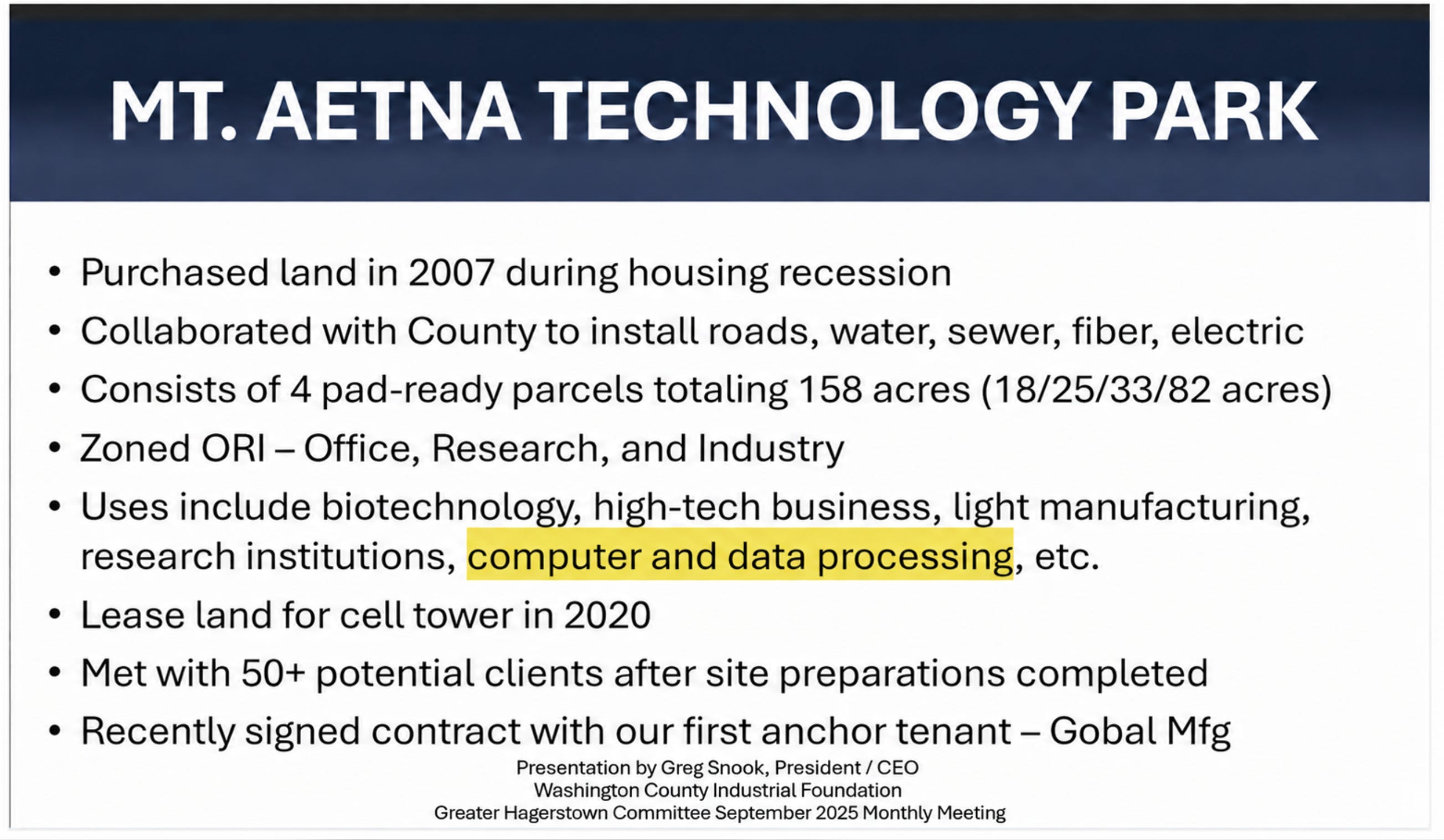
Many older zoning codes lack a specific category for data centers, creating a loophole that allows developers and local planners to classify them under broader terms such as data processing, information processing, light industrial, or light manufacturing. These classifications can make a data center look on paper like an ordinary, quiet warehouse with little traffic. This language often functions as a wink to data center buyers: the zoning allows it, but the sales pitch avoids saying “data center” where residents might notice.
Corderman’s written testimony sold the exemption as a way to make the site more attractive to investors and bring in high-tech industries, research centers, and manufacturing operations. Those are broad promises for a very specific tax break. If officials hoped to attract data centers, residents deserved to hear that while the incentive was being pushed, along with an honest accounting of the costs.
Cheaper for developers but more expensive for Frederick and Washington County residents?
The tax breaks and easier approvals Corderman supported help make Washington and Frederick counties more attractive to data center developers. But the costs of accommodating those projects can reach people who never agreed to help finance them. A Harvard Electricity Law Initiative study found that utilities can shift the costs of serving data centers onto households and other businesses, leaving ordinary customers to subsidize the infrastructure supporting Big Tech’s expansion.
Those costs can hit household budgets hard. An analysis published in Utility Dive cited projected utility bill increases of $40 to $50 a month in several states from grid investments driven by data center demand. That amounts to another $480 to $600 a year. Those projections are not estimates for Washington or Frederick County, but they show why residents should demand enforceable protections before developers’ promises become everyone else’s bills.
In April 2026, Maryland lawmakers passed legislation containing protections against that kind of cost shifting. The Utility RELIEF Act required the Maryland Public Service Commission to consider whether data centers would pay enough to cover the additional costs of serving them. The final bill extended those rules to more projects by lowering the power-demand threshold from 100 to 25 megawatts. The commission would determine the actual rates, but the purpose was straightforward: make data centers cover the costs they create rather than pass those costs on to other customers. Corderman voted against final passage on April 13.
The law also required large electricity customers to register and disclose information about their electricity supply, estimated water use, backup generators and competing requests to connect projects to the grid. A registration fee of at least $1,000 per megawatt of peak demand would support household electricity assistance and energy efficiency programs for low-income residents. Corderman’s vote does not tell us which provisions he opposed. It does mean he owes residents an explanation for rejecting a bill containing those protections while supporting measures that lower developers’ costs.
His work on the bill raises another question about who should pay for new infrastructure. Before voting against the final legislation, Corderman introduced an amendment that would block the commission’s effort to end subsidies for new gas connections. He pointed to a housing development in his district that he said was being held back. But preserving those subsidies would allow utilities to keep charging existing customers for part of the cost of connecting new ones.
In June 2025, the commission ordered an end to that practice, deciding that new customers should pay the full cost of extending gas service to them. The Office of People’s Counsel estimated that the change would spare BGE and Washington Gas customers $952 million in cumulative gas-bill increases through 2035. Customers of smaller utilities, including Columbia Gas of Maryland, would also benefit from lower future rates.
Corderman’s campaign received $2,750 from NiSource, Columbia Gas of Maryland’s parent company. His donor’s subsidiary operates one of the gas systems affected by the reform he sought to block. NiSource is also pursuing opportunities to serve the growing data center industry, which is increasingly turning to natural gas to power AI and cloud computing facilities as electricity supplies struggle to keep pace with demand.
Corderman justified his amendment by citing housing, and that does not establish that he proposed it for data centers. It does, however, show his willingness to preserve a system that makes existing customers help pay for expansion. Residents in Washington and Frederick counties deserve to know why he fought to preserve those gas subsidies, why he voted against the final electricity protections, and what he would actually put into law to keep developers’ infrastructure costs off their monthly bills.
The data center interests helping finance Corderman’s campaign
Corderman received $1,000 from FirstEnergy, which owns Potomac Edison, the electric utility serving much of Western Maryland. His donors also include Amazon, which has a four-building data center project in Frederick County. One donor is developing data centers, and another owns the utility that supplies electricity in the region. Residents deserve to know how Corderman will protect their electric bills as those businesses expand.
Manno & Associates, a lobbying and law firm led by former Maryland state senator Roger Manno, contributed at least $750 to Corderman’s campaign. Manno testified against HB 120, a proposed statewide pause on certain new data centers, and described data center campus development as part of his legal practice. His firm also promotes a Sage Policy Group white paper touting the benefits of data centers in Maryland. Corderman’s donors include a firm that works on data center development and has directly urged lawmakers to reject a pause on new projects.
In his February 24 letter, Manno also pushed to let data centers connect to the grid before fully meeting a proposed electricity supply requirement. The proposal would require large electricity users to secure capacity covering 25 percent of their demand before connecting. Manno wanted companies to meet that requirement in stages, emphasizing investment and construction jobs. But Maryland’s legislative analysts identified the requirement as a possible way to help hold down electricity prices. They warned that allowing more projects to connect, or letting them connect sooner, could increase demand, require grid upgrades and contribute to higher bills. Manno’s proposal could reduce developers’ upfront costs while increasing the risk that households face higher electricity bills.
Corderman’s campaign donors also include the following people and firms with documented connections to data center development, lobbying, and tax exemptions:
Amazon: Corderman’s campaign retained $1,000 in contributions from Amazon, whose AWS subsidiary operates multiple large data centers in neighboring Frederick County. Amazon is now pushing to build “data center towns.”
Sushant Sidh contributed $500 in January 2024, and Frederick County’s official ethics disclosures show him seeking special treatment for a proposed data center the following year. On March 10, 2025, Sidh, representing Capitol Strategies, participated in calls requesting an exemption from current and potential future data center legislation for property at 2518 Ballenger Creek Pike. A separate disclosure describes his proposal for a data center near the Doubs substation and identifies conflicts involving the property’s planning designation, zoning and pending legislation.
Evans & Associates: Corderman’s campaign received $1,500 from the lobbying firm across two contributions in 2020 and 2024. Maryland’s current lobbying registrations list the firm’s Gerard Evans and Hayley Evans as representatives of Quantum Maryland LLC, identified by MDE as Quantum Loophole, and Atmosphere’s Dickerson property entity, associated with another proposed data center project. His contributors include a firm whose current clients have direct interests in Maryland data center development.
Gordon Feinblatt PAC contributed $250 in October 2021, and the state’s 2025–2026 registration identifies the firm’s attorney Michael Powell as a lobbyist for Aligned Data Centers on energy and environmental matters. Aligned is developing a parcel within the Quantum Maryland campus in Frederick County.
Richard Tabuteau contributed $300 across donations in 2023 and 2026, after helping advocate for the tax incentives used to attract the data center industry. Tabuteau co-signed Maryland Tech Council testimony supporting SB 397 in 2020, which provided a sales and use tax exemption for qualifying data center equipment. The testimony explicitly argued that Maryland needed the exemption to compete for data center investment. Corderman voted for that same legislation.
Cornerstone Government Affairs contributed $500 on August 5, 2026, just two weeks after publishing an article describing its work helping clients win approval for data center projects. In its July 22 article, a Cornerstone principal explains that approvals often depend on a handful of elected officials and discusses providing political “cover” for them to vote yes. The firm describes helping clients promote favorable examples from other communities and structure projects to improve their chances of approval. Cornerstone also recommends that developers pay their infrastructure costs and provide tangible community benefits, but its commercial role is clear: helping data center clients navigate local opposition and secure approval from elected officials.
Holcim and Holcim (US) Inc contributed $1,250 across donations in 2020 and 2021. Holcim actively markets its building materials to the data center industry, offering concrete, cement and roofing systems for projects from foundation to rooftop. The company says its order book includes numerous large data center projects through 2028 and highlights collaborations with Meta and Amazon, including supplying its special concrete for AWS data centers. Its commercial interest is straightforward: more data centers mean more opportunities to sell the materials used to build them. This is just one of Corderman’s campaign donors positioning itself to profit from the same construction boom his policies help encourage.
John Favazza: Corderman received $1,750 across six contributions from Favazza between 2021 and 2026. The state’s current lobbying list identifies Favazza as a representative of both the Washington County Community Coalition and Amrize North America, formerly Holcim Participations (US). Corderman’s campaign also received $1,250 directly from contributors recorded as Holcim and Holcim (US) Inc., adding a lobbyist connection to the building-materials company already discussed above.
Corderman’s donor NiSource wants a piece of the data center business too
NiSource has contributed $2,750 to Corderman’s campaign, and its Maryland subsidiary, Columbia Gas of Maryland, has been lobbying for legislation that could help it capture more data center business. Columbia Gas, which serves Washington, Allegany, and Garrett counties, submitted testimony supporting SB 26 on February 19 and testimony supporting HB 1190 on March 3. Both proposals would exempt qualifying off-grid electricity providers from much of Maryland’s utility regulation, and both submissions explicitly cited data center electricity demand.
NiSource already has energy agreements supporting Amazon and Alphabet data centers in Indiana to power them with natural gas. In its February 2026 earnings call, management said its Virginia team handled more than 40 data center inquiries during 2025 and was working on approximately two dozen active projects involving gas infrastructure. Its Maryland subsidiary was asking lawmakers to loosen oversight of a potential market for that growing business under the guise that the proposal would benefit customers.
Sierra Club and its partners warned that HB 1190 would remove safeguards designed to keep ordinary utility customers from paying expenses belonging to businesses generating electricity for data centers. A company contributing to Corderman’s campaign stands to gain from supplying the data center industry, while consumer advocates are warning about the costs which residents would absorb. Washington County households deserve protections that keep a campaign donor’s next business opportunity from becoming another expense on their utility bills.


Senator Corderman has helped data center developers. What did Washington and Frederick county residents get in return?
Corderman has spent years helping make these developments more attractive to the companies behind them. He voted for data center tax exemptions in 2020, with a lower investment requirement in Washington County, supported removing an approval requirement for backup generators, and pursued another decade of tax relief at Mount Aetna. The people he represents deserve an accounting of what they get in return: how many permanent jobs, at what wages, how much tax revenue after the exemptions, and what protections keep the costs off their utility bills. Calling something economic development does not explain why the public should help pay for it.
Before residents are asked to accept more promises, they need to see the numbers for electricity demand, water use, sewer capacity, backup generators and infrastructure upgrades. They need to know how much tax revenue is being surrendered, who will pay to expand public systems, and whether those commitments can actually be enforced. Corderman should explain why he voted against the final Utility RELIEF Act and name the protections he would support instead. “Data Centers should be self-sufficient” is an easy sentence to send us. Putting that obligation into law would give residents something they could rely on.
Corderman has shown he is willing to keep working on a tax break until it becomes law. Washington and Frederick county residents deserve the same effort when their household budgets are at stake. They should not have to give up public revenue, accommodate enormous new demands on their utilities, and then hope the promised benefits are worth the expense. For someone with plenty to say on Facebook, Corderman should be able to explain why he keeps supporting concessions for developers and exactly what he has secured for the people expected to live with the bill.
🤬🤬🤬🤬🤬🤬