


For weeks, Washington County officials have tried to frame the planned ICE detention warehouse outside Hagerstown as something largely outside of their hands—a federal project with limited local involvement and minimal communication.
That framing is no longer sustainable.
This week, Hagerstown Rapid Response uncovered and broke two developments that tell a very different story—one that raises serious questions about how this project has been handled and what residents have (and haven’t) been told.
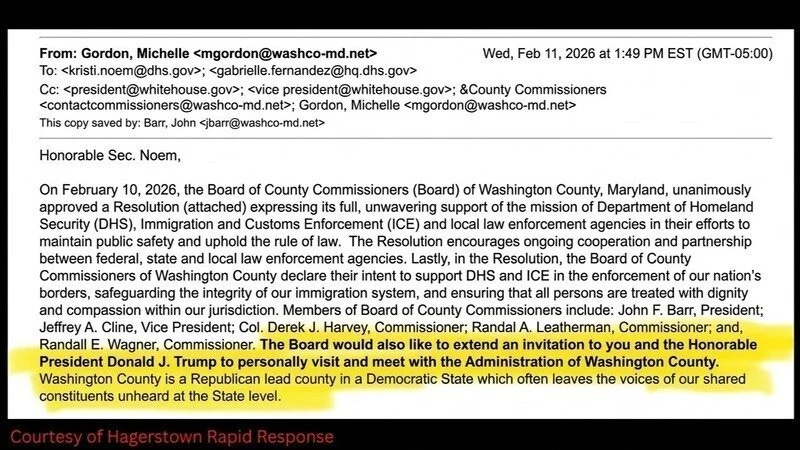
The first came through a Maryland Public Information Act request, filed Ethan Wechtaluk, a core member of the group’s research and media team. Those records revealed that Washington County officials invited President Donald Trump and Vice President JD Vance to tour the ICE warehouse site.
That contradiction is difficult to ignore. A visit of that scale and profile requires communication, planning, and coordination. It suggests a level of engagement that goes well beyond what residents have been led to believe.
And it is especially striking given the broader context. For months, residents have been asking basic, unresolved questions about the facility: how an 825,000-square-foot industrial building is being converted into a high-capacity detention center, what the environmental and infrastructure impacts will be, and how the project will affect local resources. Those questions have not been fully answered, despite sustained public interest.
The second story we broke, which unfolded at yesterday’s Washington County Commissioners meeting, highlights a different but related issue: how those questions are being handled when they are raised in public.
Taj Smith, president of the Washington County NAACP, attended the meeting to speak during the public comment period about the proposed 911 fee increase. Her focus was not abstract opposition, but the county’s finances—specifically, connected to the proposed 911 fee increase and an emerging budget shortfall—and how those pressures intersect with the decision to move forward with a large-scale detention facility.
Her concern was straightforward. Facilities of this size rely heavily on local infrastructure, including emergency services, dispatch systems, and healthcare providers. If the county is already facing financial strain in maintaining those services, the addition of a high-capacity detention center raises obvious questions about cost, capacity, and long-term sustainability.
Smith attempted to raise those questions directly.
She was cut off before she could finish, removed from the meeting, and ultimately trespassed.
Taken together, these two developments point to a broader pattern. On one hand, there is evidence of behind-the-scenes coordination and engagement around the project, including outreach to national political figures. On the other, there is a visible breakdown in how local concerns are received, particularly when they touch on accountability, cost, and transparency.
That gap—between what is happening privately and what is being acknowledged publicly—is where much of the tension around this project now sits.
It also helps explain why so much of the information that has emerged about the ICE warehouse, just outside of Hagerstown, has not come from official disclosures, but from independent efforts to obtain and analyze public records. Hagerstown Rapid Response has played a central role in that process, filing requests, reviewing documents, and working with media to bring new details into public view.
The result is a clearer, more complete picture of how this project is moving forward—one that challenges the idea that it has simply been a passive or externally driven process.
And while the immediate focus is on Washington County, the implications extend beyond it. Across the country, similar facilities are being developed through the rapid conversion of industrial buildings, often with limited public input and uneven transparency. What is happening in Hagerstown reflects a broader dynamic in how immigration detention infrastructure is expanding—and how communities are responding when they feel excluded from the process.
At this point, the core issue is not whether the project exists. It is how it has been handled, what has been communicated, and what remains unclear.
Inviting the president to tour the site while residents are still seeking basic information about its impact is not a minor inconsistency. Neither is removing a community leader for raising questions about how the project could affect already strained emergency services.
Those are decisions. And they are shaping how this story is being understood, both locally and beyond.
The more that comes to light, the harder it becomes to maintain the idea that this has been a limited, hands-off process.
And that is exactly why the details matter.