



There was a reason we wanted Derek Harvey’s emails. Before becoming a Washington County Commissioner, Harvey briefly served as Senior Director for Middle East and North African Affairs on President Donald Trump’s National Security Council before National Security Adviser H.R. McMaster removed Harvey from his position following internal complaints about Harvey’s management style and repeated clashes between the two men. The Post reported that Harvey had also drawn complaints from other senior officials and that his relationship with his own staff had become a significant problem.
Harvey later went to work for Republican Congressman Devin Nunes on the House Intelligence Committee, where he became involved in another controversy, this time connected to Ukraine and the events that became central to Trump’s first impeachment.
In January 2020, House impeachment investigators released text messages showing extensive communications between Harvey and Lev Parnas, an associate of Rudy Giuliani who was working with Giuliani to obtain information from Ukrainian officials that could damage Joe Biden. The Washington Post reported on the messages, which showed Parnas working to arrange conversations between Harvey and Ukrainian prosecutors who were providing information to Giuliani. CBS News also reported that the released materials contained numerous exchanges between Harvey and Parnas dating back to February 2019.
The texts provide important context for why Harvey’s communications practices deserve scrutiny. In one exchange, after Parnas sent Harvey material involving allegations about Ukraine and the 2016 election, Harvey asked him, “Any documents for us or are you going to keep working through Solomon?” Other messages showed Harvey and Parnas discussing meetings at the Trump International Hotel in Washington and Parnas arranging interviews for Harvey with former Ukrainian officials, including former Ukrainian prosecutor Viktor Shokin. The Los Angeles Times reported that the messages also showed Parnas and Harvey arranging a meeting involving Giuliani and conservative columnist John Solomon. The released texts established Harvey’s extensive communications with Parnas, although they did not by themselves establish every broader allegation Parnas made about Nunes or Harvey.
That history matters because years later, while serving as a Washington County Commissioner, Harvey once again left behind questions about his handling of government communications.
Harvey abruptly left the Washington County Board of County Commissioners in February 2026. Washington County announced his resignation on February 25, saying Harvey cited “new business opportunities” that better aligned with his family and long-term professional goals.
As we began examining what Harvey had been doing before that resignation, we noticed something we still cannot explain. Harvey had started forwarding large numbers of Washington County government emails to an outside, non-Washington County email address. These were not simply personal emails that happened to pass through his County account. The material included government correspondence and communications involving constituents that Harvey had access to because he was a Washington County Commissioner.
That immediately raised questions about why Harvey was saving government emails outside the County system in the first place. Why was he preserving correspondence that did not personally belong to him? Why did he want copies outside Washington County’s email system? What information was he selecting to save? What did he intend to do with it? And did he retain any of that correspondence after abruptly leaving public office?
Harvey’s history made those questions impossible for us to ignore. This was a former senior National Security Council official who had been removed from that position, later became a senior aide on the House Intelligence Committee, and then had his text messages with Lev Parnas released during the Ukraine impeachment investigation. He understood government communications, investigations, and the significance of documentary records. When we discovered that he had been forwarding Washington County government correspondence to an outside account shortly before resigning as a Commissioner, we wanted to know why.
So in May, we at Hagerstown Rapid Response filed a Maryland Public Information Act (MPIA) request for Derek Harvey’s emails. Washington County initially charged us $200 for the records. Then the County came back and told us it would cost another $300. We paid the $500. It is now almost October and we have received only about one third of the emails Washington County told us would ultimately be produced.
We still do not know why Harvey was saving Washington County correspondence outside the government email system. But in trying to answer that question, we discovered something else. The emails produced from Harvey’s County account show what Washington County Administrator Michelle Gordon and the County Commissioners knew internally about the proposed ICE detention facility. Other emails show what residents were subsequently being told about the same project. When those records are placed next to each other, there are serious contradictions.
On January 16, Gordon Was Already Calling It a “Detention Facility”
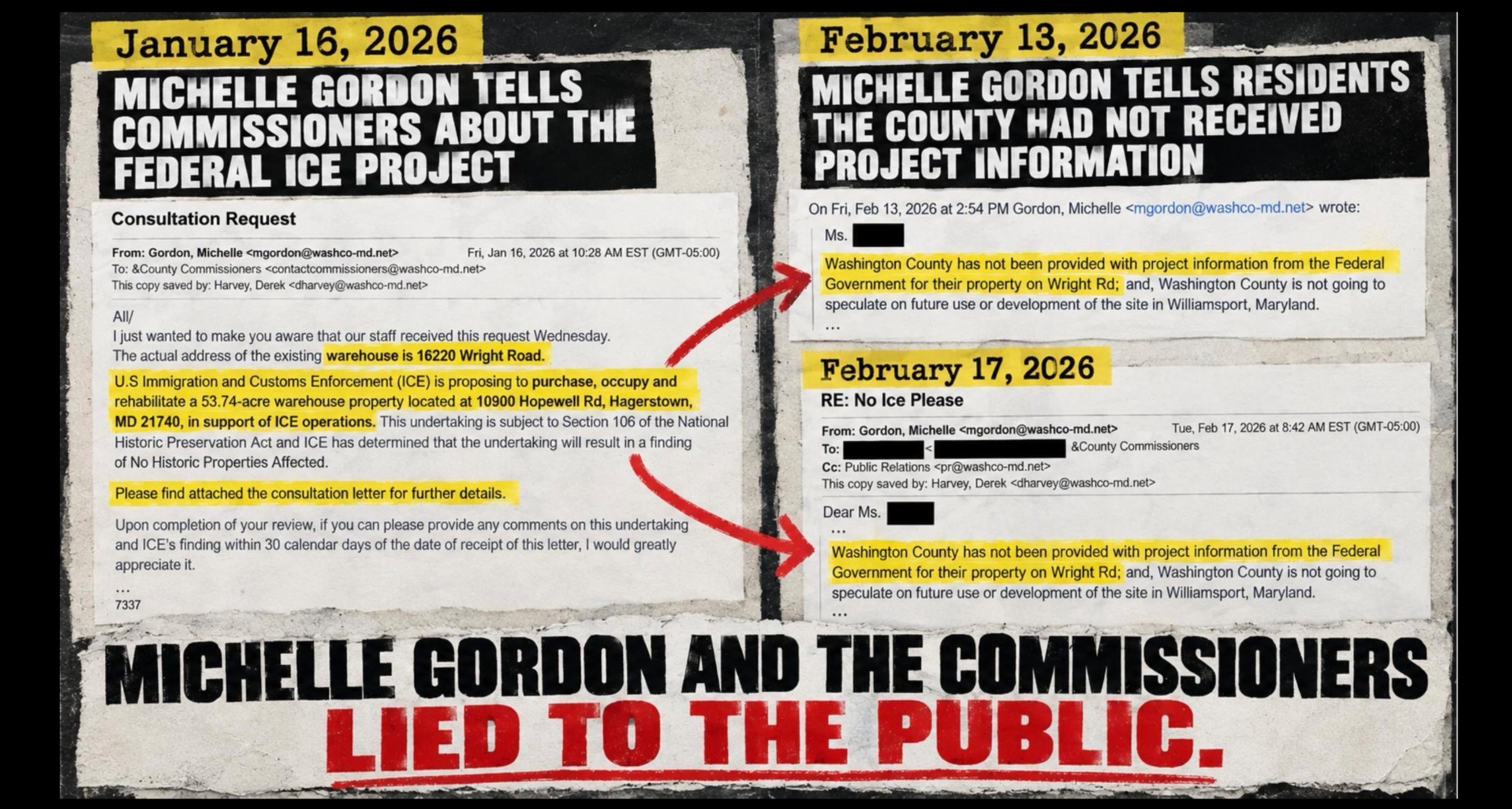
At 10:28 a.m. on January 16, 2026, Washington County Administrator Michelle Gordon emailed the Washington County Commissioners about the massive warehouse at 16220 Wright Road. The email contained federal information stating that U.S. Immigration and Customs Enforcement was “proposing to purchase, occupy and rehabilitate” the roughly 54-acre warehouse property “in support of ICE operations.”
Gordon then told the commissioners: “Regardless, this particular parcel is zoned IG which means a detention facility is a principally permitted use.” Those are Gordon’s own words: “detention facility.”
The terminology matters because Gordon was not merely being told that the federal government had purchased a warehouse or that ICE had some unspecified interest in the property. By January 16, Washington County’s Administrator had federal information identifying ICE, identifying the property, and describing ICE’s proposal to purchase, occupy and rehabilitate the warehouse for its operations. Gordon was discussing that information directly with the County Commissioners and describing the contemplated use as a “detention facility.” Less than a month later, however, Gordon would begin telling Washington County residents that the County had not been provided with federal “project information.”
What Did Gordon Mean by “Our Position Would Still Be the Same”?
There is another sentence in Gordon’s January 16 email that raises questions about what Washington County officials may have already discussed before the email was sent. After describing what ICE was proposing, Gordon wrote, “Our position would still be the same.” She then described that position: “Washington County does not comment on actions being taken by the US Government, Department of Homeland Security.”
Gordon did not write that she was recommending a position for the County to adopt after receiving new information from DHS, nor did she ask the commissioners what Washington County’s position should be. She referred to “our position” and said it “would still be the same.” Washington County has publicly identified January 14 as the date its Historic District Commission and Planning and Zoning Department received the DHS consultation letter concerning the proposed facility. That date comes directly from the County’s January 28 public statement about the proposed ICE facility. Gordon sent her email to the commissioners only two days after the date the County says that letter arrived.
The January 16 email raises an obvious question about what had already been discussed. If January 14 was the beginning of Washington County’s knowledge of the proposed project, what previous discussion, communication or situation was Gordon referring to when she told the commissioners that “our position would still be the same”?
On February 13, Gordon Told a Resident the County Had No Federal “Project Information”
Less than a month after the January 16 internal discussion, Gordon responded to a resident asking about the proposed facility. On February 13, Gordon told the resident that Washington County had “not been provided with project information from the Federal Government for their property on Wright Rd.” She also told the resident that Washington County was “not consulted by the federal government” concerning the sales transaction.
That response is difficult to reconcile with Gordon’s January 16 email. By then, Gordon had received federal information stating that ICE proposed to “purchase, occupy and rehabilitate” the Wright Road warehouse in support of ICE operations. She had discussed that information with the commissioners, considered the zoning implications of the proposed use and explicitly described that use as a “detention facility.”
Four Days Later, Gordon Told Another Resident Essentially the Same Thing
On February 17, another constituent contacted Washington County with concerns about the proposed ICE facility. Gordon responded, with the Washington County Commissioners copied, that “Washington County has not been provided with project information from the Federal Government for their property on Wright Rd; and, Washington County is not going to speculate on future use or development of the site in Williamsport, Maryland.”
By this point, the problem was not simply that Gordon had internally used the words “detention facility” one month earlier. In its January 28 public statement, Washington County had already acknowledged that the DHS letter described construction of holding and processing spaces, office and visitor space, cafeterias, bathrooms and health care spaces, along with fencing, lighting, recreation areas, cameras and other site improvements.
Gordon nevertheless told a second resident that Washington County had not been provided federal “project information” and added that the County would not “speculate on future use or development” of the property, even though she had already discussed the proposed use of that exact property with the commissioners as a “detention facility.”
The fact that there were two resident responses matters. On February 13, a resident was told that Washington County had not been provided federal project information. Four days later, another resident was told essentially the same thing. Meanwhile, the internal emails show that Gordon and the commissioners had received and discussed federal information about the project weeks earlier.
The Commissioners Were Receiving Both Sides of These Communications
The February 17 email also makes this larger than a question about Michelle Gordon alone because the Washington County Commissioners were copied on her response. Those same commissioners had received Gordon’s January 16 email discussing federal information about the Wright Road property, describing its proposed use as a “detention facility” and referring to “our position” that “would still be the same.” A month later, they received Gordon’s response telling a resident that Washington County had not been provided federal project information and would not speculate about the property’s future use.
That is why these emails raise questions about what the Board of County Commissioners knew and what residents were being told, rather than simply whether Gordon chose her words poorly in a single response. At least by February 17, the commissioners had both sides of this timeline sitting in their inboxes. They had Gordon’s internal discussion of a detention facility and her later representation to multiple constituents that the County had not received project information. All of this also occurred after the commissioners had already taken a formal public position supporting DHS and ICE.
The Commissioners Had Already Declared Their Support for DHS and ICE
On February 10, between Gordon’s January 16 internal email and her February responses to residents, the Washington County Commissioners adopted a resolution expressing their “full support” for DHS and ICE. The February 10 resolution encouraged “ongoing cooperation and partnership” among federal, state and local law enforcement, declared the Board’s intent to support DHS and ICE, and directed that a copy be transmitted to DHS and ICE as a sign of the County’s support.
Put the chronology together:
January 14: According to Washington County’s January 28 statement, the DHS consultation letter concerning the proposed facility arrived.
January 16: Gordon told the commissioners that the property permitted a “detention facility” and referred to “our position” that “would still be the same.”
January 28: Washington County publicly acknowledged receiving federal information describing holding and processing spaces and numerous other components of the proposed facility.
February 10: The commissioners formally expressed their “full support” for DHS and ICE and called for ongoing cooperation and partnership.
February 13: Gordon told a resident that Washington County had not been provided federal “project information.”
February 17: Gordon told another resident essentially the same thing, adding that the County would not “speculate on future use or development” of the property. The Washington County Commissioners were copied on her response.
Viewed together, the chronology is why the Derek Harvey email production is so important. The records allow us to compare what Washington County officials were discussing internally with what residents were being told only weeks later. The January emails show federal project information being received and discussed, including Gordon’s own characterization of the proposed use as a detention facility. The February emails show residents repeatedly being told that Washington County had not been provided federal project information.
Why Was Derek Harvey Saving Washington County Emails That Did Not Belong to Him?
Shortly before abruptly resigning from the Washington County Board of County Commissioners, Derek Harvey began forwarding large numbers of Washington County emails to an outside, non- Washington County email address. The material included Washington County government correspondence and communications involving constituents that he had access to because he was serving as a County Commissioner.
That raises a question beyond why Harvey wanted copies outside the County system: why was Derek Harvey saving government correspondence that did not belong to him personally? Some of these communications involved members of the public writing to their local government. Harvey received them because he held public office. His decision to forward County correspondence to an outside account shortly before leaving that office raises questions about what information he was preserving, why he wanted it outside Washington County’s system, what he intended to do with it, whether he continued to have access to it after resigning, and whether Washington County knows what records were moved outside its system.
Did Washington County conduct a security review after Commissioner Derek Harvey transferred County government and constituent emails to an outside email account, and did the County determine whether any of those messages contained confidential or legally protected personal information? And wouldn’t this be considered a data breach?
That behavior deserves additional scrutiny precisely because this is not the first time Harvey’s electronic communications have become part of a major public controversy. During the first Trump impeachment, text messages between Harvey and Lev Parnas became public evidence of Harvey’s communications with a figure working alongside Rudy Giuliani to pursue information about Trump’s political opponents in Ukraine. The Washington Post reported that the messages showed extensive contact between Harvey and Parnas and indicated that Nunes’s office was aware of the Ukraine effort and sought information Parnas was gathering. CBS News reported that Parnas appeared to arrange interviews for Harvey with senior Ukrainian officials and that Harvey and Parnas repeatedly discussed meeting at the Trump Hotel in Washington.
Those texts do not tell us why Harvey was forwarding Washington County emails years later, and we are not claiming the two situations are the same. They do, however, make Harvey’s handling of government-related communications a legitimate subject of scrutiny rather than a trivial technical question about which email account he preferred to use.
There is also an unexpected connection between Harvey’s behavior and what we have now discovered about the ICE detention center. We still do not know why Harvey was saving these records and to whom he was forwarding them, but his unusual email behavior ultimately helped us uncover a separate problem involving what Washington County officials were telling the public.
Several Months Ago, We Paid $500 for Derek Harvey’s Emails and Still Have Only About One Third of Them
Hagerstown Rapid Response filed this MPIA request in May. Washington County initially charged us $200 for the records and then required another $300. We paid $500. More than four months later, Washington County has produced only about one-third of the emails it told us would ultimately be provided.
The first third alone contains the January 16 internal email in which Gordon discussed the property as a “detention facility” and told commissioners “our position would still be the same.” It contains the February 13 response telling a resident that Washington County had not been provided federal “project information,” followed four days later by another response telling another resident essentially the same thing while saying the County would not speculate about the future use of a property Gordon had already discussed internally as a detention facility. The commissioners themselves were copied on the February 17 response.
Those records leave Washington County with questions it should answer. What did Gordon mean when she said “our position would still be the same”? When was that position established, and what discussions had already occurred? Why were multiple residents told Washington County had not received federal project information when the County’s own records show federal information about the project had been received and discussed? Why tell a resident the County would not speculate about the property’s future use after Gordon had already discussed that use internally as a detention facility? Why did the commissioners, who had received Gordon’s January 16 email and were copied on at least one of the subsequent responses to a resident, allow that representation of the County’s knowledge to stand? And separately, why was Derek Harvey forwarding Washington County government and constituent correspondence to an outside email account immediately before leaving office?
We paid $500 and have waited several months for Derek Harvey’s emails, and Washington County still has not produced roughly two thirds of what it told us would be provided. The first third of the emails we requested have already shown us that Washington County officials knew more than they told residents, while raising serious questions about why a former commissioner was forwarding government correspondence to an outside email account before abruptly resigning. Now we want the other two thirds we paid for.
Great journalism