



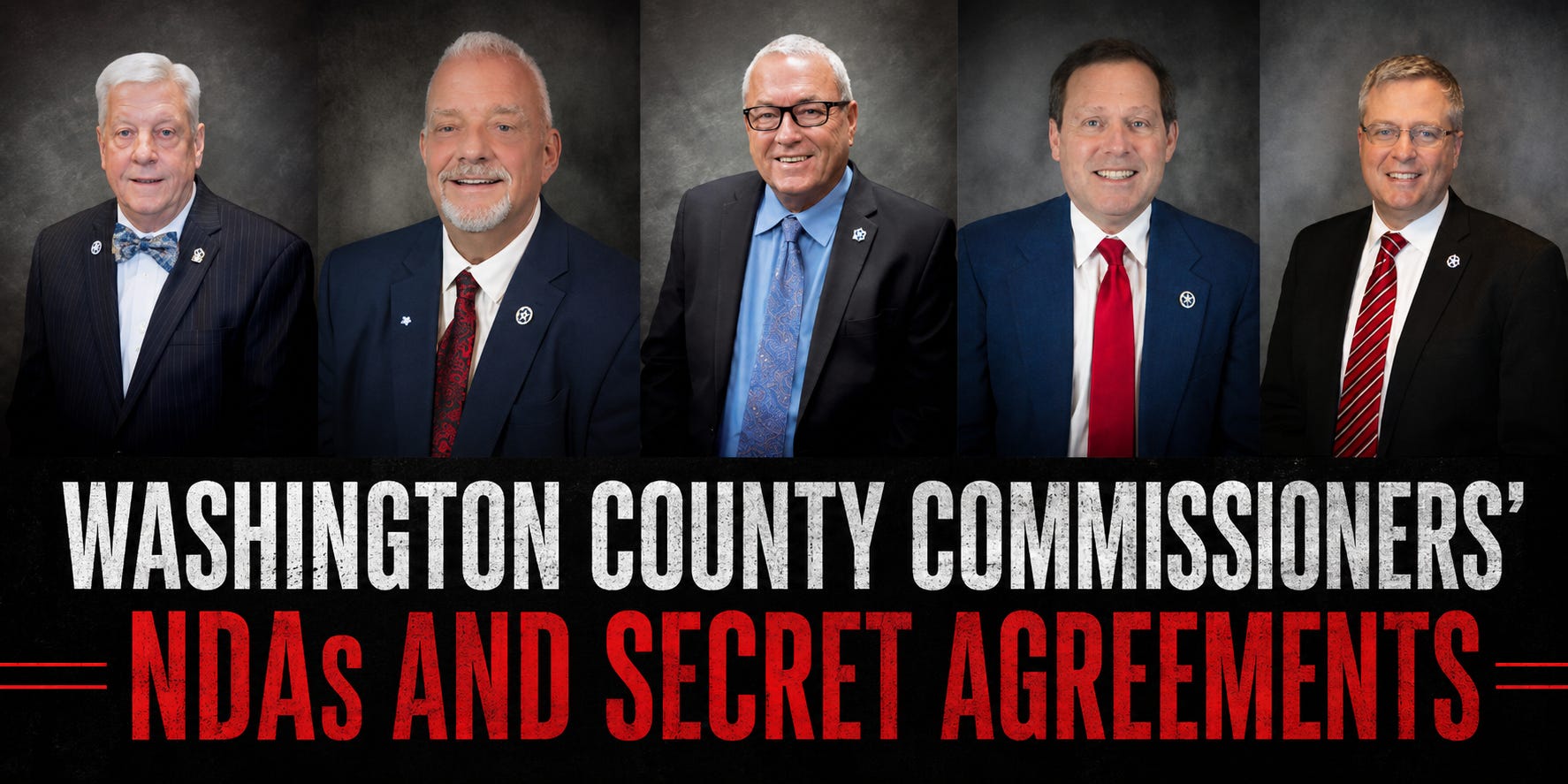
Meeting: Washington County Board of County Commissioners Special Meeting
When: Thursday, May 21, 2026, 8:30 AM
Where: Washington County administration building, Hagerstown
Presiding: Commission President John F. Barr
Source agenda: https://www.washco-md.net/wp-content/uploads/05212026-Open-Agenda-REVISED-PACKET.pdf
Why this meeting matters
A “special meeting” of the Board of County Commissioners is a focused session called outside the regular schedule. Tomorrow’s meeting has three open items, a closed session, and a packet that was revised on short notice. Two of the three items raise serious questions about how Washington County contracts for infrastructure work, and the closed session, as published, appears to mis-cite the Open Meetings Act in ways the statute itself addresses directly.
This guide walks through each item in plain language, then explains what’s wrong with the way the closed session is framed and what can be done if a violation occurs.
What’s on the agenda
Item 1: A consulting contract that raises ethics concerns
The Commissioners are being asked to approve a consulting contract with GDMS, LLC, a small company whose principal is Gregory B. Murray.
Murray’s history matters here:
He was Washington County’s Administrator until October 2017, when he was forced out under contested circumstances.
His wife, Debra Murray, was fired at the same time over an unauthorized $250,000 loan tied to a county landfill project.
He later became City Manager in Punta Gorda, Florida, and resigned in November 2024 after a publicly reported incident at a bar and a contested severance vote.
Debra Murray has been CFO of Ellsworth Electric since 2018.
Ellsworth Electric was founded by Commissioner John F. Barr, who remains chairman of the board.
So the company being awarded the contract is run by a former County Administrator whose spouse works for a business controlled by the Commissioner presiding over tomorrow’s meeting.
The contract itself includes:
A one-sided attorneys’ fees clause requiring the County to pay GDMS legal costs in disputes.
A broad scope allowing the County Administrator to assign additional work without formally amending the contract.
The scope overlaps with issues central to the federal lawsuit Maryland v. Noem, including sewer capacity, infrastructure readiness, and growth impacts connected to the proposed ICE detention warehouse near Williamsport.
Item 2: The County pays for sewer upgrades on private land
The second item amends a 2019 agreement involving the former Fort Ritchie property, now known as Cascade Town Centre Development.
Under the amendment:
The County builds sewer improvements on private property.
The private sewer system is transferred to the County.
The County operates it.
In return, the developer upgrades several roads and deeds them to the County.
The amendment is tied to subdividing the property into 21 lots.
The most notable issue is the staff report listing the fiscal impact as “N/A” despite the County funding sewer construction.
Item 3: A labor agreement
The third item is a five-year extension of the union contract covering multiple County departments including Water Quality, Highway, Transit, and Emergency Communications.
This item is largely routine.
The closed session
The BoCC plans to enter closed session after the open items.
The published notice states:
“To consult with counsel to obtain legal advice on a legal matter (7). Open session discussion would breach attorney/client privilege. Legal advice pertaining to statutory interpretation and potential litigation.”
The guide argues the notice raises several Open Meetings Act concerns.
Key concerns raised in the guide
1. Wrong exception cited
The notice cites exception (7), which covers obtaining legal advice from counsel.
However, the notice also references “potential litigation,” which falls under a separate exception, (8), under Maryland law.
The guide argues the Board may be relying on the wrong statutory justification.
2. Lack of specificity
The phrase “statutory interpretation” does not identify which statute is being discussed.
The guide argues this prevents meaningful public oversight.
3. Questions about Open Meetings Act compliance training
Maryland law requires public bodies to designate at least one member trained in Open Meetings Act requirements before holding closed sessions.
The guide recommends a Maryland Public Information Act request to verify compliance.
Possible enforcement mechanisms
The guide outlines three primary remedies:
Open Meetings Compliance Board complaints
Circuit court petitions under §3-401
Civil penalties under §3-402
It also discusses timelines, disclosure requirements, and procedural standards under Maryland law.
Conclusion:
The ethics concerns discussed are allegations and pattern evidence, not adjudicated misconduct.
The legality of the closed session depends partly on what is actually said during the meeting.
The revised packet has not yet been fully compared to the original version.
Open Meetings Act challenges must be tied to specific procedural violations.
Such good reporting and organizing folks!!