



Recently, the Herald-Mail published Washington County Commissioner candidates’ responses to a handful of questions, and Commissioner Jeff Cline’s contribution was to mention the moratorium, suggest recycling water, shove energy back into the grid, and leave out his own dealings with a data center developer.
In one question, candidates were asked to share their thoughts regarding whether Washington County should allow data centers and what restrictions or requirements should be placed on them.
Commissioner Cline’s response:
“Currently, Washington County Government has a moratorium on Data Centers. Data Centers should be required to place energy back in the grid to assure no increase in electric bills to the public. Water consumption from Data Centers should be recyclable, limited to prevent any shortfall in daily consumption and economic development. Location and setbacks from residential neighborhoods should be considered.”
His solution is about as serious as he is a commissioner, which becomes considerably more obvious when you compare those answers with his actual record.
Start with the dog-and-pony-show moratorium he so helpfully mentions. It only applies to unincorporated Washington County, a rather substantial limitation the County failed to highlight in its original announcement. In addition to that, the commissioners can vote to end it at any time they want, which will presumably happen right after the election in November. Meanwhile, as we first reported, Diversified Capital is seeking to annex roughly 172 acres into Hagerstown, where that moratorium would not apply.
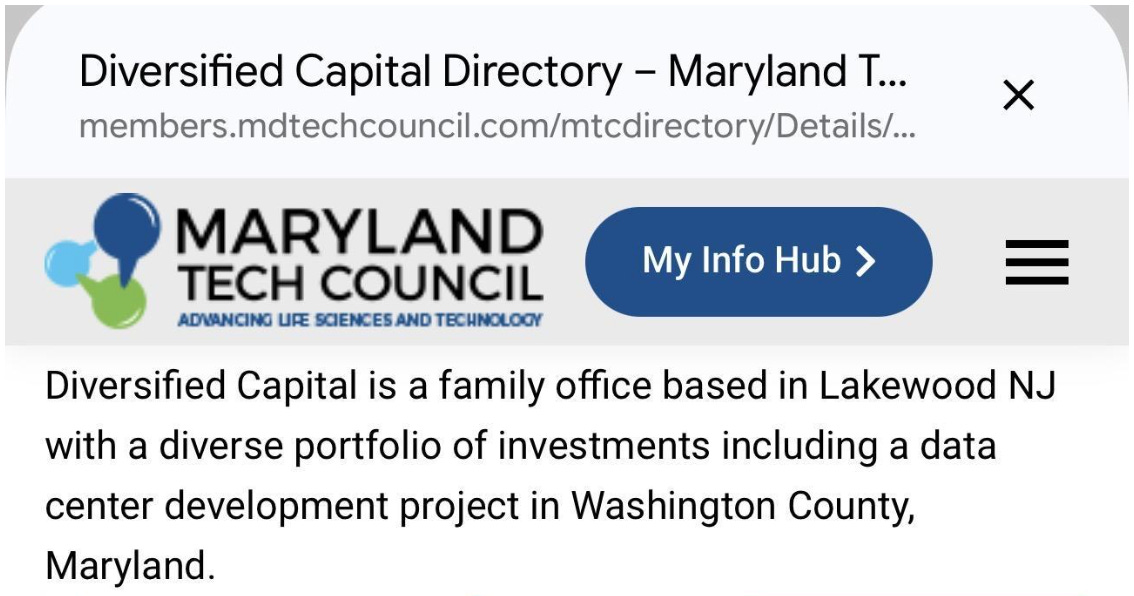
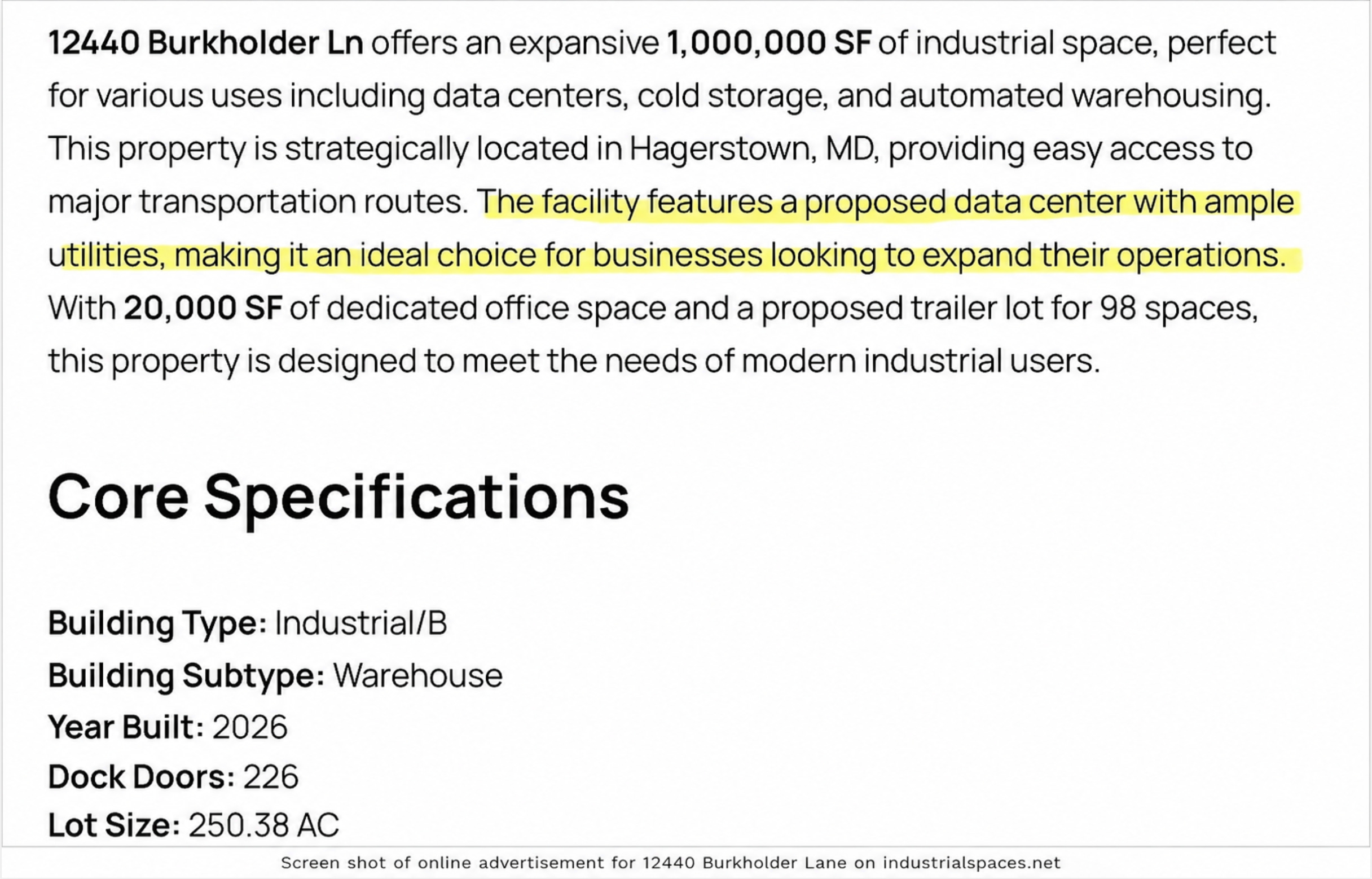
In an October 5 Herald-Mail interview, Diversified Capital’s CFO, Moshe Rubin, decided to play coy and pretend that a decision has not been made about whether the property his company is developing specifically for a data center is in fact going to be a data center. Laughably, Rubin wants the public to know it is “under serious consideration” but that no decisions have been made. This, of course, is coming from the CFO of a company which describes itself as having a “portfolio of investments including a data center development project in Washington Count, Maryland.”
confirmed that a data center is under serious consideration. Residents are being reassured with a county moratorium while a developer pursues annexation into a jurisdiction outside its reach.
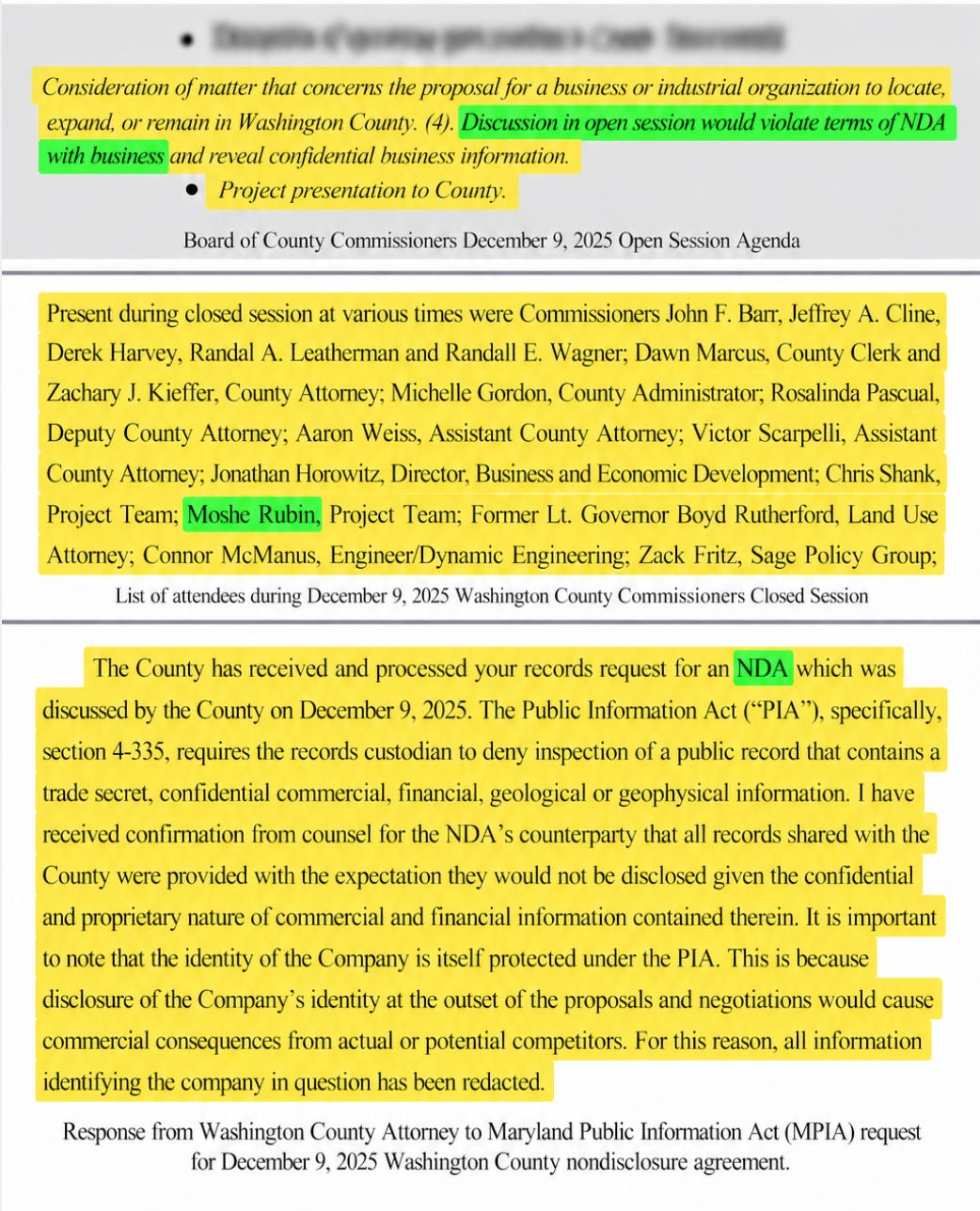
Cline has already met Rubin, but if the Herald-Mail is your only news source, you would not know this. As we previously reported - and informed Herald-Mail reporter Julie Greene about the day we reported it - Rubin donated $500 to Cline’s campaign in August of 2025 and then just a handful of months later was having a private land deal meeting with the Washington County Commissioners, County Administrator Michelle Gordon, Business Development Director Jonathan Horowitz (currently on Maryland’s Data Center Alliance Steering Committee), and Zack Fritz, COO of Sage Policy Group (a Baltimore-based, pro-data center consulting pushing for data centers in Maryland), the project’s land-use attorney and former Maryland Lieutenant Governor Boyd Rutherford, and others. And all are bound by an NDA.
Commissioner Jeff Cline apparently does not understand that water evaporates
Commissioner Jeff Cline says water consumption from data centers should be “recyclable, limited to prevent any shortfall in daily consumption and economic development.” After sixteen years in office, he has arrived at the position that we should use water without running out of it. Excellent. Now comes the part where someone asks how much water these projects will need, and the commissioner is expected to know something beyond his preference that there be enough.
The Environmental and Energy Study Institute reports that large data centers can consume up to five million gallons of water a day, while the World Economic Forum describes water reuse strategies that can reduce freshwater use by 50 to 70 percent. For illustration, if a facility otherwise needed five million gallons of freshwater a day and reduced that demand by 70 percent, it would still need 1.5 million gallons every day. If the city supplied all of that freshwater, that would be 1.5 million gallons a day from the public system, or roughly 548 million gallons a year. That is a hypothetical calculation, not a demand estimate for the proposed Hagerstown project. It does, however, demonstrate why “recyclable” is not an answer to “how much?”
Reusing water can reduce demand, but “closed-loop” does not mean the entire cooling system consumes no water. A sealed loop can operate alongside a separate evaporative cooling tower, as cooling equipment manufacturer Baltimore Aircoil explains. The Department of Energy explains why those towers need replacement water. Recirculating the water that remains does not bring back the water that evaporated. This is why a pot of boiling water does not refill itself, even if you stir it and tell it how many jobs the developer has promised.
If replacement water comes from Hagerstown’s public supply, how much will the project need each day? How much during a heat wave? What enforceable cap would protect existing customers? Cline’s answer provides none of those details. Asked how to protect the water supply, he essentially replied that the water supply should be protected. A resident could have submitted the same answer without attending a single developer presentation, signing an NDA, or spending sixteen years collecting a commissioner’s paycheck paid for with our tax dollars.
Hagerstown’s regional water system produces about 12 million gallons a day. If a large data center still needed 1.5 million gallons daily after recycling water, and drew all of it from the city’s supply, that single facility would add demand equal to 12.5% of the system’s average daily production. If serving it requires new pipes, pumps, or treatment upgrades and the developer does not cover the full cost, residents could face higher water bills while using exactly the same amount of water. And with county officials working to attract data centers, what happens when the next data center developer wants water too?
Just shove some electricity back into the grid or something
His electricity proposal is similarly unfinished. How much power would these enormous electricity consumers generate, how much would they return, and who would pay for the infrastructure needed to serve them? Cline supplies none of that. Apparently, “put some energy back” is supposed to reassure households worried about their bills without requiring him to explain how the numbers would work. Instead, he appears to be echoing the reassurance in Columbia Gas’s testimony supporting HB 1190: let these enormous electricity users obtain their own power, and everyone else’s bills will supposedly be fine. Columbia Gas proposes off-grid generation, while Cline wants electricity fed into the grid, but neither approach automatically protects household budgets.
Energy Innovation experts explain in Utility Dive that data centers running their own natural gas power plants still compete for the fuel used to heat homes and generate electricity, driving up both gas and electric bills. None of those costs or risks gets an explanation in Cline’s answer. He never explains how much electricity a data center would supply compared with what it consumes, when that power would be available, or who would pay for the necessary infrastructure. He simply suggests “no increase” as though residents can pay their utility bills with his assurances.
Now why would we need more water, Jeff?
Cline’s answer to another Herald-Mail question makes his assurances about water even harder to take seriously: What do you see as Washington County’s greatest need, and how would you address it as a commissioner?
Cline’s answer? “Public Safety, and infrastructure to include a plan for increased water allocation.“
Cline says water consumption from data centers should be “recyclable, limited to prevent any shortfall in daily consumption and economic development.” Then, answering another question, he names “a plan for increased water allocation” as one of Washington County’s greatest needs. What could possibly be driving that need, Jeff? Perhaps the enormous data centers you were just discussing? He seems perfectly capable of recognizing that the county will need more water to accommodate development. He just leaves that part out when assuring residents that recycling and limits will protect their supply.
Residents are supposed to be satisfied with “recyclable” while the county figures out how to provide more water for the businesses doing the consuming. His answer says nothing about how much water these projects would need, where it would come from, or who would pay to deliver it. Those are fairly basic questions for a commissioner who identifies increased water allocation as a county priority. Before he volunteers the county to help meet developers’ demand, he could at least explain what he expects the rest of us to spend on it.

The tax breaks and contracts were considerably more specific
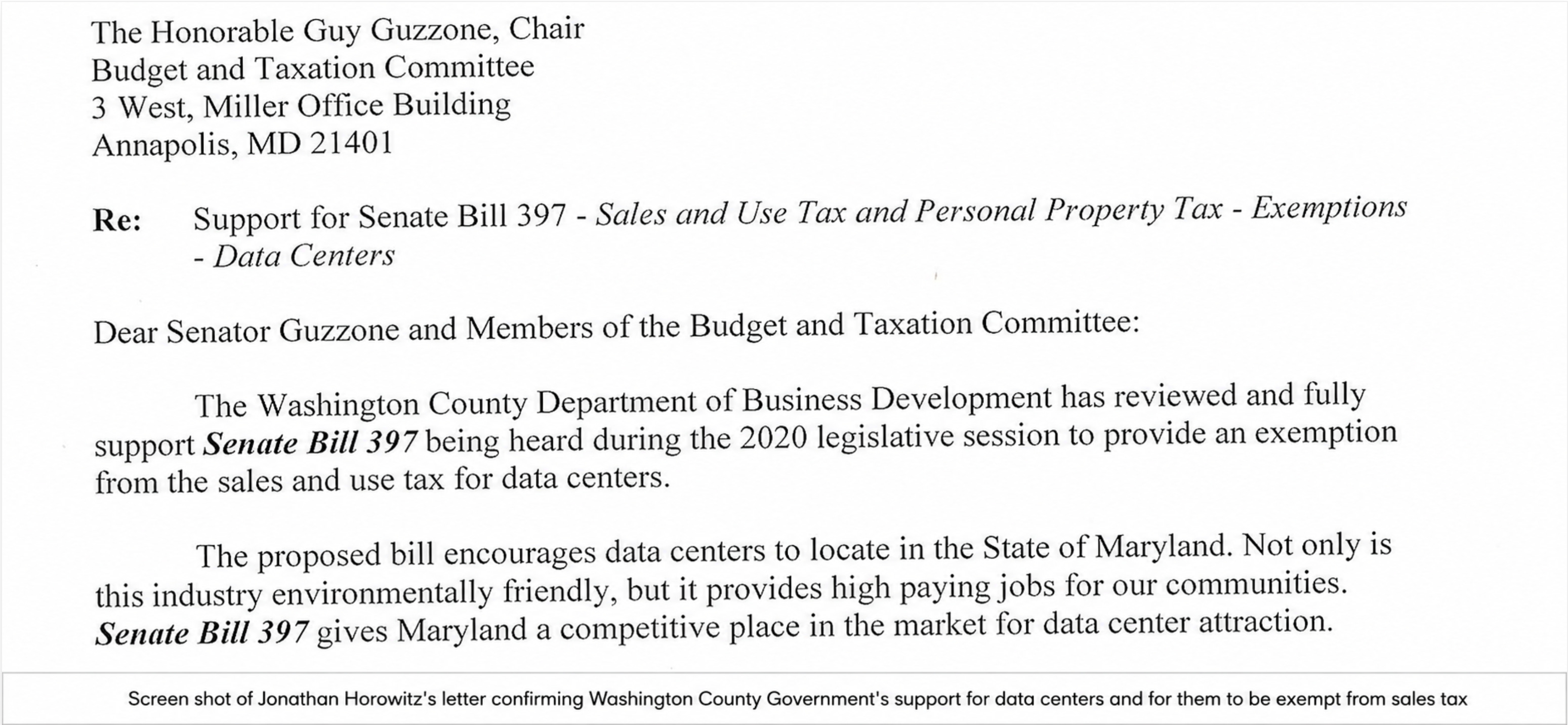
County officials have shown considerably more initiative when developers stand to benefit. In 2020, Horowitz submitted Washington County’s support for SB 397, legislation offering tax incentives specifically to attract data centers. The Commissioners then backed SB 698 in 2025 and SB 193 in 2026, seeking a decade of sales and use tax exemptions for qualifying purchases at Mount Aetna Technology Park, where data center brokers had been asking about land and utilities. The enacted law includes computer systems and equipment, and Cline participated in the Commissioners’ 4–0 ratification of their support letter. They were perfectly capable of putting specifics on paper when asking Annapolis for tax relief.
Then there is their Commissioner Cline’s childhood buddy, Greg Murray, the former County Administrator. On May 21, Cline and John Barr voted to give Murray’s firm, GDMS, a no-bid consulting contract to assess the County’s water and sewer service areas and help address infrastructure problems. The official minutes show Cline made the motion, the contract passed 3–2, and payment would come from the water and sewer fund. How awfully convenient: developers need utility capacity, and their old friend gets a paid assignment examining the infrastructure.
Asked whether public comment should return to Commissioners’ meetings, Cline would not even give residents a straightforward yes. He answered with conditions about decorum. Developers get private presentations, tax incentives, and infrastructure attention; residents get instructions on how to behave if they are allowed to speak again. After sixteen years, Cline ought to have a better explanation of whom all this is supposed to serve. His interview gives us recycled assurances, but the money, meetings, and contracts give us a much clearer answer.
NDA’s need to be illegal when it comes to deals businesses make with local governments.
We the people are the government and have every right to know how our money, resources, and land are being used.
It’s crazy to think that this current Board of County Commissioners have probably been getting away with backdoor deals for DECADES. It ends in 2026.