



We started with two campaign refunds. What we found was a much bigger story. On June 12, 2026, Washington County Commissioner Jeff Cline returned $500 to Moshe Rubin and $250 to Chris Shank, nearly ten months after both men had contributed to his campaign. Cline’s campaign gave the same explanation for each refund: “Candidate decided to decline contribution.”
That would be interesting on its own. It gets a lot more interesting when you learn that Rubin and Shank later sat across from Cline and the other Washington County Commissioners as members of the same confidential “Project Team,” pitching a development project the County still has not publicly identified.
And that is where this starts to get quite interesting.
The December 9 Closed Meeting
Earlier this year, we reported that on December 9, 2025, Washington County Commissioners went behind closed doors for a project presentation involving a secret land project. The public was locked out and the Commissioners signed nondisclosure agreements covering the project. Just one week later, the official meeting records show the Washington County Board of County Commissioners then entered another closed session to discuss the acquisition of property.
We filed a Maryland Public Information Act (MPIA) request to get the NDA signed by the County Commissioners, only to receive an unhelpful, redacted version. But the County’s own meeting minutes tell us who was in the room, even if they still refuse to tell us exactly what was being pitched. Along with every County Commissioner, County Administrator Michelle Gordon, and Jonathan Horowitz, the County Business and Development Director, the closed-door presentation included:
Moshe Rubin, COO of Diversified Capital, a New Jersey-based commercial real estate investment and management company that says it invests in “localized data center development initiatives.” Washington County planning records identify Diversified Capital as the developer behind the Martin Farm/Burkholder Lane project at 12440 Burkholder Lane. The County minutes identify Rubin as part of the “Project Team.”
Chris Shank, a former Washington County state senator and Hogan administration official with extensive lobbying and government-relations experience. The County minutes also identify Shank as part of the “Project Team.”
Former Maryland Lt. Gov. Boyd Rutherford, now an attorney with Davis, Agnor, Rapaport & Skalny (DARS). The County identifies Rutherford as the project’s land-use attorney.
Connor McManus, a civil engineer with Dynamic Engineering, a land-development consulting firm with data center experience. Dynamic Engineering also worked with Diversified Capital on the Martin Farm/Burkholder Lane project.
Zack Fritz, COO of Sage Policy Group, a Baltimore economic and policy consulting firm that has produced multiple studies making the economic case for data center development in Maryland.
At the time of the secret December, 2025 meeting, Cline’s campaign had already been holding Moshe Rubin’s $500 contribution and Chris Shank’s $250 contribution for more than three months.
Who Is Chris Shank?
Chris Shank previously represented Washington County in the Maryland Senate and later served in senior roles in Governor Larry Hogan’s administration, including chief legislative officer and deputy chief of staff. In other words, he knows how government works, who makes decisions, and how to move an issue through the political process. His appearance as part of the confidential “Project Team” makes this look a lot less like a routine warehouse presentation and a lot more like a serious government-relations effort.
Moshe Rubin and Diversified Capital
Commissioner Cline’s campaign finance report supplied an especially useful clue about the importance of Moshe Rubin in all of this, listing his occupation as “Real Estate Investment” and his employer as Diversified Capital.
Diversified Capital was not difficult to connect to Washington County. The company was already tied to one of the County’s biggest industrial development proposals.
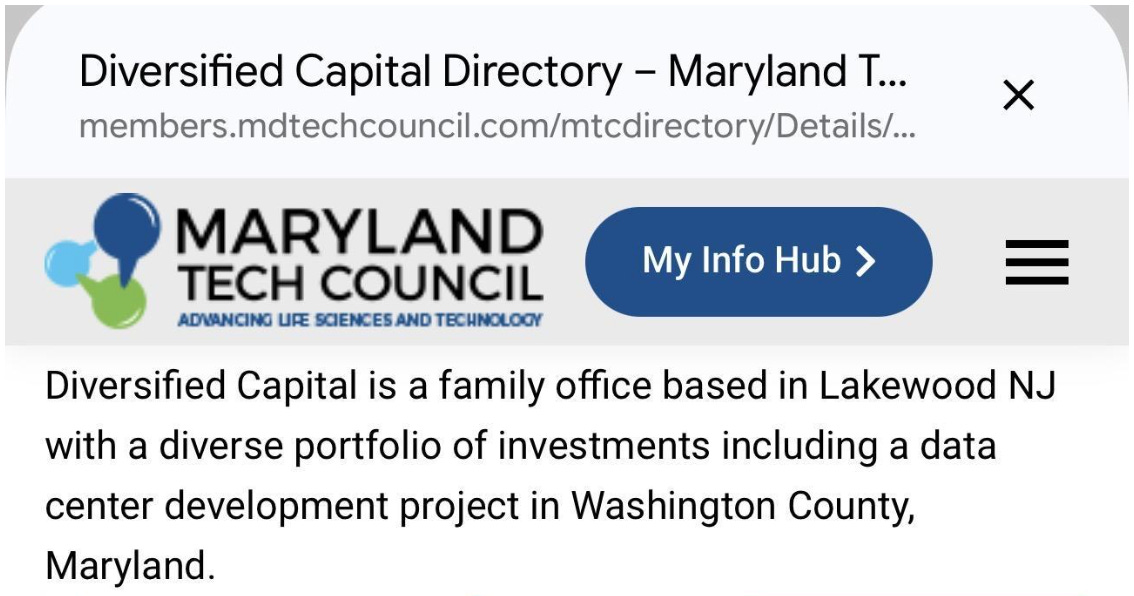
Washington County planning records identify Diversified Capital as the developer of the Martin Farm/Burkholder Lane project at 12440 Burkholder Lane in Hagerstown. The proposal involved roughly 242 acres of Planned Industrial land and about one million square feet of development. More importantly, Diversified Capital’s own public profile describes the firm as a Lakewood, New Jersey family office with a portfolio that includes a “data center development project in Washington County, Maryland.”
Zack Fritz and Sage Policy Group
Then there is Zack Fritz. His presence becomes much more interesting once you look at what Sage Policy Group had been doing just a few months before the secret meeting.
Washington County’s minutes identify Fritz, Sage Policy Group’s chief operating officer, as present during the confidential presentation with the Commissioners, Rubin, Shank, Rutherford, and McManus. The County labels Rubin and Shank as the “Project Team,” Rutherford as the land-use attorney and McManus as the engineer. It says nothing about why Sage was there.
Sage Policy Group is a Baltimore-based economic and policy consulting firm specializing in economic-impact studies, economic development, forecasting and legislative analysis. Just four months before Fritz appeared in Washington County’s secret presentation, Sage prepared a strongly pro-data center economic report for the Maryland Tech Council, the same organization whose directory says Diversified Capital has a data center development project in Washington County.
The report says Maryland “cannot afford to sit on the sidelines” while other states compete for data center investment and argues that Maryland should welcome responsible data center development before the opportunity goes elsewhere.
According to the Sage report, data centers are attractive to governments because they generate large amounts of tax revenue while using relatively few public services. The report describes them as requiring “exceedingly few government services,” producing little traffic and waste, placing relatively low demands on emergency services, and requiring minimal public infrastructure beyond electricity and internet connectivity.
That sales pitch is especially interesting in Washington County, given the county’s recent data center moratorium ordinance, which cites enormous electricity demands, substantial water use, strain on utility infrastructure, noise from cooling systems and generators, impacts on roads and public facilities, hazardous materials, electronic waste, and effects on nearby residential and agricultural properties.
So the economic consultant sitting in Washington County’s secret December meeting worked for a firm that had recently been making the statewide case for the very industry Washington County would soon say needed to be paused while its impacts were studied. Funny how much a data center can change depending on whether you are writing the sales brochure or the zoning ordinance.
Sage’s data center work was not limited to that statewide report. It also prepared studies for the Maryland Tech Council on the Quantum Frederick data center project and the economic and fiscal impacts of data centers in Prince George’s County.
What Was Former Lt. Gov. Boyd Rutherford Doing There?
Another person in the room deserves a closer look: former Maryland Lt. Gov. Boyd Rutherford.
Washington County’s records identify Rutherford as the project’s “Land Use Attorney.” He was sitting with Cline and the rest of the Board of County Commissioners, Rubin and Shank from the confidential Project Team, McManus from Dynamic Engineering, and Fritz from Sage Policy Group.
After leaving office, Rutherford joined Davis, Agnor, Rapaport & Skalny (DARS), where his work includes government relations, lobbying, government contracting and real estate. The firm describes his role as helping clients navigate the “crossroads of politics, government and law” and work with elected officials, appointed officials and regulatory agencies.
That makes the “Land Use Attorney” label worth paying attention to. DARS represents developers and investors through property acquisition, land-use planning, zoning, rezoning, permitting, development agreements and other approvals. Put another way, this was not a room full of people casually brainstorming what to do with an empty field.
Boyd Rutherford’s Support for Data Centers Goes Back Years
Boyd Rutherford’s appearance as the land-use attorney in Washington County’s secret December 9 presentation is even more interesting when you look at his record while he was Maryland’s lieutenant governor.
Rutherford was part of the Hogan administration when Maryland made a deliberate push to become more competitive for data center development. In February 2020, the Maryland Department of Commerce submitted official testimony supporting Senate Bill 397, legislation designed specifically to lure data centers to Maryland with major tax incentives. The testimony is issued on Department of Commerce letterhead identifying Larry Hogan as Governor, Boyd Rutherford as Lieutenant Governor, and Kelly Schulz as Secretary of Commerce.
SB 397 offered qualifying data centers a 10-year exemption from Maryland sales and use taxes on equipment and allowed counties and municipalities to reduce or eliminate business personal property taxes on qualifying data center equipment. Commerce’s explanation was refreshingly straightforward: Maryland needed the incentives because data center operators were shopping between states, and jurisdictions offering tax breaks were more attractive places to build.
The Hogan-Rutherford administration was not talking about data centers as something Maryland should merely tolerate. Commerce said the state should compete to attract a significant portion of the industry, specifically pointing to Maryland’s proximity to Northern Virginia’s enormous data center market as a selling point. The testimony concluded that the legislation would provide “a foundation for Maryland counties to build upon” and said the Department of Commerce looked forward to working with interested counties to attract these businesses and jobs.
Five years later, Rutherford turns up in a closed Washington County development meeting, this time not as lieutenant governor but as the project’s land-use attorney, sitting alongside a Diversified Capital executive whose company says it has a data center development project in Washington County, an engineer already connected to the Martin Farm project, and an economic consultant whose firm was actively promoting data center development across Maryland.
Jonathan Horowitz and Washington County Business Development
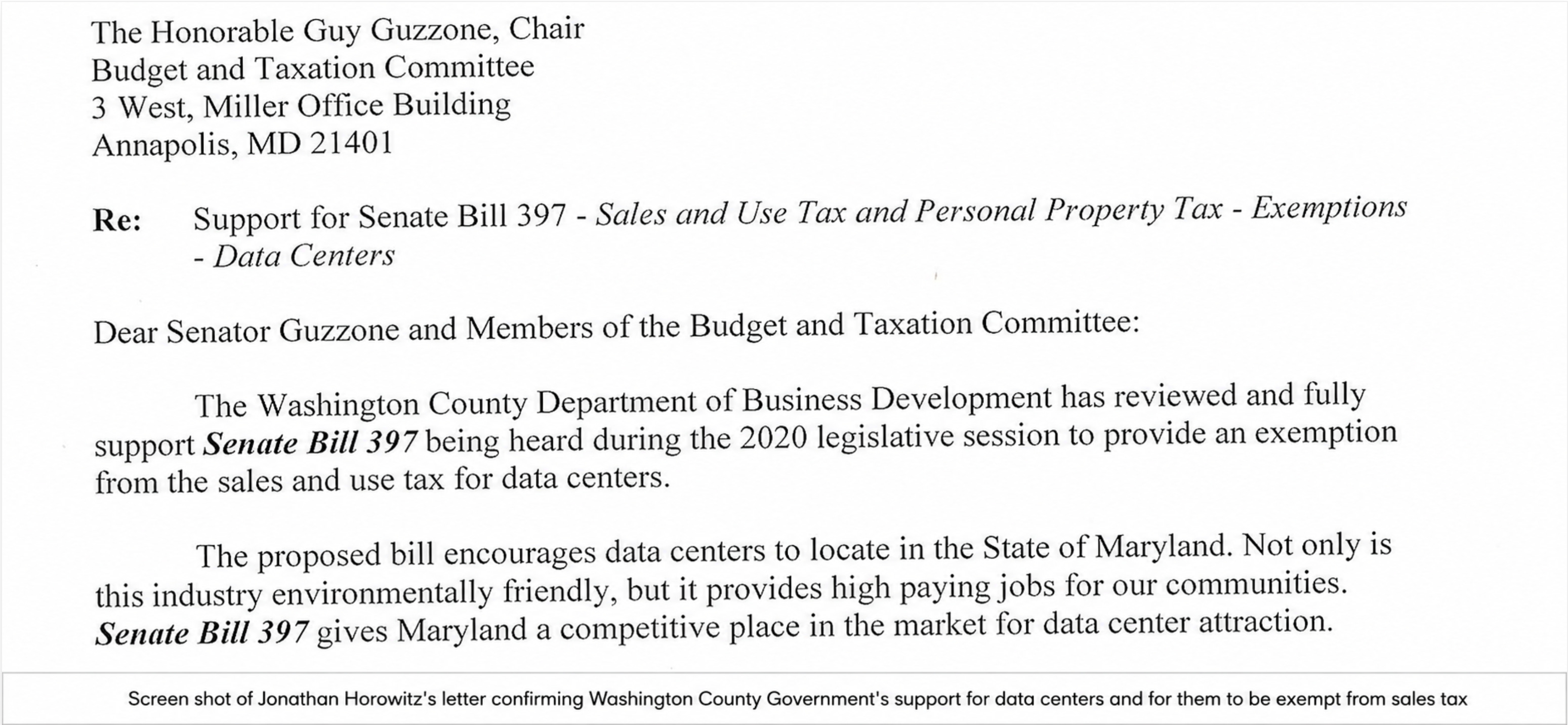
Washington County Business Development Director, Jonathan Horowitz, has been promoting data center development for years. On February 4, 2020, on behalf of the County’s Business Development department, Horowitz sent the Maryland Senate Budget and Taxation Committee a letter saying Washington County “fully support [sic] Senate Bill 397” because it would encourage data centers to locate in Maryland by exempting them from both sales and property taxes. Horowitz wrote that the bill would give Maryland “a competitive place in the market for data center attraction.”
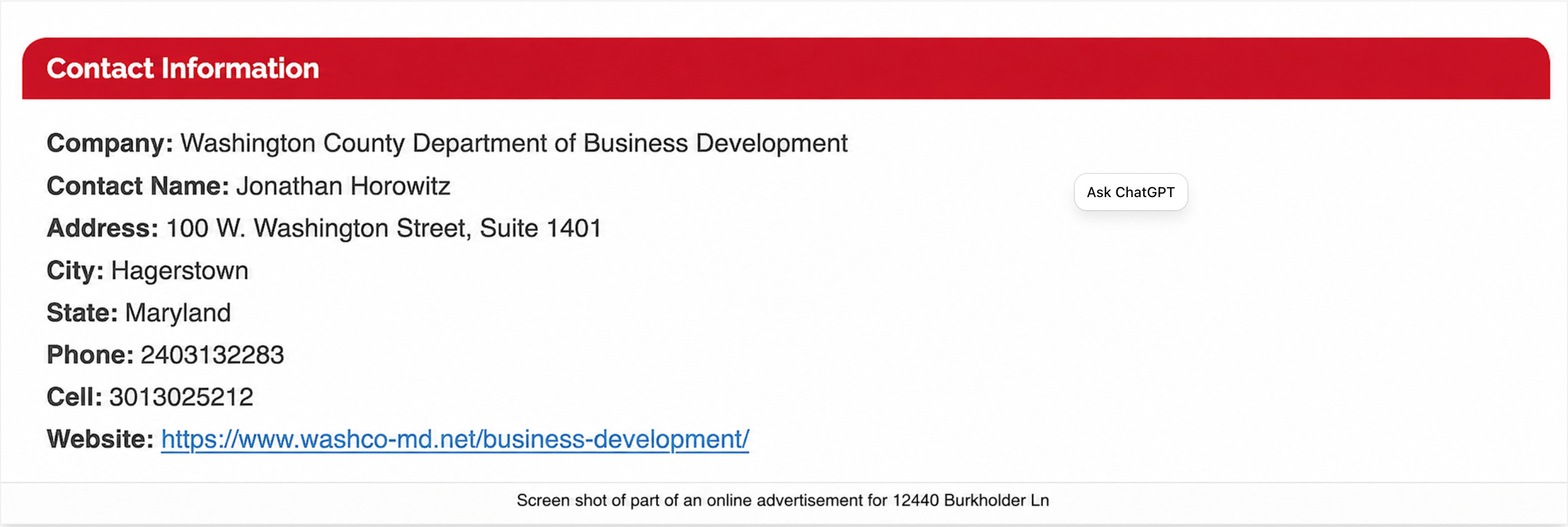
Fast-forward to the Martin Farm property. Horowitz is listed as a Washington County Business Development contact on sales brochures for the property. The brochure does not just list a generic County office. It lists both Horowitz’s office number and cell number, indicating that Washington County was not exactly keeping its hands off the marketing effort.
Martin Farm Was Being Marketed for Data Centers
Washington County planning records originally described the Burkholder Lane proposal as a warehouse project, but the people marketing the property clearly had a wider menu in mind.
A commercial real estate listing posted in June 2024 advertised 12440 Burkholder Lane as “Ideal for Data Center.” A later January 2025 listing described the proposed million-square-foot facility as suitable for automated warehousing, cold storage, e-commerce distribution, and data centers.
The marketing materials also highlighted electrical power, city water, and city sewer, three things a large data center tends to care quite a bit about.
And the pitch did not stop there. Multiple websites have marketed the property as suitable for data centers, with one description saying the facility features a “proposed data center with ample utilities.”
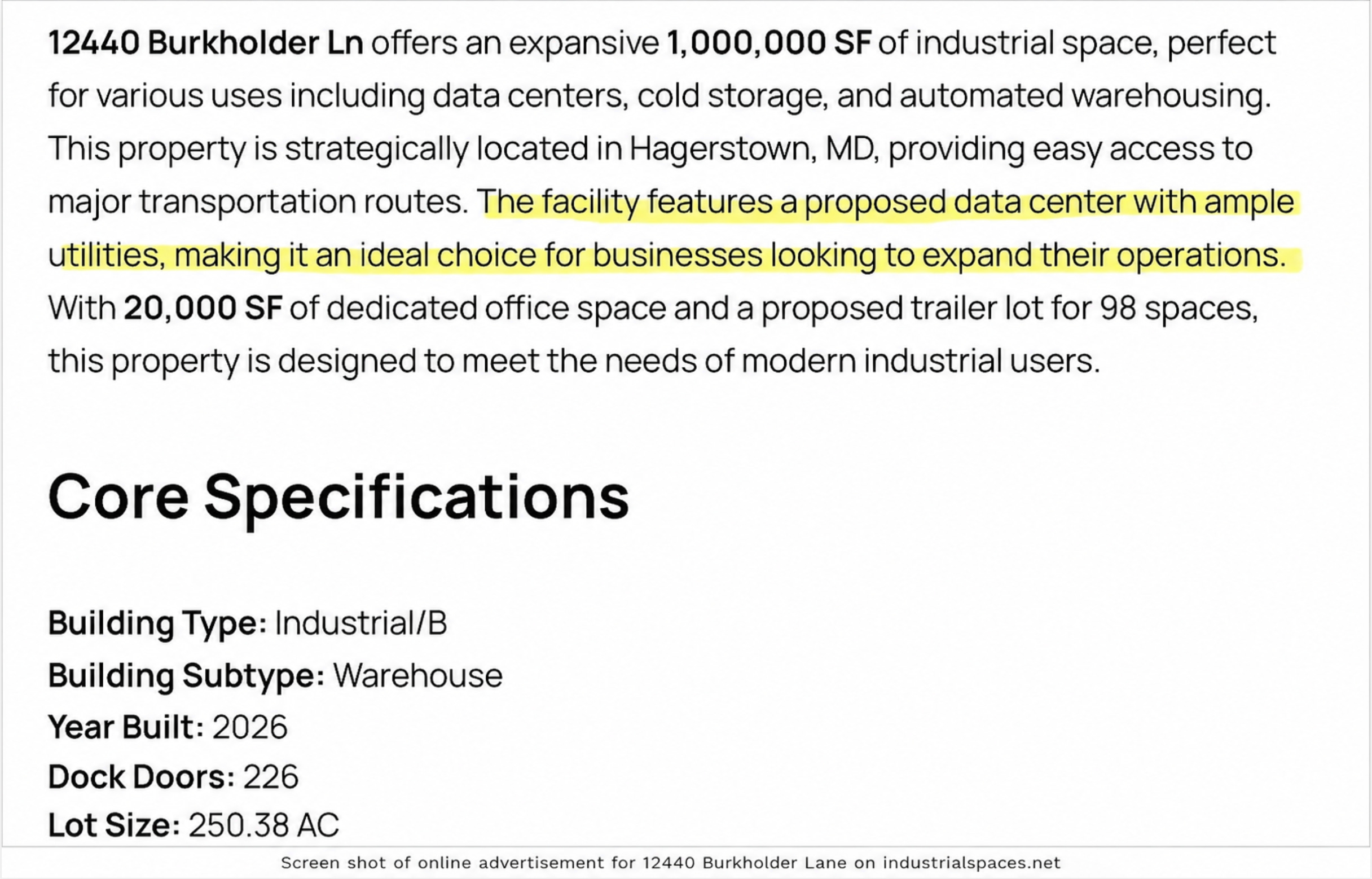
So before Rubin ever appeared in the confidential meeting, the massive industrial property connected to his employer was already being marketed for data center development. That does not prove the December 9 presentation was about the Martin Farm, but it does make the overlap awfully hard to ignore.
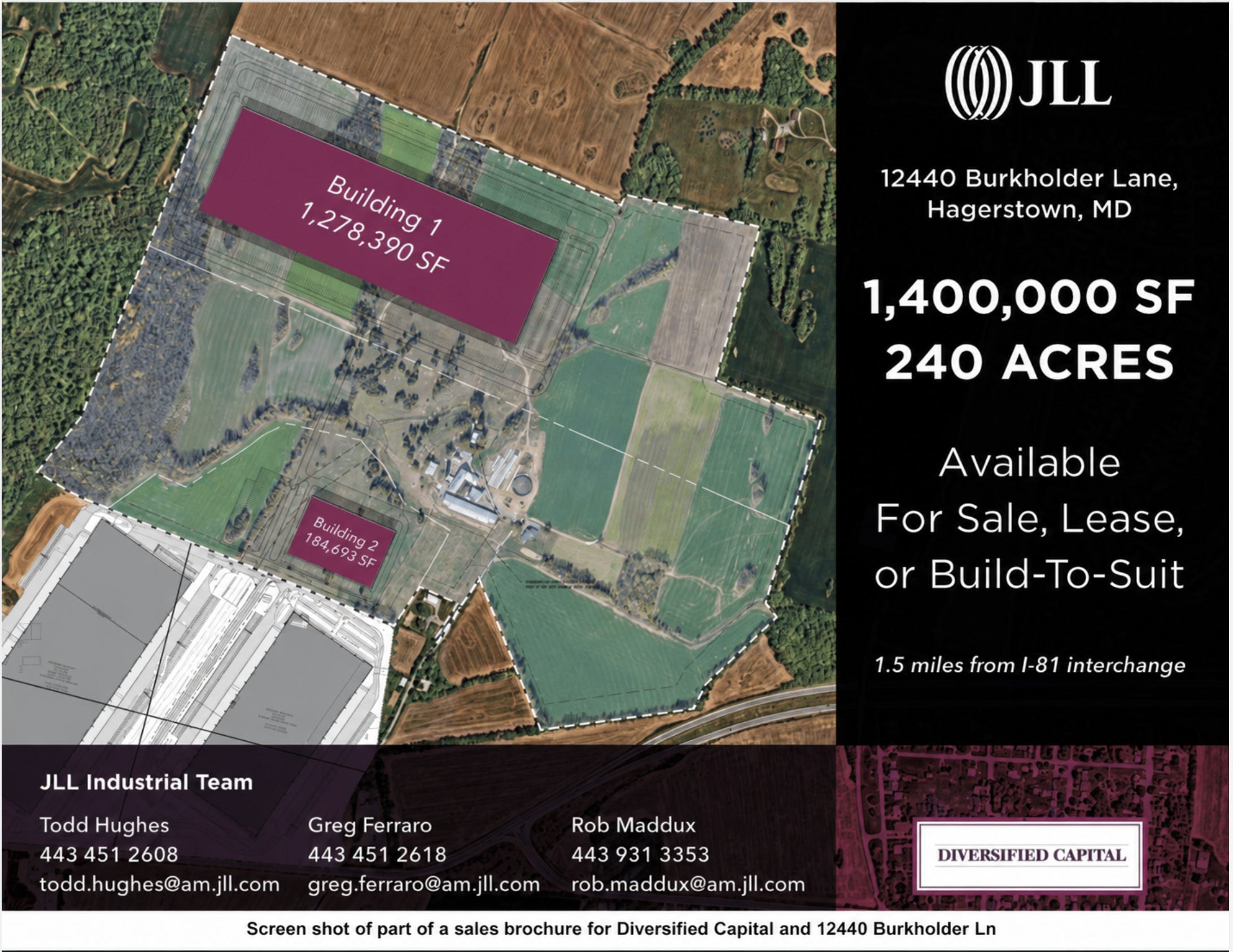
And Now the Property Is Conveniently Being Annexed Into Hagerstown
The Burkholder Lane property is also caught up in an annexation moving through the City of Hagerstown, and that matters because Washington County currently has a moratorium on new data center applications. Hagerstown does not.
Property records show that Lawayne Martin sold 12440 Burkholder Lane to Burkholder Lane Acquisitions LLC for $2.231 million in 2023. County planning records identify that same address as the Martin Property where Diversified Capital pursued the million-square-foot industrial development. Burkholder Lane Acquisitions LLC is now seeking annexation into Hagerstown as part of the Burkholder-McDade annexation, which covers nearly 172 acres of mostly undeveloped industrial land.
Why does that matter? Washington County’s Commissioners adopted a 12-month moratorium that prevents the County from accepting, processing, reviewing or approving new data center applications conveniently until after November election. Hagerstown has its own zoning and permitting authority, so land annexed into Hagerstown could fall outside the reach of Washington County’s data center moratorium.
The timeline for all of this deserves scrutiny. Diversified Capital was behind the original Martin Farm development. Connor McManus and Dynamic Engineering worked on it. Rubin and McManus later appeared together in the December 9 confidential presentation. Washington County then imposed a moratorium on new data center applications. Now land connected to the Burkholder project is being annexed into a jurisdiction where that County moratorium would not apply.
There are still facts we need to pin down, including exactly which portions of the original roughly 242-acre Martin property are included in the approximately 172-acre annexation, when annexation discussions began and whether Washington County officials participated in those discussions.
Most importantly, we want to know whether a data center has been discussed as part of the current plans for this property and whether the County moratorium ever came up in conversations between the developer, Washington County and the City of Hagerstown.
These are not complicated questions and someone involved should be able to answer them.
Why Did Washington County Commissioner Jeff Cline Return Shank and Rubin’s Money While the County Was Preparing a Data Center Moratorium?
Now we get back to those campaign refunds, because the timing is hard to miss.
On June 12, 2026, Cline returned $500 to Moshe Rubin and $250 to Chris Shank. Both contributions had been made on August 25, 2025. Both men later appeared before Cline as members of the confidential Project Team on December 9.
And Cline returned the money while Washington County was preparing to temporarily stop new data center applications.
We learned about the proposed moratorium while reviewing County records ahead of the Commissioners’ June 30 meeting. Buried in the agenda packet was a public hearing and a three-page draft ordinance explaining why the County believed data centers posed enough of a problem to justify refusing new applications while officials studied the issue.
We published the draft ordinance on June 18 because almost nobody knew this was happening. For a policy with enormous consequences for development in Washington County, the County had done remarkably little to make sure the public noticed. And the ordinance is especially revealing now because of the County’s own description of data centers.
Washington County called them “high energy consumers, significant noise generators and substantial water users.” The County raised concerns about electricity demand, strain on utility infrastructure, cooling water, generator and cooling-system noise, hazardous materials, electronic waste, roads, public facilities and impacts on nearby homes and farms, and thus enacted to implement a one-year moratorium on data centers in the county.
This is a strikingly different response from the one residents got over the ICE detention center. For months, residents raised concerns about water, wastewater, roads, emergency services and environmental impacts from a detention facility designed for as many as 1,500 people. The Commissioners would not pause that project. With data centers, suddenly hitting the brakes was considered prudent government.
Which raises a pretty obvious question: what scared them?
There was no publicly announced data center proposal before the Commissioners. Yet County officials had already reached the point of drafting legislation to stop new applications while they figured out what rules they needed.
When we first found the moratorium, we did not yet have Rubin’s contribution in front of us. We had not connected Rubin to Diversified Capital, Diversified Capital to Martin Farm, or Martin Farm to the listings advertising the site as “Ideal for Data Center.”
Now put the dates in order.
August 25, 2025: Rubin and Shank each contribute to Jeff Cline’s campaign.
December 9, 2025: Rubin and Shank appear before Cline as members of the same confidential Project Team. Connor McManus of Dynamic Engineering is there too. McManus had already represented the Diversified Capital-backed Martin Farm project.
June 12, 2026: Cline returns both contributions.
June 18, 2026: we publish the County’s proposed data center moratorium.
June 30, 2026: the Commissioners hold the public hearing. County staff say even the proposed six-month pause is not enough and recommend 18 months. The Commissioners ultimately approve a 12-month moratorium. And strangely, on the same day, the owners of the Martin Farm also filed a petition for the farm to be annexed by the city of Hagerstown.
So why June 12?
Cline held Rubin’s money for almost ten months. He kept it for roughly six months after Rubin appeared before him as part of a secret development team. Then, while the County was preparing legislation aimed specifically at data centers, he decided he no longer wanted Rubin’s contribution. On the very same day, he returned Shank’s money too. Maybe there is a perfectly innocent explanation. If so, Cline should have no trouble providing it.
The records that could answer this are obvious. When was the moratorium first discussed internally? Who asked the County Attorney to draft it? When did Commissioners receive the first draft? What prompted the County to believe a moratorium was necessary? Had anyone approached County officials about a data center? Was Martin Farm or Burkholder Lane part of those discussions?
Those questions matter even more because land tied to the Burkholder project is now moving toward annexation into Hagerstown, where Washington County’s moratorium would not control the zoning.
Washington County needs to explain what prompted the moratorium, what Cline knew when he returned the contributions and what Rubin, Shank and the rest of that December development team were pitching behind closed doors.
Commissioner Cline’s campaign was holding money from two members of the Project Team while that December, 2025 secret land development meeting happened. Six months later, while the County was preparing a moratorium aimed at data centers, he returned both contributions on the same day. The relevant question is no longer whether Cline crossed paths with this development team. He did. The question is what he knew, when he knew it and why the money suddenly became unacceptable.
There’s Still One Big Missing Piece
We still want to know exactly what Rubin, Shank, Rutherford, McManus, and Sage Policy Group were pitching to Washington County on December 9.
If the secret presentation concerned Diversified Capital’s Washington County data center project, then Commissioners were privately hearing about a data center months before the public learned the County believed the industry posed enough risk to justify a moratorium.
If it was unrelated, that raises another question: What other Washington County development project was important enough to bring this particular group together behind an NDA?
Either way, the public still does not know what was being discussed in that room. And Washington County officials have not explained why it needed to be kept secret.
A note to other news outlets: You’re welcome to republish this reporting. We just ask that you credit Kyle McCarthy and Laura Spivak as the original authors and include a link back to this article.
Good investigating reporting
Great reporting. Isn't this the same property where we were initially concerned about an ICE facility? 😕