



There is a difference between protecting sensitive information and deliberately keeping the public in the dark. What we have uncovered in Washington County could point squarely to the latter.
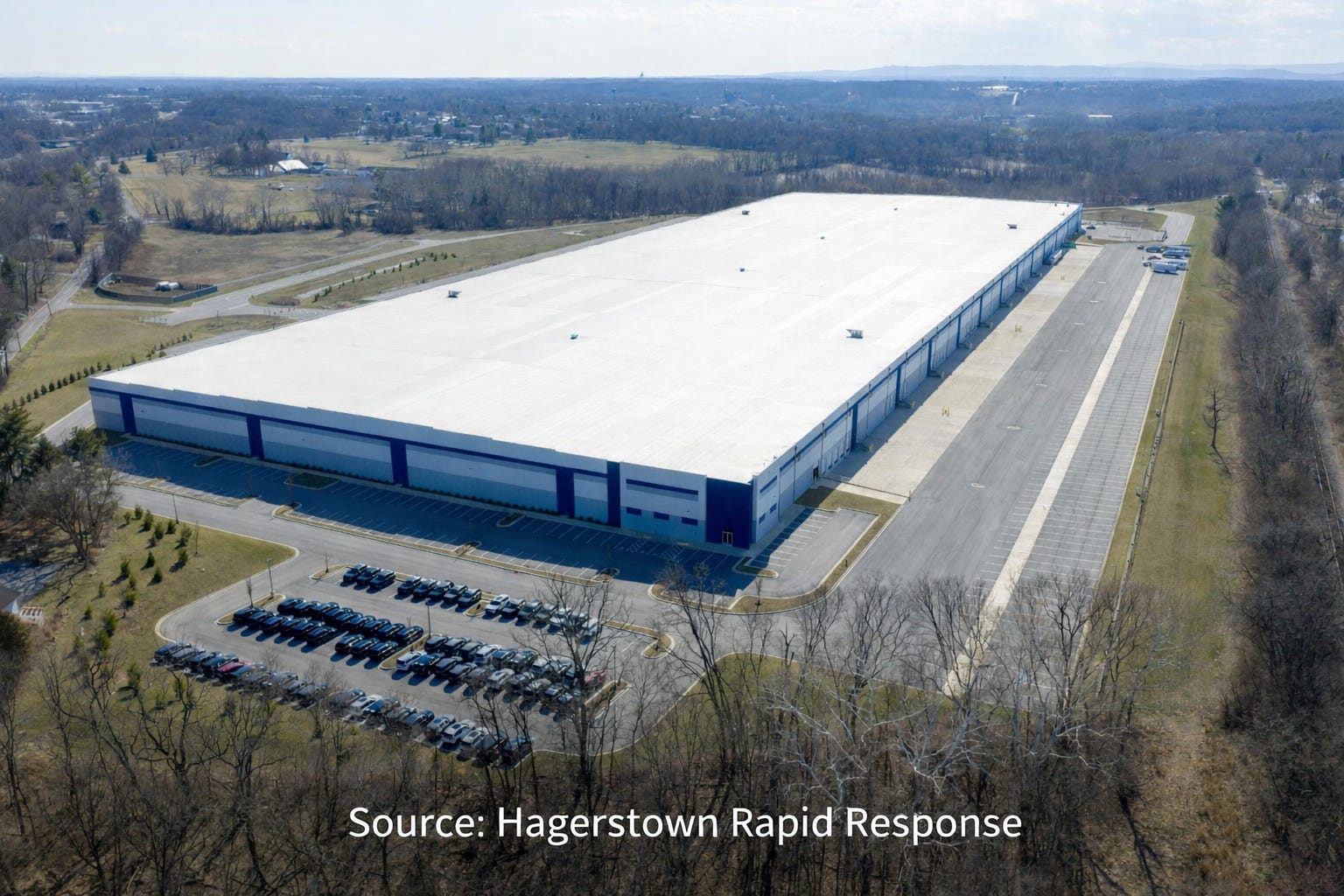
Based on a review of official county documents and meeting records, we have discovered that the Washington County Board of County Commissioners (BOCC) signed a non-disclosure agreement (NDA) in early December tied to a confidential land project. While there is not yet evidence regarding which project the NDAs covered, the timeline of the now-public plan by the Department of Homeland Security to acquire a warehouse near Hagerstown for use as an ICE detention facility aligns with these NDAs.
This raises the obvious question: did The BOCC gag themselves in order to keep the public in the dark about this deeply unpopular project?
The Timeline
On October 28, 2025, property records show that FRIND-Hopewell, LLC, a subsidiary of Fundrise, took on a new $352.7 million first-position mortgage, replacing an earlier $95 million loan. This kind of large-scale refinancing typically signals that a major transaction is imminent.

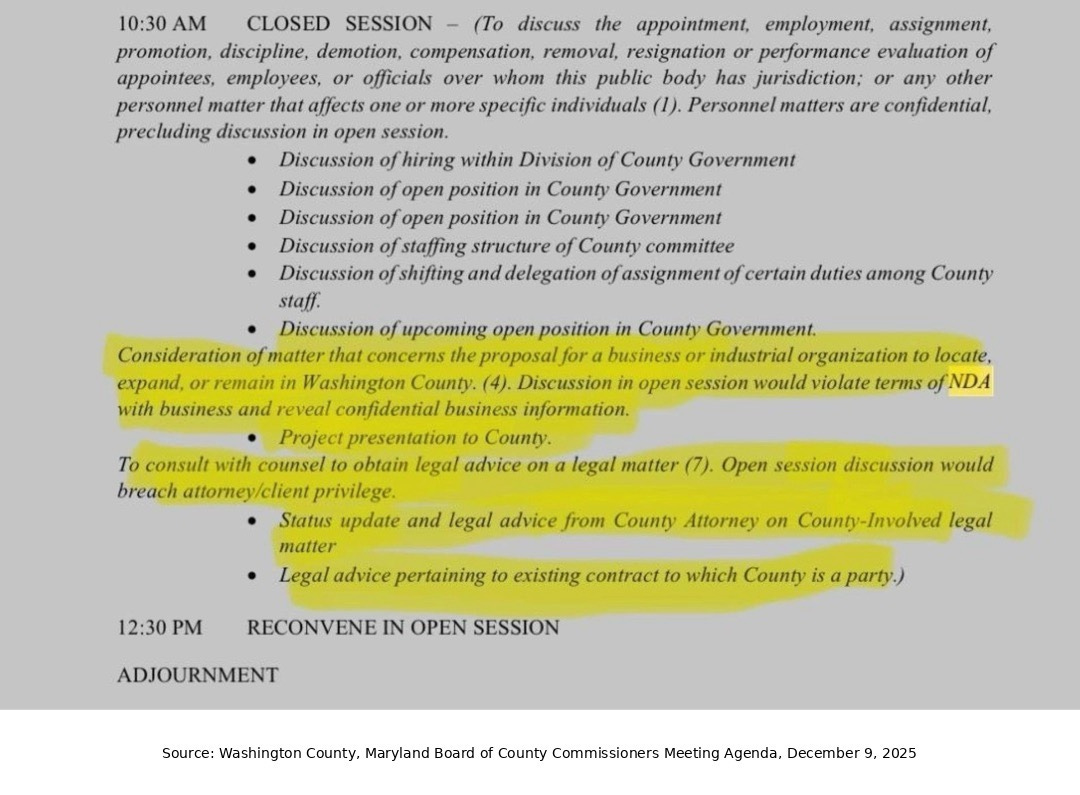
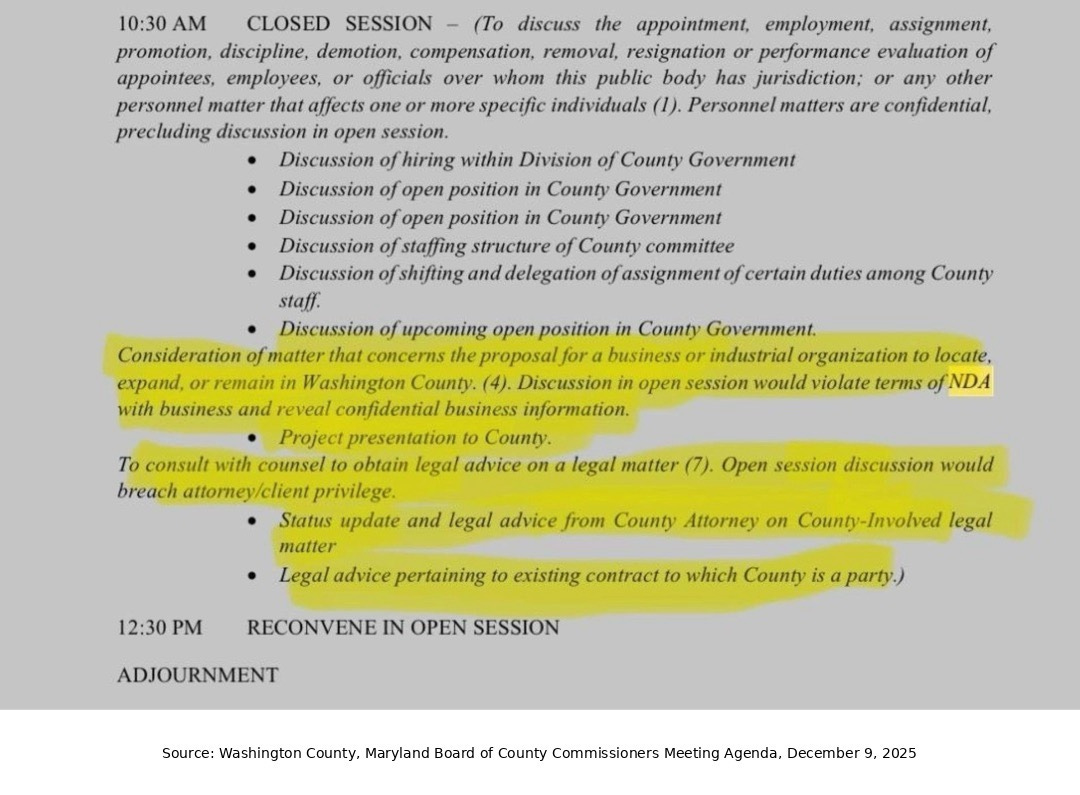
On December 9, according to the county’s official agenda packet, commissioners were presented with a confidential project under a signed NDA. This is the inflection point. The Washington County Commissioners did not just receive information. They agreed, in writing, to keep it secret.
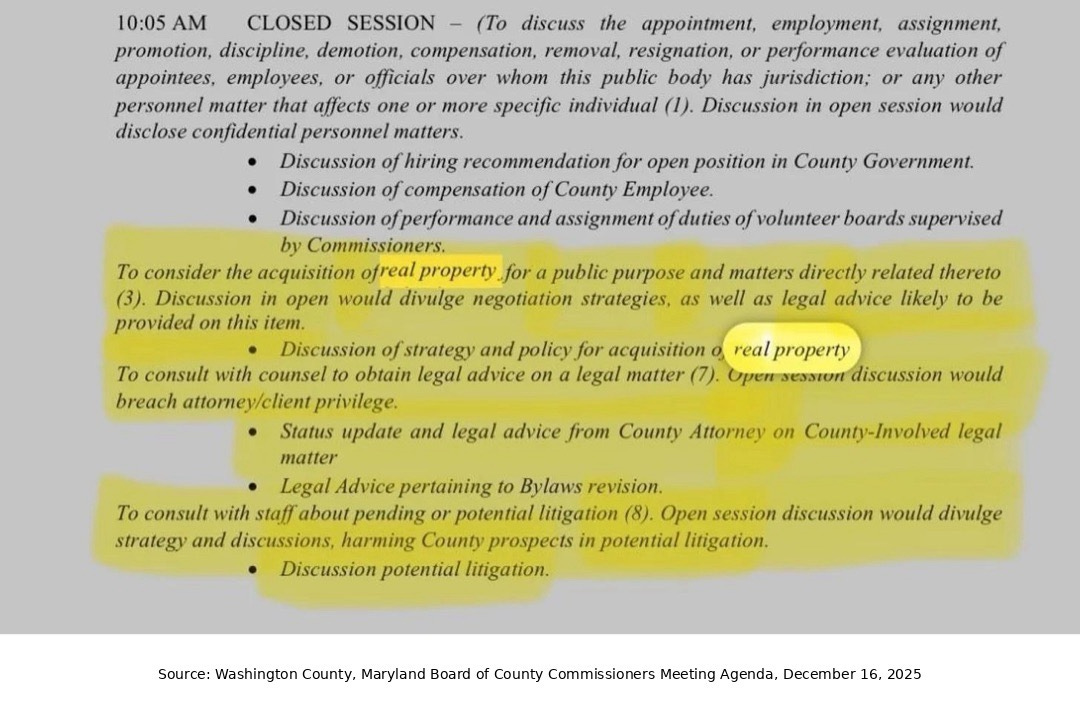
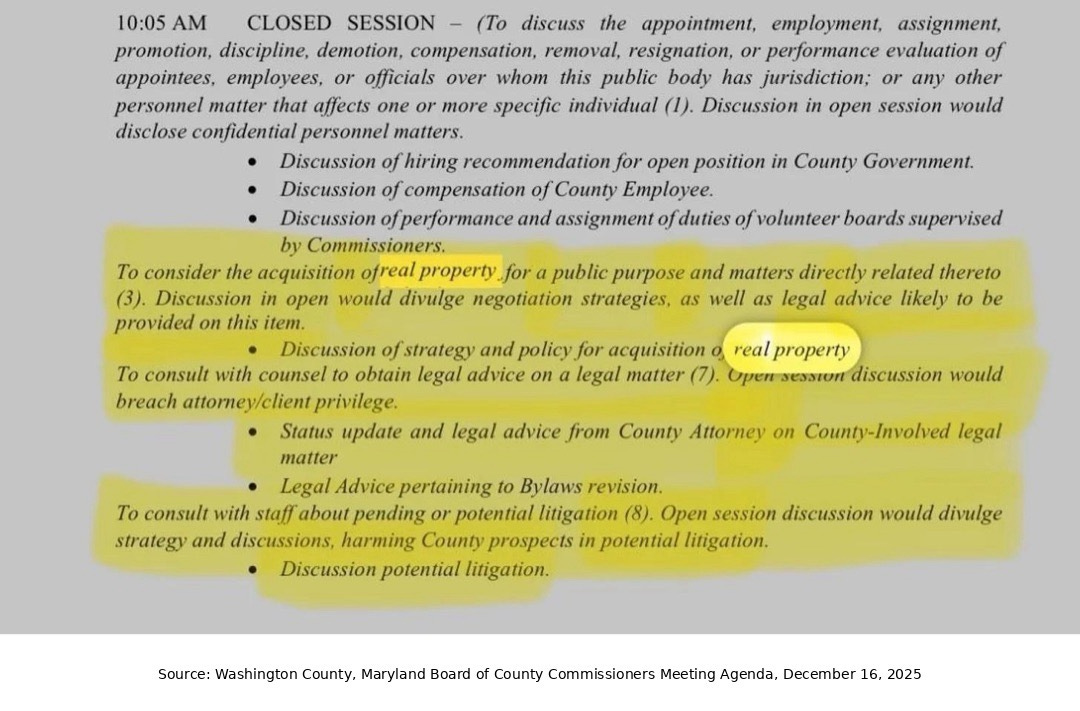
On December 16, the official meeting records show the Washington County Board of County Commissioners entered a closed session to discuss the acquisition of property. This meeting occurred just one week after signing the NDA. The public was still completely in the dark. Strangely, this page with the December 16, 2025 meeting minutes was recently removed from the Washington County website, but luckily, a copy of it was found here.
Then, on December 22, Representative April McClain Delaney publicly reversed her position on the Laken Riley Act, which she had previously supported. At the time, the reversal appeared sudden and unexplained. Though not a part of the Washington County Board of County Commissioners, the timing of her sudden reversal of her position is certainly interesting. In light of this timeline, it raises the question, did Delaney reverse her position because she caught wind that DHS had planned to purchase a warehouse in her district with the intention of turning it into an ICE processing facility?
Two days later, on December 24, the Washington Post reported that DHS was planning to purchase a warehouse in Hagerstown for use as an immigration processing facility.
On January 16, 2026, DHS completed the purchase of the 825,000 square foot industrial warehouse with the intention of converting it into a 1,500-bed ICE processing facility.

The timeline shows that there may have been a deal already in motion before the public knew anything.
The most straightforward explanation is also the most concerning: Washington County officials knew in mid-December that this project involved DHS and an ICE detention facility, and they had already agreed not to disclose it.
It would explain why basic questions from residents have gone unanswered. It would explain the delays and resistance surrounding Maryland Public Information Act requests. It would explain why officials have consistently avoided giving clear, direct answers about the warehouse.
Because they may have signed an agreement not to.
The NDA Playbook: From Big Tech to ICE Warehouses
What happened in Washington County does not exist in a vacuum. The use of non-disclosure agreements by local officials to shield major projects from public scrutiny follows a well-established playbook, one that has been used repeatedly by large tech companies building data centers across the country.
In those cases, local governments are asked to sign NDAs before being briefed on “confidential economic development projects.” Elected officials are brought into closed-door presentations, bound by legal agreements that prevent them from disclosing details to the public, even as decisions with long-term consequences begin to take shape. By the time residents learn what is being built, the key decisions have already been made.
The way the county has been handling public records requests helps to explain how it works in practice with these agreements. As Radio Free Hub City documented, the county’s approach to public records requests has gone beyond routine delay into something more deliberate. Requests have been slow-walked, narrowly interpreted, and met with just enough compliance to avoid outright rejection while still limiting what the public can actually learn. As they put it, “it has now become clear that the county intends to delay or deny as many records requests related to this as is legally possible.” Paired with the NDAs signed by county officials, this begins to look less like dysfunction and more like a system designed to control what the public is allowed to know.
If DHS or its contractors are using NDAs to brief local officials before detention facilities are publicly announced, it raises serious questions on whether this same model is being used in other communities. Washington County may not be an outlier – it may be a blueprint.
This approach has clear advantages for the agencies and businesses who make use of them by securing local cooperation before public scrutiny begins. It limits what elected officials can disclose. Most importantly, it delays community opposition until projects are approved or already underway.
While non-disclosure agreements may be standard in private sector deals, their use in government deal-making is far more troubling because it allows for elected officials to keep their own constituents in the dark about a project with massive implications for the community. If opened, this ICE processing facility will impact public health systems, infrastructure capacity, and fundamental human rights.
And since the public was cut out of the conversation from the start, questions now are unavoidable.
Who asked the commissioners to sign the NDA? Was it the Department of Homeland Security or a private contractor acting on its behalf? What exactly were they told on December 9? And why did they believe it was acceptable to withhold that information from the people they were elected to represent?
Most importantly, what else are they still hiding from the public?
This is no longer just about the warehouse. It is about whether Washington County residents can trust their own government to tell them the truth.
Republishing encouraged. Other outlets are encouraged to republish this article, in full or in part, as long as they clearly credit the original authors and link back to the original source.
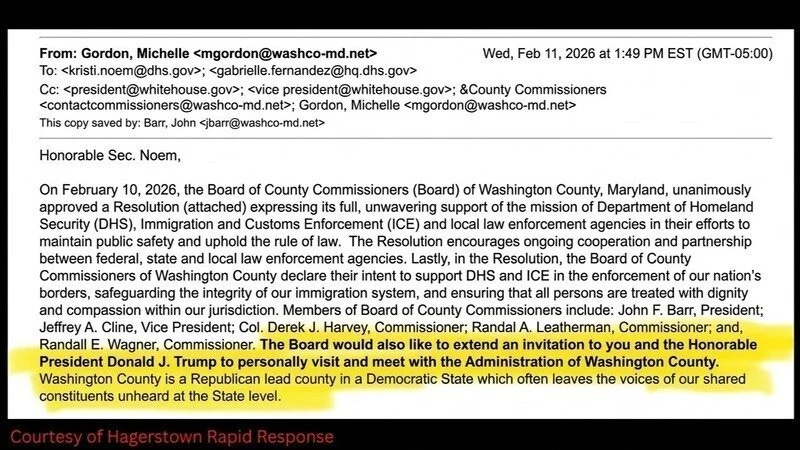
Related Reading: Washington County Invited Trump, JD Vance to Tour Hagerstown ICE Warehouse Amid Local Backlash
One of two stories we broke this week, and it raises serious questions about what officials knew and when after reading the documents we received through an MPIA request.
THIS IS AN ENORMOUS STORY?!?!?! I hope @Hagerstown Rapid Response is getting calls from every TV news station, newspaper and non profit newsroom to explain this to their viewers/readers.
Call them what they are : Concentration Camps!!!
Untergropenfuhrer Trumpolini will arrest everyone who does not give him a Sieg Heil and wear his MAGA on their forehead.
We have arrived, meine Damen und Herren.
Ladies and Gentlemen, it is almost Midnight. 🕛
Achtung!