



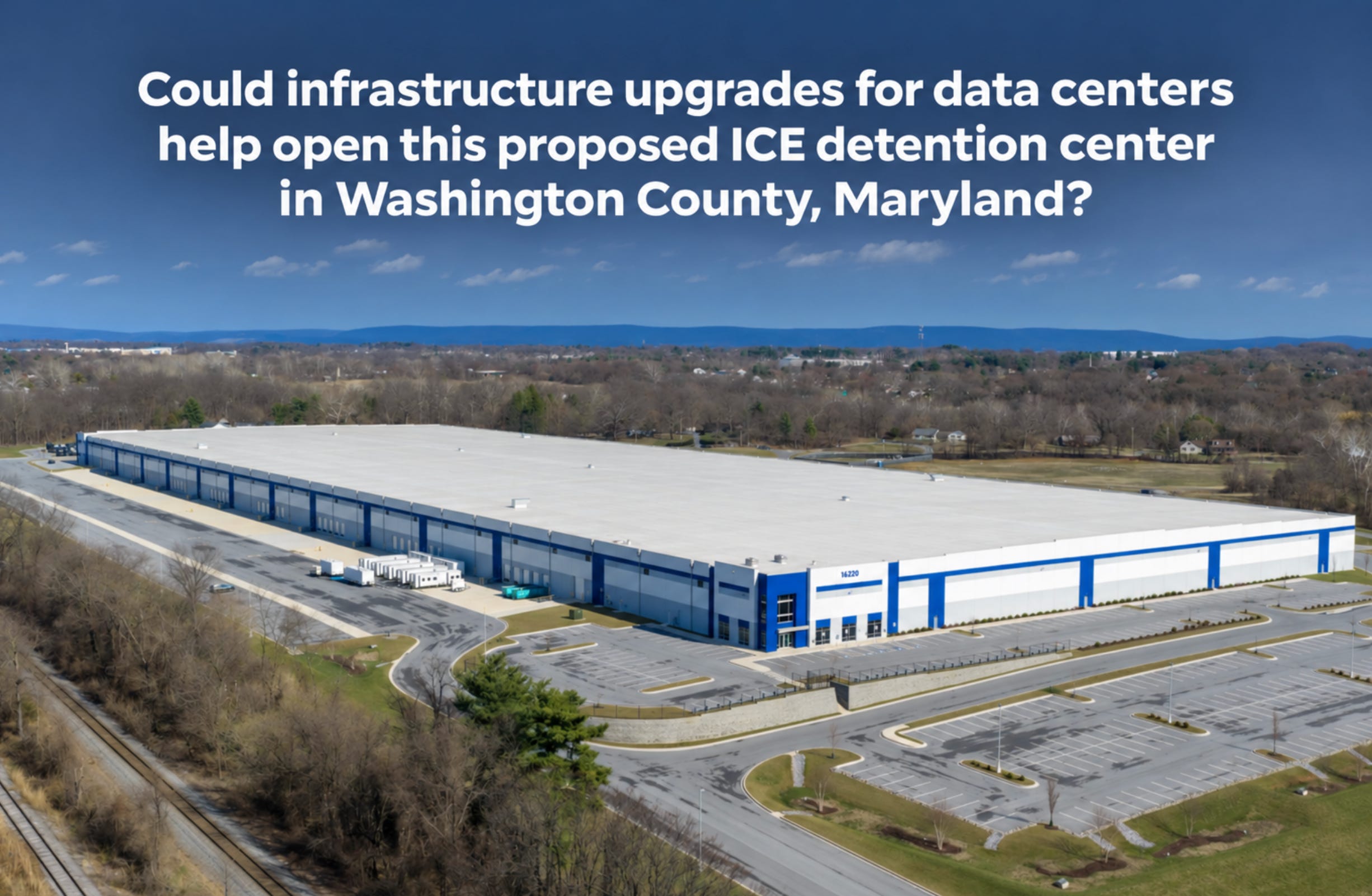
Maryland Attorney General Anthony Brown went to federal court to stop the Trump administration from converting an enormous warehouse in Williamsport into an immigration detention center. A judge halted the conversion, and the Maryland Department of the Environment separately ordered Washington County not to expand sewer service to accommodate the facility. But while Maryland has restricted infrastructure improvements intended for ICE, Hagerstown and Washington County have been coordinating on water and wastewater planning that explicitly contemplates accommodating data centers.
That distinction raises a troubling possibility: Could infrastructure improvements undertaken for data centers also help ICE overcome the very capacity problems Maryland has prohibited Washington County from addressing? The question becomes considerably more interesting when examining the engineering contracts, coordination between the two governments, and Hagerstown’s plans to finance tens of millions of dollars in wastewater improvements without identifying any direct developer contributions.
Maryland Blocked the Sewer Improvements ICE Needs
The proposed detention center at 16220 Wright Road would have approximately 1,500 beds, with detainees potentially cycling through every three to seven days. The building was never designed to handle that volume of people, and the existing wastewater infrastructure reflects it. According to reporting on ICE’s environmental assessment, the Wright Road Sewage Pump Station was already operating at more than 99% of its allocated capacity before ICE proposed adding approximately 187,500 to 197,000 gallons of wastewater per day. The project would require substantial improvements, including an estimated $10 million sewer extension and additional pump station upgrades.
On April 13, 2026, the Maryland Department of the Environment issued a binding administrative order prohibiting Washington County from allocating additional sewage capacity or making improvements intended to accommodate increased wastewater flows from the ICE facility until the required state approvals are obtained. Two days later, U.S. District Judge Brendan Hurson granted Maryland’s request for a preliminary injunction, preventing DHS and ICE from converting or operating the warehouse as a detention center while the lawsuit proceeds.
Those restrictions are particularly significant considering the money already committed to the project. ICE purchased the warehouse for $102.4 million in January and subsequently awarded KVG LLC a contract with a maximum potential value of approximately $641.8 million through March 2029. That brings the combined potential federal expenditure to approximately $744 million, before accounting for certain additional contracts and infrastructure expenses.
Yet while ICE faces these restrictions, engineering work involving other large developments has continued.
Black & Veatch Proposed Planning Data Center Infrastructure for Both Governments
On January 22, 2026, engineering firm Black & Veatch submitted a $2.79 million proposal to Hagerstown for a comprehensive Water and Wastewater Master Plan. Among its optional additional services was Task 10: Data Center Owner’s Advisor, which proposed helping municipalities evaluate data center locations, drinking-water demands, cooling-related wastewater, electrical requirements, and the infrastructure necessary to support such development.
What makes the actual Black & Veatch proposal particularly interesting is that it explicitly identifies Washington County alongside Hagerstown. The firm stated that its proposed services would help both governments make decisions about data center placement and long-term water and wastewater sustainability. Although the advisory task was optional, Hagerstown moved forward with the broader master planning project, which also included evaluating existing utility capacity and potential improvements to the R.C. Willson Water Treatment Plant in Williamsport.
The coordination between the city and county extends beyond that proposal. As Hagerstown Rapid Response reported on October 16, Washington County commissioners approved a no-bid contract with Greg Murray in May to evaluate the county’s water and wastewater infrastructure. His September 18 invoice showed $6,826.25 in charges for 63.5 hours of work, including reviewing Black & Veatch and HDR engineering materials, attending eight water progress meetings, meeting with a Hagerstown representative, and communicating with the Maryland Department of the Environment and environmental law firm AquaLaw.
These records establish that Washington County was paying its own consultant to review engineering materials associated with Hagerstown’s infrastructure planning. And this was happening while both governments were also participating in discussions concerning ICE.
In September, County Administrator Michelle Gordon confirmed that representatives from KVG, Hagerstown, Washington County, Potomac Edison, and Columbia Gas had met to discuss the detention center’s utility requirements. KVG was preparing an engineering study addressing electricity, natural gas, water, and wastewater, while local utility providers calculated what would be needed to serve the facility.
This is particularly interesting because Hagerstown supplies drinking water to the area serving the ICE warehouse, while Washington County handles wastewater service. The governments have also entered into agreements governing wastewater transfers between their systems, demonstrating how infrastructure investments can alter which facilities handle wastewater from particular areas.
The county and city are therefore coordinating on infrastructure matters involving data centers and have separately participated in discussions about supplying utilities to ICE. What the public has yet to see is whether any of the improvements being evaluated would benefit both.
Could Data Center Infrastructure Provide a Workaround for ICE?
Maryland’s April 13 order restricts Washington County from authorizing additional sewage flow or altering the sewer network that feeds Wright Road Pumping Station until MDE approves a revised county water and sewer plan. Utility projects can serve more than one development, and changes to how wastewater is collected or routed can affect capacity elsewhere in the system.
Diversified Capital is seeking to annex roughly 172 acres along Burkholder Lane and McDade Road into Hagerstown for its proposed data center development. Company representatives met privately with both governments on December 9, 2025, six weeks before Black & Veatch submitted its proposal, and the city has refused to release its nondisclosure agreement with the developer. Washington County subsequently adopted a dog-and-pony-show data center moratorium that applies in unincorporated areas. Hagerstown’s annexation plan anticipates extending city water to the Burkholder property and puts the cost of any city-required sewer extensions on the property owner or developer.
Washington County took the same approach in 2023, when Diversified Capital proposed a warehouse at Martin Farm. County staff told the developer it would have to pay to extend the sewer main, including design, easements and inspections. The county’s records point to Cedar Springs for the Martin Farm connection and list Conococheague as the sewage treatment plant. That’s the same plant that receives sewage from the ICE warehouse through Wright Road Pumping Station.
If Hagerstown annexes the land, the city could work directly with Diversified Capital to get sewer extensions built for the data center. If the developer installs a larger sewer pipe that could serve the ICE warehouse or reroutes some of the sewage that already flows through the Wright Road Pumping Station, the data center project could make room in the sewer system for ICE before it even asks for permission to send more than 400 gallons of wastewater a day. The joint sewer agreement gives Washington County responsibility for construction and inspections on projects under its jurisdiction. Before the city votes on annexation, it should show where the developer’s work would connect, who would have to approve it, and whether it would make more sewer capacity available to the warehouse.
Local Ratepayers Face $52.9 Million in Wastewater Spending, With No Developer Contributions Identified
Hagerstown’s own financial documents reveal another concerning aspect of the situation. The city’s five-year wastewater improvement program totals $52.9 million, including approximately $49.5 million in planned borrowing and $3.4 million from the wastewater fund. The financing includes $3 million in loan forgiveness, but the remaining debt would be supported by the wastewater system’s revenues, including money collected from utility customers.
And what does the city’s financing plan identify as contributions from developers? Zero dollars. The funding table lists $0 under the category labeled “Grant or Devel,” with no direct developer funding budgeted for the program. Hagerstown’s customers are being asked to support substantial infrastructure spending while the city considers major development proposals that could require additional utility capacity.
The October 27 council agenda also included approximately $30.6 million in wastewater-related contracts, including $27.7 million for treatment plant improvements and another $2.84 million for construction-phase engineering services from Black & Veatch. Those particular plant improvements are described as maintaining existing treatment capabilities and meeting environmental requirements, while the firm’s separate master planning project addresses future infrastructure needs.
That distinction makes the broader planning work particularly important. Residents need to know which improvements are intended to maintain existing services, which would increase capacity for new developments, and what financial contributions developers would be expected to make.
There’s also the matter of DHS’s own promises. Following a March meeting with county officials, DHS indicated that the federal government would pay for additional water and wastewater capacity fees and required improvements to the Wright Road Sewage Pump Station.
If capacity useful to ICE is created through infrastructure improvements justified by data centers, could the federal government benefit from work financed by local utility customers instead?
What Are Hagerstown and Washington County Actually Planning?
The financial implications are especially concerning given the federal government’s own record. A September 24 Government Accountability Office investigation found that ICE had pursued its nationwide detention expansion without adequate strategic planning, purchasing 11 warehouses for approximately $1.07 billion before deciding to sell seven of them. Federal auditors also found that ICE had failed to adequately evaluate long-term costs, and DHS does not expect to complete its comprehensive detention expansion plan until August 2027.
In Washington County, meanwhile, officials have been coordinating with engineering consultants and utility providers while the federal detention project remains subject to state restrictions. We now have a Black & Veatch proposal explicitly contemplating data center infrastructure planning for both governments, county invoices documenting related engineering reviews, direct utility discussions involving ICE’s contractor, and major wastewater investments being financed without identified developer contributions.
What residents deserve to know is whether infrastructure improvements being planned for data centers could also help ICE overcome the water and sewer limitations that Maryland has prevented the county from addressing directly.
If those improvements are being considered, the public should know which facilities would be expanded, how much additional capacity would become available, whether ICE’s anticipated demand is included in the engineering calculations, and why local utility customers would be expected to finance infrastructure that could benefit a federal project.
Maryland has already intervened to stop the detention center from moving forward without the required environmental review. Local officials should be prepared to explain whether their infrastructure plans could help ICE get around the practical obstacles that have kept the warehouse from opening, particularly if the costs of those improvements are being passed along to the very residents who opposed the facility in the first place.
What a smart theory and conjecture!!
Perhaps some residents of Washington County want an ICE Detention Center no matter what the impact on residents' quality of life, the county's infrastructure and future higher property taxes. I wonder how a majority of residents will feel/react after they find that the incoming Democrat-controlled US House will severely curtail Trump's ICE war on immigrants? What will become of a giant, costly ICE dentention center that is (hopefully) vacant?