




Hagerstown’s mayor and City Council met privately with data center developer Diversified Capital CFO Moshe Rubin on December 9, 2025, according to approved meeting minutes obtained through a Maryland Public Information Act request. The city’s utilities director, chief financial officer, and planning and economic development officials were there, too. Residents looking through the city’s online minutes archive would have had a difficult time finding any of this. The city has now acknowledged that the last minutes posted there were from December 2024.
That is a remarkable arrangement for a government whose decisions affect public infrastructure, development, and residents’ bills. The developer gets a meeting with elected officials and the people responsible for utilities and finances. The public gets an archive that is nearly two years behind, a vague agenda item called “Business Proposal,” and the opportunity to file a records request to learn who showed up. And when Hagerstown Rapid Response separately asked for the city’s nondisclosure agreement with this developer, the city refused to provide it or identify who signed it.
Approved in January. Obtained in October.
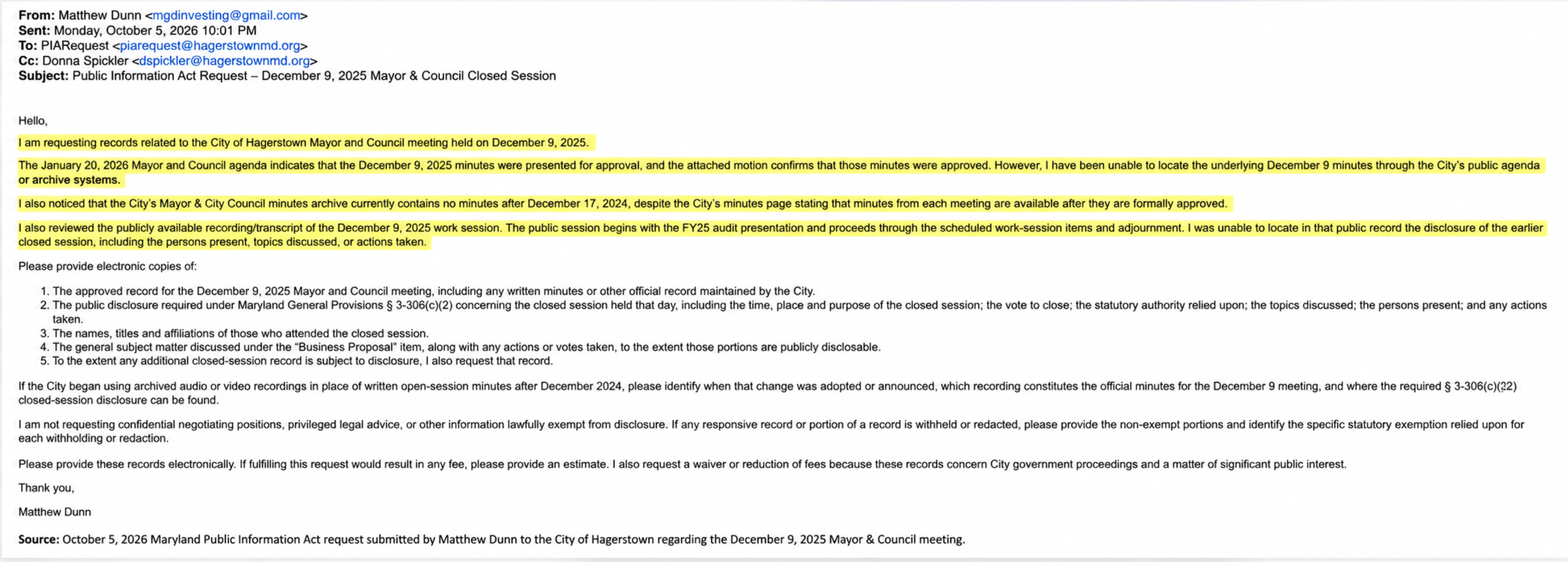
We filed a records request on October 5, 2026, after discovering that the December 9 meeting minutes had come before the council for approval on January 20, 2026, yet were nowhere to be found in the city’s public agenda or minutes archive. This actually led to a much larger gap: the online minutes archive contained nothing after December 17, 2024.
In an October 12 response, Decker supplied the approved minutes and confirmed the archive problem. He attributed it to the city clerk’s transition between archiving products, which had taken longer than expected, and said the minutes were anticipated to be current within two weeks. It has currently been eight days since Decker’s response, so we hope to see this corrected by next week.
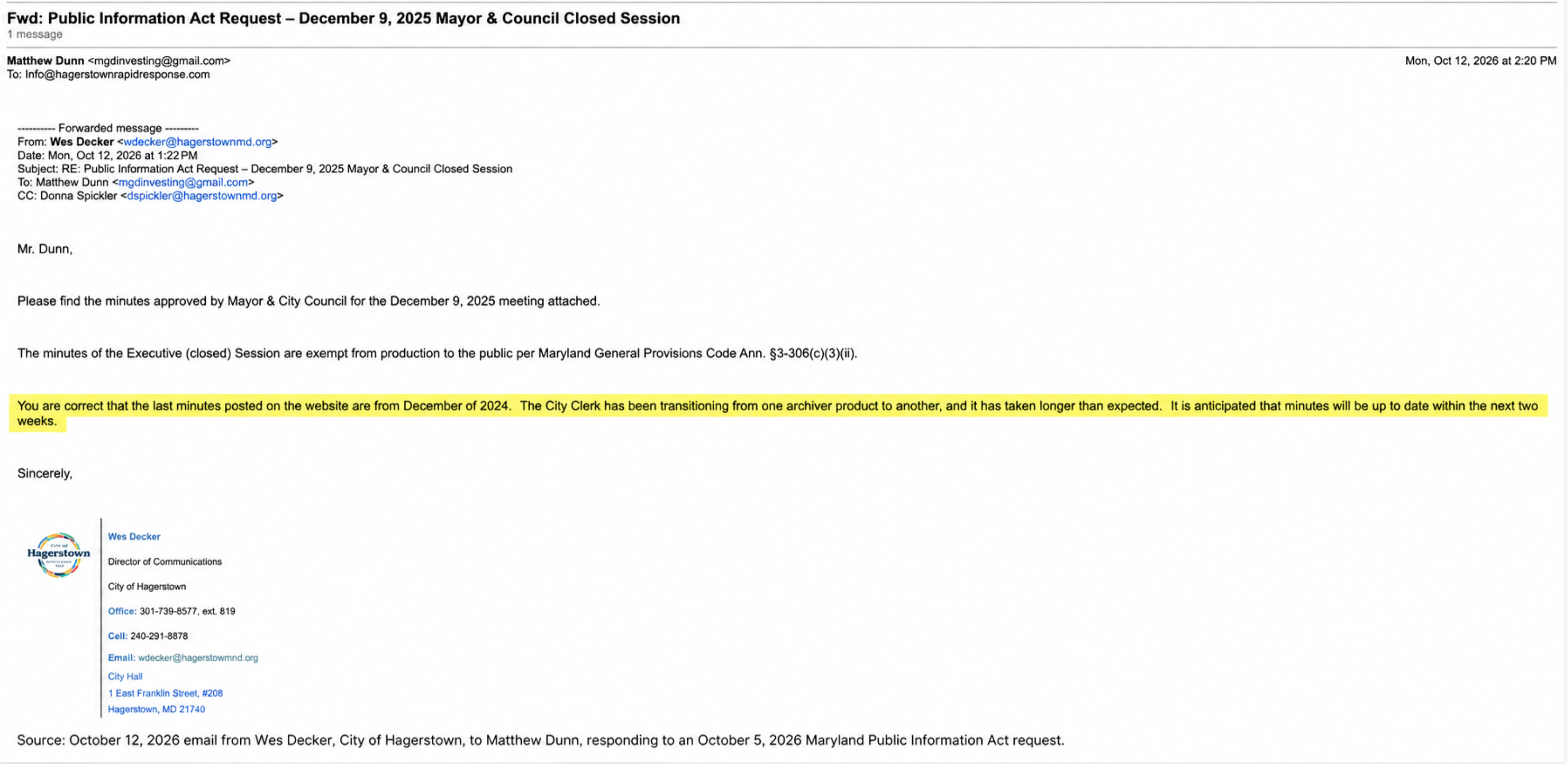
The December 9 minutes had been approved for nearly nine months when we filed our request. Whatever the explanation for the backlog, residents should not have to discover that a record exists, trace its approval through another meeting, and submit an MPIA request to obtain the city’s approved account of its own proceedings. The explanation does not change the practical result: information documenting a private meeting with a developer was missing from the online minutes archive where residents would reasonably look for it.
Decker also stated that the underlying executive session minutes were exempt from public production, citing Maryland General Provisions §3-306(c)(3)(ii). The released document therefore gives us the city’s summary of the closed session, while the more detailed account remains withheld.
The same developer. The same “Project Team.” The same day.
On December 9, 2025, Diversified Capital’s CFO and three members of its development team met behind closed doors with both Washington County’s commissioners and Hagerstown’s mayor and City Council. The county meeting was the confidential presentation involving the “Project Team” that we previously documented, along with the NDAs signed by commissioners and senior officials. The newly obtained city minutes establish that the same four representatives also met privately with Hagerstown’s elected leadership and senior staff that day.
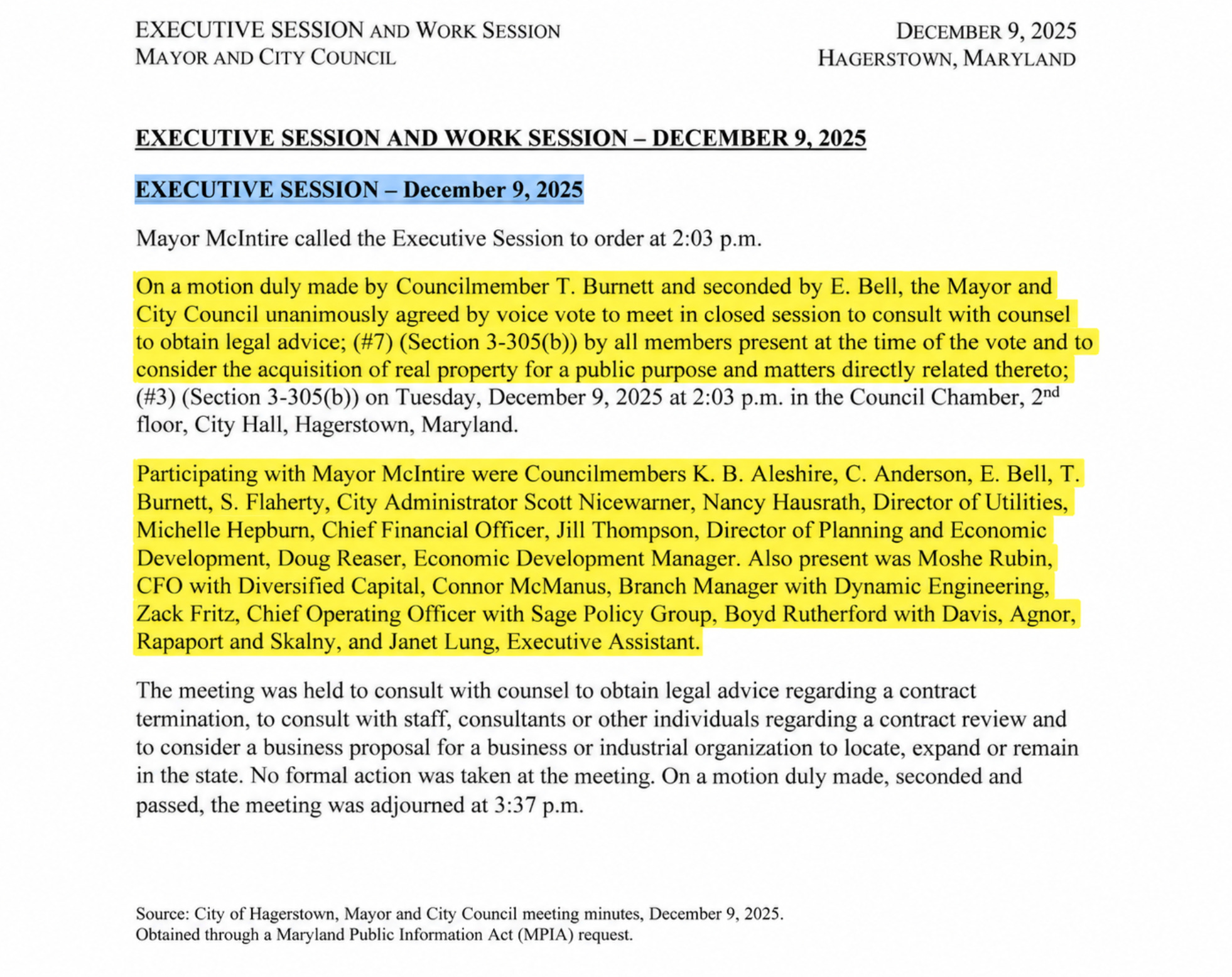
Hagerstown’s executive session ran from 2:03 p.m. to 3:37 p.m. The minutes list Mayor McIntire and all five councilmembers, Aleshire, Anderson, Bell, Burnett and Flaherty, as participating. Joining them were City Administrator Scott Nicewarner, Utilities Director Nancy Hausrath, Chief Financial Officer Michelle Hepburn, Planning and Economic Development Director Jill Thompson, and Economic Development Manager Doug Reaser. The developer had access to the entire elected city government and the officials responsible for the utilities, finances and development approvals a major project would depend on.
Diversified Capital CFO Moshe Rubin was joined by Connor McManus of Dynamic Engineering, Zack Fritz of Sage Policy Group and Boyd Rutherford of Davis, Agnor, Rapaport and Skalny. All four also appear in the county’s record of its confidential development presentation. The same developer and the same representatives were meeting privately with both governments months before county commissioners adopted their dog-and-pony-show data center moratorium.
We also now know that Hagerstown is under an NDA with Diversified Capital. Both governments held private meetings with the developer’s representatives, and both entered confidentiality arrangements involving the company. Washington County provided a redacted copy of its NDA through an MPIA request. Hagerstown has refused to release its agreement or identify who signed it. Residents are left trying to piece together dealings that their own governments agreed to keep confidential.
The city’s minutes describe the purpose of the meeting this way:
The meeting was held to consult with counsel to obtain legal advice regarding a contract termination, to consult with staff, consultants or other individuals regarding a contract review and to consider a business proposal for a business or industrial organization to locate, expand or remain in the state.
That description supplies no project name, property address or mention of a data center. Residents reading the agenda would not have known that Diversified Capital’s CFO and members of the county’s “Project Team” were coming to City Hall. The approved minutes identifying them were then missing from the city’s online minutes archive for nearly nine months after their approval.
Officials spent a closed session with a developer and its representatives, with the city’s utilities, finance, and development leadership participating. Residents deserve to know what the developer presented, what it requested and whether those requests involved water, sewer capacity, infrastructure spending or financial assistance. The city should disclose that information and identify the proposal, rather than leave residents reconstructing its dealings with Diversified Capital ten months after the meeting.
Six weeks later, the city received a proposal to help plan for data centers
The December 9 meeting adds to questions raised in our October 16 investigation into city and county infrastructure planning. On January 22, 2026, roughly six weeks after Rubin and his team met privately with both governments, engineering firm Black & Veatch submitted a water and wastewater master plan proposal to Hagerstown. Among its proposed additional services was a task called “Data Center Owner’s Advisor,” covering assistance with developer negotiations, drinking water demand, cooling system wastewater and electrical requirements. The proposal explicitly described a role helping both Hagerstown and Washington County evaluate data center placement and long-term water and wastewater needs.

The timing gives officials another question to answer: did anything presented by Diversified Capital influence the work the city asked its engineering consultant to consider? Hagerstown’s utilities director, chief financial officer and senior development officials were all listed as attending the private meeting. Six weeks later, the city received an engineering proposal offering advice on the infrastructure demands of precisely this industry.


The county’s infrastructure work deserves scrutiny for the same reason. A September invoice from Greg Murray, whom commissioners hired through a no-bid contract in May, includes reviews of Black & Veatch engineering materials and a meeting with a Hagerstown representative. The invoice establishes that county taxpayers were paying a consultant to review the firm’s materials and meet with someone from the city while Diversified Capital pursued annexation of land tied to its data center development.
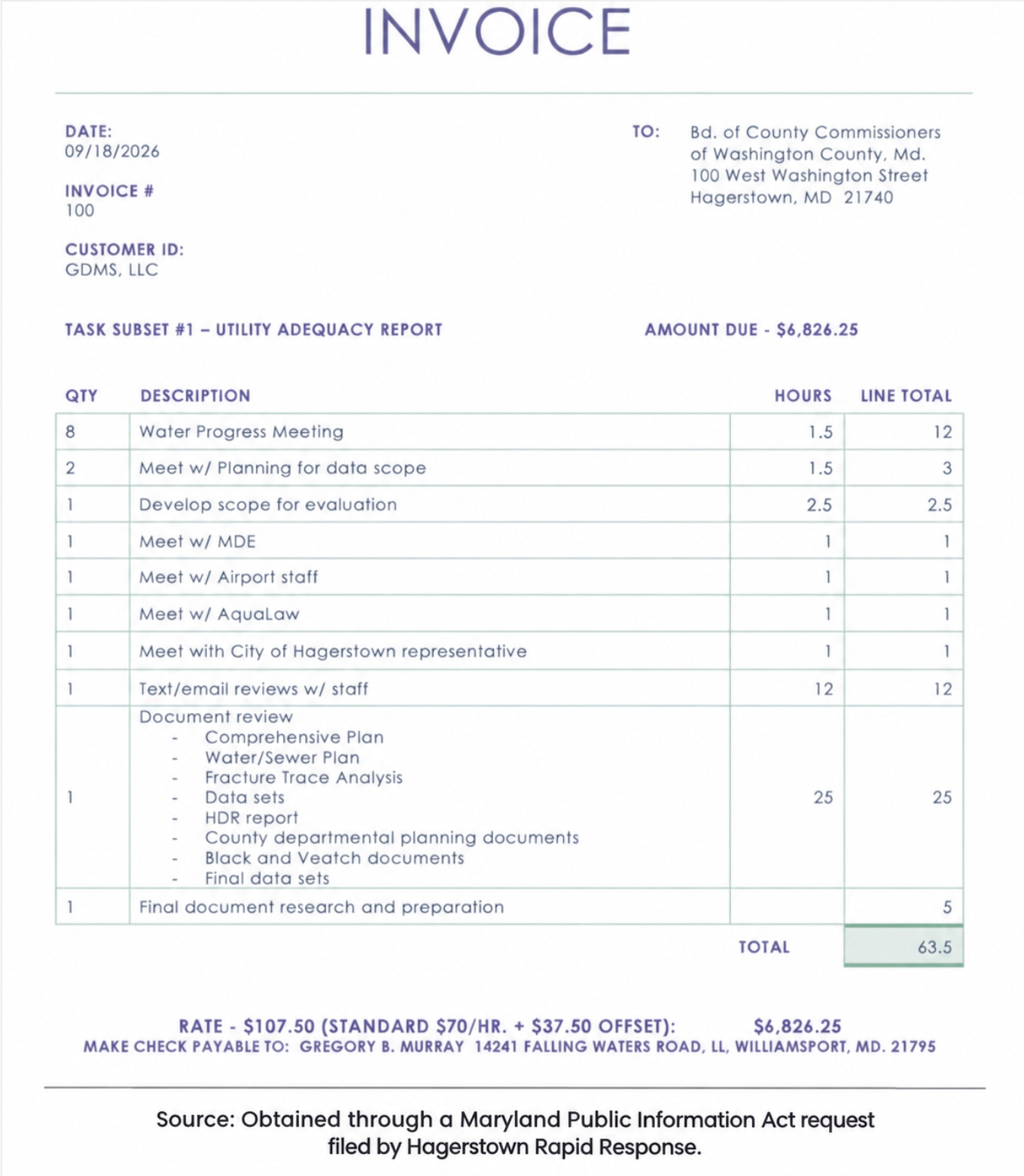
City and county officials should coordinate on water and sewer planning and residents should also be able to find out whose development plans are driving that work and who would pay for any resulting improvements. Did Diversified Capital ask either government for utility capacity, infrastructure extensions or financial assistance? Were those requests passed along to Black & Veatch or Murray? Annexation would put the property beyond the reach of the county’s data center moratorium. Before that happens, residents deserve to know what the developer has asked of their government and what serving the project could cost them. The city has had months to make that information available. Instead, residents are still chasing meeting records and asking to see an agreement their own government signed.
October 27: Millions for the Same Firm That Proposed Helping Hagerstown Plan for Data Centers
Black & Veatch, the same engineering firm that proposed helping Hagerstown and Washington County plan for data centers in January, is now listed for a $2,841,509 wastewater engineering contract on the city’s October 27 consent agenda. That is the same meeting scheduled for the Burkholder-McDade annexation hearing.


County consultant Greg Murray’s September invoice also shows taxpayers paying him to review Black & Veatch engineering materials and meet with a Hagerstown representative. The company’s work is already part of the county’s infrastructure review, and now the city is considering another multimillion-dollar contract with it while residents are still chasing records of private meetings with Diversified Capital. Before approving that spending, officials should release the development assumptions and demand projections behind the improvements and Murray’s work, including any projected data center demand and who would pay to accommodate it.
Is Hagerstown complying with Maryland’s Open Meetings Act?
Hagerstown says a change in archive software explains why its posted minutes stop in December 2024. But does that explanation satisfy Maryland’s Open Meetings Act? The law generally requires minutes to be prepared “as soon as practicable” and minutes or recordings to be posted online “to the extent practicable.” The December 9 minutes were approved in January. The city should explain why a software transition prevented it from posting an already approved document for nearly nine months, including why it could not simply upload the PDF somewhere residents could find it.
Maryland does allow live and archived audio or video streaming to serve as open session minutes, so the missing written minutes alone do not prove a violation. If the city is relying on that provision, it should point residents to the recording that served as the official minutes and identify where it disclosed who attended the private meeting, what was discussed and what happened. Residents should not have to search through hours of footage hoping to find information the city has already put in an approved document.
The city’s response also leaves a question about the closed session. Decker cited the provision allowing the detailed executive session minutes to remain sealed. But §3-306(c)(2) separately requires the next open session’s minutes to disclose the closed meeting’s time, place and purpose, the votes to close it, the legal authority, the topics discussed, the people present and any actions taken. Keeping the detailed account sealed does not excuse withholding the required public summary.
The city eventually provided a summary when a resident requested it. Where could the public find that information before October? Was it included in the next open session’s record, as the law requires? And why do the approved minutes give different grounds for closing the meeting than the agenda does? Those are questions the city should answer and the Maryland Open Meetings Compliance Board can examine.
This backlog covers almost two years in which residents have been trying to understand what local officials are doing to accommodate data center development. Water, sewer capacity, infrastructure spending and residents’ bills are all at issue. Diversified Capital’s representatives got a private meeting with the mayor, the entire council and the officials responsible for utilities, finances and development. Residents could not even find the approved summary in the city’s minutes archive. By the time someone obtained it through a records request, the meeting was ten months old. How are residents supposed to weigh in while decisions are still being made if they cannot find out who met with their government until months afterward?
Hagerstown Director of Communications Wes Decker previously told HRR we could not have the NDA
This meeting record follows our earlier communications with Wes Decker and the city over an NDA involving Diversified Capital. Multiple city employees had told us a city representative signed an NDA with the developer. We requested the agreement and records identifying who signed, approved, reviewed, negotiated, or was subject to it.
The response conveyed through Decker refused to provide the agreement or the related records. The city cited confidential commercial information, deliberative process protections, and confidentiality of client communications. It did not identify the signer or say that no agreement existed. We reported that refusal on October 1.
Now the approved minutes establish that Rubin and other members of the development team met privately with the mayor, five councilmembers, and senior staff. That does not establish who signed a city NDA or whether it was signed at this meeting. It gives the city even more reason to answer our original questions about its confidentiality arrangements with the developer.
Apparently, residents can learn who attended after someone files a separate request for missing minutes. Learning who agreed to keep the developer’s business confidential is still asking too much.
Hagerstown owes residents answers
The city should identify the proposal discussed with Rubin, explain whether it involved the Martin Farm development or a data center, and disclose what was presented about water, sewer, infrastructure costs, and any assistance sought from the city. It should explain the conflicting grounds in the agenda and minutes, provide the completed closing statement used at the meeting, and answer our request for the NDA and the identity of whoever signed it.
We should not have to guess what brought the same development representatives into private meetings with two governments on December 9. County officials signed confidentiality agreements associated with their presentation. City employees told us a city representative signed an NDA, but Hagerstown has refused to give us the agreement. Meanwhile, the approved minutes documenting the city meeting sat outside an online archive that had stopped at December 2024.
This is why we are publishing Missing Minutes. The people developing these projects know what they are asking government to do. The officials meeting with them know what they are being asked. Residents deserve enough information to judge those decisions before they are expected to live with the consequences.
Be at City Hall on Tuesday, October 27 at 6:45 PM
The public hearing on the Burkholder-McDade annexation is Tuesday, October 27, at 7 p.m. in the Council Chambers at Hagerstown City Hall, 1 East Franklin Street. This is the hearing everyone needs to show up for. Annexation would move land tied to Diversified Capital’s data center development into a city where the county’s moratorium does not apply, and residents are still fighting to obtain basic records about the city’s dealings with the developer. Bring your neighbors, bring your questions and make sure the people making these decisions have to face the people who will live with them. If you want to speak at the public hearing, arrive early and sign in at City Hall before it begins.
I so appreciate your work on this. The city and county need to be held to account for utterly selling out and misleading residents and obfuscating their actions. Nail them to the wall and let everyone see what they've done to their neighbors.