



Washington County Commissioners hired Greg Murray in May to evaluate the county’s water and sewer infrastructure, awarding a no-bid contract to a longtime acquaintance of Commissioner Jeff Cline. Five months later, documents obtained by Hagerstown Rapid Response raise a considerably more interesting question about what taxpayers are funding: Is Murray’s work helping lay the groundwork for data center development in Washington County and Hagerstown?
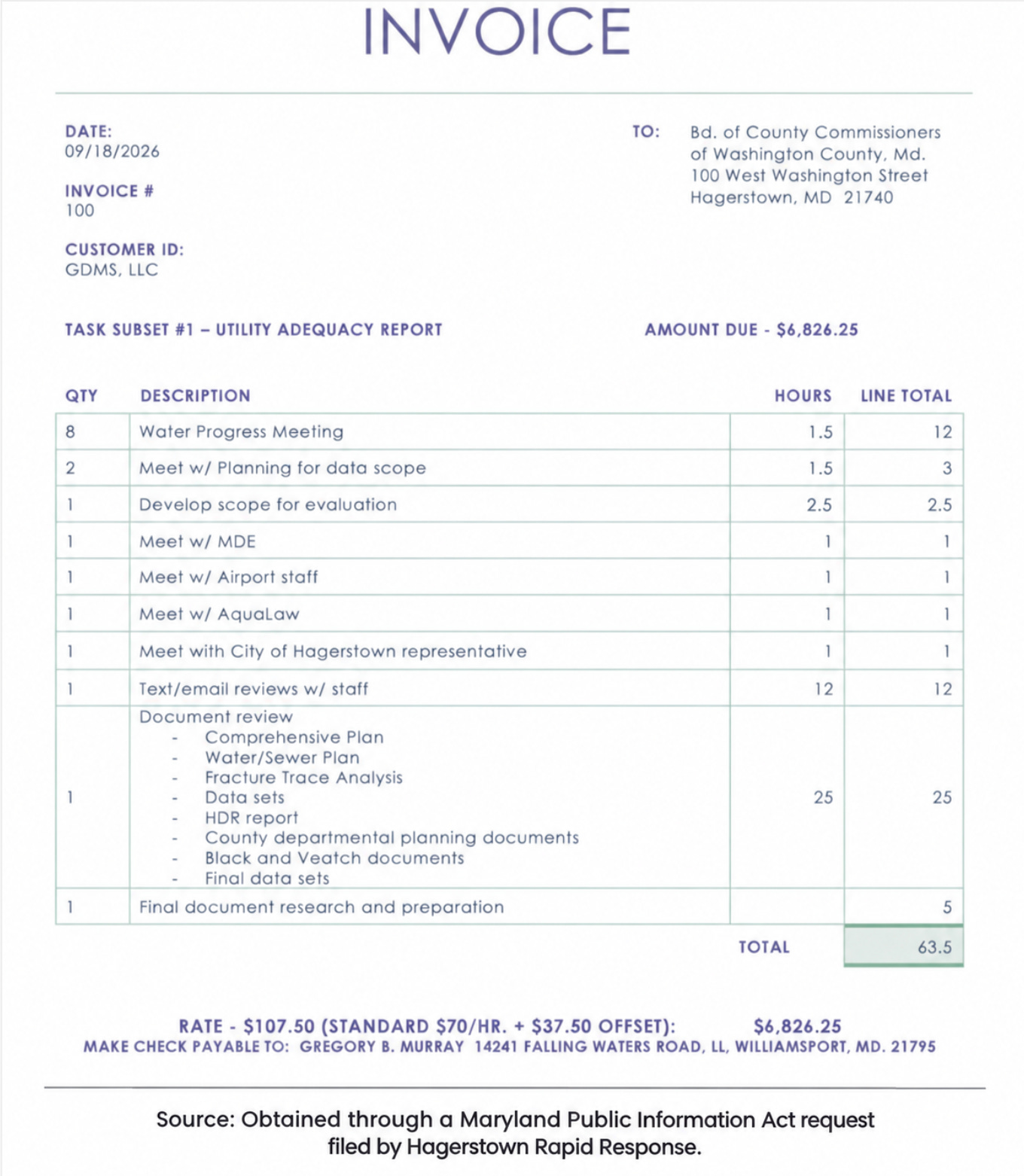
A September 18, 2026 invoice shows Murray billing the county $6,826.25 for 63.5 hours of work, including eight water progress meetings, a meeting with a City of Hagerstown representative, discussions with the Maryland Department of the Environment and environmental law firm AquaLaw, and reviews of engineering materials from HDR and Black & Veatch. Those are the kinds of activities involved in determining where water and sewer capacity exists, where it falls short, and what improvements would be needed to support additional development.
The contract approved by the commissioners deserves closer attention because Murray’s responsibilities extend beyond documenting existing water and sewer deficiencies. His assignment includes evaluating future infrastructure needs, identifying opportunities for regional improvements, considering agreements with neighboring municipalities, and balancing water and sewer availability against Washington County’s economic development objectives.
That last responsibility is especially important. A data center developer cannot simply purchase industrial land and assume the required infrastructure will materialize. Large developments need adequate electricity, reliable water service where required by the cooling design, and sufficient wastewater capacity. Identifying existing limitations and recommending improvements is part of determining whether those developments can proceed and what they would cost.
Greg Murray’s Contract Specifically Includes Infrastructure for Economic Development
The commissioners approved Murray’s contract on May 21 by a 3–2 vote, with Commissioner John Barr casting the deciding vote. As Tri-State Alert reported, the decision raised concerns about the lack of competitive bidding and the relationship between Murray and Commissioner Jeff Cline.
The commissioners also agreed to pay Murray considerably more than his stated $70 hourly rate. His September 18 invoice reveals that taxpayers were billed $107.50 per hour, including an additional $37.50 hourly charge described as a “Social Security offset.” That represents a 53.6% increase over his standard rate. The supplement was authorized in the contract, subject to an annual payment threshold of $72,000. On this single invoice, the additional charge cost taxpayers $2,381.25. Why did commissioners agree to pay their handpicked, no-bid consultant an additional 53.6% on top of his standard rate?
The contract approved by the commissioners deserves closer attention because Murray’s responsibilities extend beyond documenting existing water and sewer deficiencies. His assignment includes evaluating future infrastructure needs, identifying opportunities for regional improvements, considering agreements with neighboring municipalities, and balancing water and sewer availability against Washington County’s economic development objectives.
That last responsibility is especially important. A data center developer cannot simply purchase industrial land and assume the required infrastructure will materialize. Large developments need adequate electricity, reliable water service where required by the cooling design, and sufficient wastewater capacity. Identifying existing limitations and recommending improvements is part of determining whether those developments can proceed and what they would cost.
Murray’s contract authorizes exactly the kind of infrastructure evaluation that could help determine where data centers can be accommodated and what changes would be necessary to serve them. Washington County has legitimate infrastructure problems affecting existing residents and businesses, but that makes the development assumptions underlying Murray’s work critically important. If county officials are paying him to evaluate future economic development needs, residents should know which developments are being considered and whether any proposed improvements would primarily benefit private developers.
Hagerstown’s Engineering Consultant Explicitly Proposed Preparing Both Governments for Data Centers

The most revealing document is Black & Veatch’s Water and Wastewater Master Plan proposal, submitted to Hagerstown on January 22, 2026.
Under Additional Services, the engineering firm proposed Task 10: Data Center Owner’s Advisor, describing work that would help municipalities negotiate with prospective data centers, evaluate drinking-water needs, assess contaminants from cooling-system wastewater, and understand electricity requirements and site design.
The proposal then explicitly states:
“This will support the City and Washington County in making informed decisions on data center placement and impacts on long term water and wastewater sustainability.”
This is an important statement about the type of planning being contemplated. The proposal wasn’t simply about maintaining aging pipes or replacing pumps. Black & Veatch was offering to help Hagerstown and Washington County evaluate where data centers should be located and how their infrastructure demands could be managed.
Black & Veatch even identified proposed personnel for the task, including senior electrical engineer Roland Kamdem, distribution system specialists Ali Nakhli, Kaneel Shah and Kevin Laptos, project manager Betsy Baldwin, and other engineering and modeling personnel.
The advisory task was proposed as an additional service, and we have not confirmed that Hagerstown authorized or purchased it. We also have not established who requested Washington County’s inclusion. But its presence in the proposal is particularly relevant because Black & Veatch was already contemplating a data center planning role involving both governments months before Washington County adopted its data center moratorium.


The company also has substantial experience serving private data center developers. Its own project portfolio describes engineering two 300-megawatt substations for a confidential hyperscale data center developer, and its data center services cover electrical infrastructure, water treatment, permitting, and campus development.
Why Was Murray Reviewing Black & Veatch’s Engineering Materials?
Murray’s September invoice lists 25 hours reviewing documents that include materials from Black & Veatch and HDR, a fracture trace analysis, water and sewer plans, and county planning documents. The invoice does not identify the titles or dates of the specific engineering reports he reviewed.
That omission matters. Black & Veatch has been working on Hagerstown’s water and wastewater infrastructure planning, and its January proposal included hydraulic modeling, facility evaluations, capital improvements planning, and proposed investigations into an additional drinking-water intake or treatment plant.
If Murray was reviewing Black & Veatch’s Hagerstown infrastructure assessments, we need to know what information was being shared, whether it included projected industrial demand, and whether any recommendations concerned locations being considered for data centers.
His invoice also lists a one-hour meeting with a Hagerstown representative. We do not know who attended or what was discussed, but Murray billed Washington County taxpayers for that meeting while working on the county’s Utility Adequacy Report.
That is particularly interesting because Mayor Bill McIntire attended the May 21 county commissioners’ meeting when Murray’s contract was approved. The mayor was paying attention to the county’s infrastructure planning, and the county subsequently paid its consultant to meet with someone from the city.
Mayor McIntire told us on October 14 that Hagerstown and Washington County do not communicate much. That may describe the relationship between their elected officials, but the public records show that utility coordination exists. More importantly, they show why the substance of that coordination matters much more than how frequently the two governments talk.
Diversified Capital’s Burkholder Lane Project Makes This Particularly Important
Consider what has been happening with Diversified Capital.
The developer is pursuing the annexation of approximately 171.88 acres along Burkholder Lane and McDade Road into Hagerstown. The property includes land associated with the Martin Farm development, previously marketed for data center use. In a September 19 statement reported by Tri-State Alert, Diversified Capital CFO Moshe Rubin acknowledged that a data center was among the possible uses, although he said no final development decisions had been made.
The timing is important. On June 30, Washington County commissioners adopted a one-year moratorium on new data center applications. That same day, an annexation petition was filed involving the Burkholder Lane and McDade Road properties. The county subsequently confirmed that its moratorium does not apply inside Hagerstown or the other incorporated municipalities.
That means a property being considered for data center development is pursuing annexation into a jurisdiction where the county’s moratorium would not apply. But changing jurisdiction does not eliminate the need for sufficient water, sewer, or electrical infrastructure.
During Hagerstown’s August 18 work session, officials discussed the Burkholder Lane and McDade Road annexation and the city’s ability to provide infrastructure for future development. According to LocalNews1’s reporting, city staff acknowledged that the area had previously been the subject of negotiations between Hagerstown and Washington County concerning services for areas designated for economic development.
So we have a development area that has already been the subject of city-county utility negotiations, a developer considering a data center there, a city engineering consultant that proposed advising both governments about data center placement, and a county consultant who is reviewing engineering materials and meeting with Hagerstown representatives.
The unanswered question is whether Murray’s work is identifying infrastructure improvements that could help make properties such as Martin Farm viable for data center development. If the answer is yes, the next questions are how much those improvements would cost, who would pay for them, and whether ordinary utility customers would be expected to absorb any of the expense.
Before Murray Was Hired, Developer Money, Data Center Marketing, and a Secret Meeting Were Already Part of the Story
The concerns about Murray’s assignment become more significant when we examine what county officials were doing before he was hired. The timeline connecting Diversified Capital, Commissioner Jeff Cline, Washington County’s confidential development discussions, and the state’s data center industry began months before Murray received his contract.
On August 25, 2025, Diversified Capital executive Moshe Rubin contributed $500 to Commissioner Jeff Cline’s campaign. Former Maryland State Senator Chris Shank contributed another $250 that same day. As we previously documented, both men would appear before Cline and the other commissioners just over three months later as members of a confidential development team.
By October 12, 2025, Diversified Capital was publicly advertising its involvement in a Washington County data center development project. An archived version of the company’s Maryland Tech Council profile described its investment portfolio as including a data center development project in Washington County, Maryland. We reported on this October 11, 2026.
The company’s intentions were not particularly difficult to uncover. Diversified Capital had already appeared in Washington County Planning Commission proceedings concerning Martin Farm in 2023. By June 2024, the property at 12440 Burkholder Lane was being marketed as “Ideal for Data Center”, and the county’s economic development materials were promoting industrial development opportunities in the same area.
Then came December 9, 2025.
On that date, all five Washington County Commissioners participated in a closed session involving a confidential development presentation. County Administrator Michelle Gordon and Business Development Director Jonathan Horowitz were also among the participants listed in the county’s official meeting minutes.
The outside development team included Moshe Rubin of Diversified Capital and Chris Shank, the same two men who had donated to Jeff Cline’s campaign on August 25. Also participating were former Maryland Lieutenant Governor Boyd Rutherford, identified as the project’s land-use attorney; Connor McManus of Dynamic Engineering, which had already worked on Diversified Capital’s Martin Farm project; and Zack Fritz of Sage Policy Group, an economic consulting firm that had been promoting data center development in Maryland.
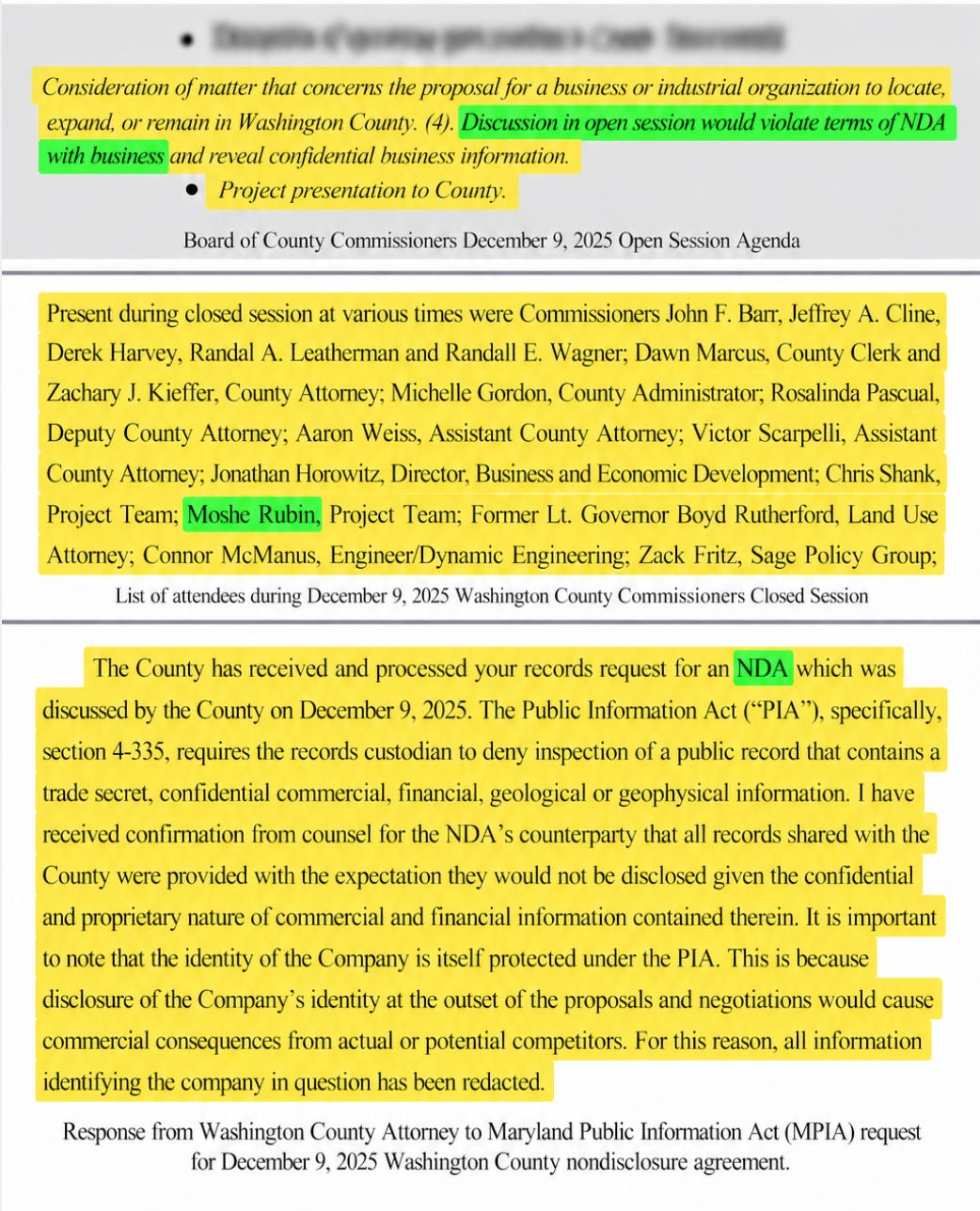
The county’s minutes explicitly state that public discussion of the presentation would violate an NDA and reveal confidential business information. The public was excluded from the meeting, and the specific project presented has still not been publicly identified.
We subsequently obtained a redacted copy of Washington County’s NDA through a Maryland Public Information Act request, confirming the existence of the county’s confidentiality arrangement. The county’s own records identify the commissioners and senior officials involved, along with the development representatives who participated in the closed session.
The campaign contributions were still sitting in Cline’s campaign account when the December meeting occurred. He did not return Rubin’s $500 and Shank’s $250 until June 12, 2026, more than nine months after receiving them and approximately six months after meeting privately with both men. His campaign reported the same explanation for each refund: “Candidate decided to decline contribution.”
The contributions and meeting do not establish that Cline took an official action in exchange for campaign money. But the timing, the developer’s publicly advertised data center involvement, and the confidential presentation warrant answers about what the commissioners knew and when they knew it.
Then Washington County’s Business Development Director Joined Maryland’s Data Center Alliance Leadership
The next development came on February 2, 2026, less than two months after the confidential meeting.
Horowitz was not simply attending a conference about data centers. He was named to the leadership committee of an organization created to advance Maryland’s data center industry, shape public policy, and promote the industry’s economic benefits.
The committee includes representatives from Amazon, BGE, Constellation Energy, Rowan Digital Infrastructure, Turner Construction, Catellus Development Corporation, the Maryland Department of Commerce, and the Maryland Economic Development Corporation, among others.
This is the same Jonathan Horowitz who was present during Washington County’s December 9 confidential meeting involving Diversified Capital’s executive and development team. It is also the same county official who had supported Senate Bill 397 in 2020, legislation offering substantial tax exemptions intended to attract data centers to Maryland.
As we previously reported, Horowitz’s appointment placed Washington County’s economic development leadership inside an organization actively promoting the industry that county commissioners would later claim needed to be paused for further study.
The chronology is difficult to overlook. Rubin and Shank donated to Cline in August. By October, Diversified Capital was publicly identifying a Washington County data center development project. In December, the commissioners and senior officials participated in a confidential presentation with those same individuals. In January, Black & Veatch proposed helping both governments make decisions about data center placement. In February, Horowitz’s statewide industry leadership role was announced. In May, the commissioners hired Murray to evaluate infrastructure and economic development needs. In June, they adopted a data center moratorium that does not apply to Hagerstown.
The commissioners should explain what they knew about Diversified Capital’s data center plans during that period, whether those plans influenced the county’s infrastructure priorities, and whether Murray has been evaluating the utility requirements of developments already under consideration.
Hagerstown Is Withholding Records About Its Dealings With Diversified Capital
While these infrastructure studies and annexation proceedings move forward, Hagerstown is refusing to provide records that could help residents understand its relationship with Diversified Capital.
As we previously reported, multiple city employees told us that a Hagerstown representative signed a nondisclosure agreement with Diversified Capital. We filed a Maryland Public Information Act request seeking the agreement and related records, including the identities of city officials involved in negotiating, approving, or signing it.
Hagerstown refused to provide the requested records. The city cited exemptions involving confidential commercial information, deliberative-process privilege, and attorney-client communications. We have since escalated the dispute to Maryland’s Public Information Act Ombudsman for mediation.


What makes Hagerstown’s refusal particularly troubling is that Washington County already provided us with a redacted NDA involving Diversified Capital through a separate MPIA request. County officials participated in a confidential development presentation involving people connected to the company, and the county’s meeting minutes identify the attendees. Hagerstown, meanwhile, will not release the NDA records we requested concerning the same developer.
On October 14, we met with Hagerstown Mayor Bill McIntire and specifically asked why the city refused to provide the records. McIntire told us that the city’s legal department handles those matters and that he did not know why its attorneys had decided not to release them.
The mayor may not personally review every MPIA determination, but this request concerns a developer seeking annexation of nearly 172 acres into his city, potentially opening the door to a data center project beyond the reach of Washington County’s moratorium. We would expect the city’s elected leadership to understand why information about such a consequential development matter is being withheld from residents.
Even more confusing is that Mayor McIntire blamed the attorneys for the NDA being withheld from us. But we know that just is not true because just two weeks ago, Hagerstown Director of Communications, Wes Decker, explained to us that the decision to allow us to access this nondisclosure between the city and Diversified Capital was his.
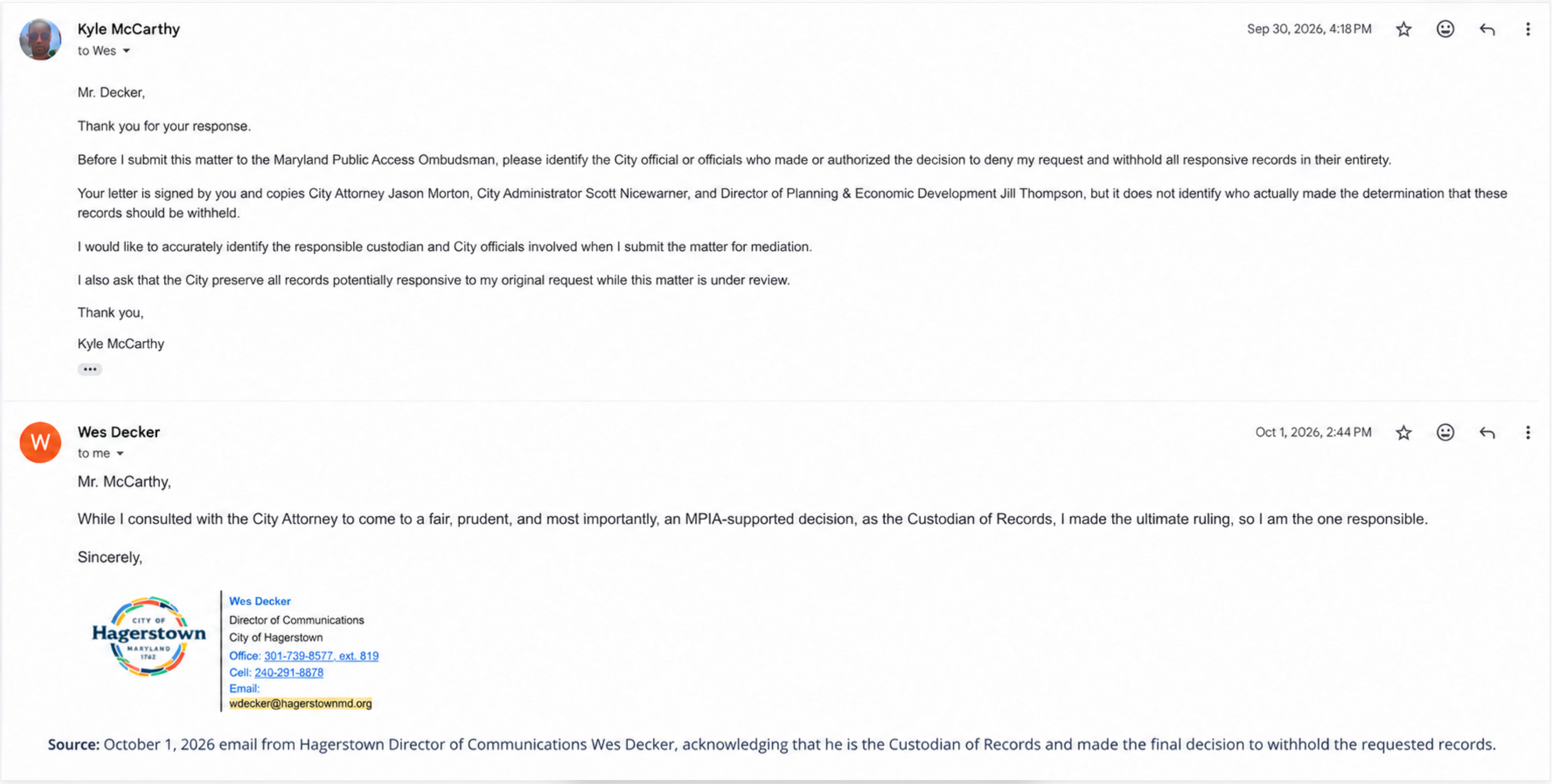
There is another detail worth investigating. On December 9, 2025, the same day Washington County’s commissioners participated in the confidential development presentation, Hagerstown’s Mayor and City Council also held a closed executive session to consider a proposal involving a business or industrial organization locating, expanding, or remaining in Maryland.
That brings us back to Murray’s work. Hagerstown’s engineering consultant proposed helping both governments evaluate data center placement. Washington County’s consultant is reviewing engineering documents and meeting with Hagerstown officials. Diversified Capital is pursuing annexation into a city where the county’s moratorium does not apply. And both governments have questions to answer about their confidential dealings with the developer.
If officials have been discussing infrastructure needed to accommodate a potential data center at Martin Farm, residents should be able to examine those discussions before decisions are made that could affect public utilities, development patterns, and future costs.
The Commissioners Should Explain Exactly What Murray Is Preparing the County For
The county’s water and sewer problems are not imaginary. Existing infrastructure needs maintenance and expansion, and officials have a responsibility to plan for future demand. But that responsibility also requires being transparent about whose demand is driving expensive infrastructure decisions.
Hagerstown City Council member Kristin Aleshire has previously warned about the county’s history of building wastewater infrastructure in anticipation of development that failed to materialize. As Tri-State Alert reported in May, the earlier I-81 corridor sewer project ultimately left the county covering approximately $54 million in debt over two decades.
Now Washington County has hired another consultant to evaluate infrastructure and future economic development needs, while major industrial developers are pursuing projects that could require substantial utility capacity.
Residents deserve to know whether Murray’s evaluations include projected data center demand, whether his recommendations identify infrastructure improvements that would accommodate those projects, and whether his discussions with Hagerstown concern developments that could move forward despite the county’s moratorium. They also deserve to know what confidentiality agreements exist between Hagerstown and Diversified Capital, who authorized those agreements, and whether discussions with the developer concerned infrastructure that Murray and Black & Veatch have been studying.
We intend to pursue the engineering reports Murray reviewed, his communications with Hagerstown, his meeting records, and the underlying assumptions used in his Utility Adequacy Report. We are also pursuing mediation over Hagerstown’s refusal to release the requested NDA records.
Washington County commissioners have told residents they need time to study data centers. They should explain whether, during that supposed pause, their own consultant is helping determine what infrastructure would be needed to build them. Hagerstown officials, meanwhile, should explain what they have discussed or agreed to with the developer seeking to move land into their jurisdiction.
Residents have already uncovered campaign donations, confidential development meetings, engineering proposals explicitly addressing data centers, and a county business development director serving on a statewide data center industry committee. Now they are paying for another consultant to study the infrastructure that could determine where those projects can be built.
The commissioners owe taxpayers a clear explanation of what they are paying Greg Murray to do, which development projects are being considered in his work, and whether public infrastructure planning is helping prepare Washington County and Hagerstown for data centers while residents are being told the county has put them on hold.