



When most people hear about the proposed U.S. Immigration and Customs Enforcement (ICE) detention warehouse in Washington County, Maryland, they assume it is a local issue. That assumption is understandable. The facility would be located in a former warehouse in Williamsport, Maryland, and many of the most immediate impacts would be felt by Washington County residents. But the information Department of Homeland Security (DHS) has released as part of its Environmental Assessment suggests this project is far larger and more complicated than a typical warehouse renovation.
Earlier this month, DHS revealed that the facility is designed to accommodate up to 1,500 people and would require significant utility modifications, wastewater infrastructure improvements, floodplain review procedures, and the installation of a massive 750,000-gallon water storage tank. The agency also estimates the facility could generate approximately 187,000 gallons of wastewater per day. Those disclosures raise some obvious questions. Where will all of that water come from? Can the surrounding infrastructure handle a project of this scale? What happens when a facility designed to hold up to 1,500 people is inserted into a watershed that already supports local communities, businesses, farms, and ecosystems?
Those questions are especially important because DHS originally attempted to move this project forward without conducting the Environmental Assessment that is now underway. The public only has access to this information because Maryland successfully challenged DHS in court and forced the agency to complete the environmental review required by federal law. That lawsuit not only opened the current public comment period, it also revealed details about the project that residents would otherwise never have had the opportunity to examine.
The Environmental Assessment has also highlighted something that receives far less attention than it should. The consequences of this project do not stop at the Washington County line. Water leaving the project area eventually flows through Semple Run, into Conococheague Creek, then into the Potomac River, and ultimately the Chesapeake Bay. Along the way, it becomes part of a network of waterways and environmental resources shared by millions of people throughout the Mid-Atlantic.
That reality matters because it means this is not simply a Washington County story. Residents of Maryland, Washington, The District of Columbia, Virginia, West Virginia, Pennsylvania, and Delaware all have a legitimate interest in understanding what DHS is proposing, what questions remain unanswered, and why now is the time to submit a public comment before the July 1 deadline.
Maryland
Maryland has the most to lose.
Unlike residents in neighboring states, Marylanders would experience both the immediate impacts of hosting the facility and any downstream consequences that follow. DHS wants to convert an 825,000-square-foot warehouse into a detention facility designed to hold up to 1,500 people. To make that happen, the agency has acknowledged that the project will require significant utility upgrades, major wastewater infrastructure improvements, floodplain review, and a 750,000-gallon water storage tank. That alone should raise eyebrows. Projects that require that level of modification are not simple warehouse renovations, no matter how DHS tries to describe them.
Marylanders should be asking some pretty basic questions. If the facility is expected to generate roughly 187,000 gallons of wastewater per day, can the existing system actually handle it? If additional upgrades become necessary later, who pays for them? What happens when infrastructure that was originally built to serve local communities is increasingly dedicated to supporting a federal detention complex? These are not abstract concerns. They are questions that affect taxpayers, local governments, and residents who depend on those systems every day.
There is also the issue of the Chesapeake Bay. Maryland taxpayers have spent decades and billions of dollars trying to improve water quality, reduce pollution, and restore one of the state’s most important natural resources. At the same time, DHS is proposing a project that would dramatically increase water consumption, wastewater generation, and stormwater runoff in a watershed that ultimately drains into the Bay. Whether those impacts end up being significant is precisely what the Environmental Assessment is supposed to evaluate. What should concern Maryland residents is that DHS initially tried to move this project forward without conducting that review at all.
And this is not just a Washington County issue. Water leaving the project area eventually becomes part of the larger watershed that connects communities across Maryland. The decisions made at this site therefore have implications far beyond the warehouse property itself. When a federal agency proposes a project of this scale in a sensitive watershed, Maryland residents have every right to demand clear answers, rigorous review, and more than vague assurances that everything will work out.
Washington, D.C.
At first glance, it might seem strange that residents of Washington, D.C. should care about a proposed detention facility more than 70 miles away in Washington County, Maryland. But the Potomac River does not begin at the District line.
The Potomac is one of the most important natural resources in the region. It provides drinking water to the Washington metropolitan area, supports recreation and tourism, and serves as the backbone of a watershed that connects communities across multiple states. It is also a river that has faced pollution challenges for decades. Combined sewer overflows, stormwater runoff, wastewater discharges, and other sources of pollution continue to affect water quality despite years of cleanup efforts and billions of dollars in public investment.
That is why the proposed ICE detention facility matters to District residents. The question is not whether Washington, D.C. will experience the immediate impacts of construction in Washington County. The question is whether DHS has fully evaluated the consequences of adding another major wastewater-generating facility to a watershed that already faces significant environmental pressures.
That is not just common sense. It is also reflected in federal environmental law. Agencies conducting environmental reviews are required to consider cumulative impacts on shared resources such as rivers, watersheds, and ecosystems.
District residents are routinely told that protecting the Potomac requires everyone to do their part. Washington, D.C. has spent billions of dollars trying to reduce sewage pollution and improve water quality in the river. Residents and businesses are expected to follow the rules, utilities are expected to invest in infrastructure, and taxpayers are expected to help fund those efforts. It is entirely reasonable to expect DHS to meet that same standard before moving forward with a project that would become part of the Potomac watershed.
Virginia
Virginia has spent decades trying to improve the health of the Chesapeake Bay and the waterways that feed it. State agencies, local governments, farmers, businesses, and taxpayers have invested enormous amounts of time and money into reducing pollution, improving water quality, and restoring ecosystems throughout the watershed. Those efforts continue today because many of the challenges facing the Bay have not been solved. Nutrient pollution, stormwater runoff, wastewater discharges, and habitat degradation remain ongoing concerns throughout the region.
That is what makes the proposed ICE detention facility in Washington County relevant to Virginia residents. DHS is proposing a project that could house up to 1,500 people, generate approximately 187,000 gallons of wastewater per day, require significant utility upgrades, and involve floodplain review and major infrastructure modifications. The facility may be located in Maryland, but it sits within a watershed that ultimately connects to the Potomac River and Chesapeake Bay, both of which are deeply important to Virginia communities.
The Commonwealth’s connection to the Potomac is not abstract. The river forms part of Virginia’s border and supports recreation, tourism, fishing, wildlife habitat, and local economies throughout Northern Virginia and beyond. Decisions made upstream can have consequences downstream, which is why watershed management has long been treated as a regional responsibility rather than a purely local issue.
Virginia has enormous political, financial, and regulatory obligations tied to Chesapeake Bay cleanup. Virginia is constantly negotiating pollution reduction targets with EPA, Maryland, Pennsylvania, and other Bay jurisdictions. A project that adds another major wastewater source into the watershed isn’t just an environmental question. It’s a regional governance question because Virginia is one of the states that gets measured on Bay outcomes.
West Virginia
For residents of West Virginia’s Eastern Panhandle, the connection to the proposed ICE detention facility is far more direct than many people might realize.
Water leaving the project site eventually makes its way through the Conococheague Creek and into the Potomac River, which flows past some of West Virginia’s most recognizable communities. Places like Harpers Ferry and Shepherdstown are closely tied to the health of the river. It supports recreation, tourism, wildlife habitat, local businesses, and some of the natural landscapes that make the Eastern Panhandle unique.
That is why residents of West Virginia have a legitimate interest in what happens in Washington County. What happens upstream can affect communities downstream, which is why environmental reviews are supposed to examine more than just impacts occurring directly on a project site.
For residents of the Eastern Panhandle, the Potomac River is one of the defining natural resources of the region, and any project that could affect the watershed deserves careful scrutiny before it moves forward.
Pennsylvania
The Conococheague Creek watershed does not begin in Maryland. It begins in Pennsylvania.
That means communities like Chambersburg, Greencastle, and Mercersburg are already connected to the same watershed as the proposed ICE detention facility.
It should very much concern Pennsylvania residents that DHS initially attempted to move this project forward without conducting an Environmental Assessment. If Maryland had not sued, many of the questions now being examined might never have been asked in the first place.
People on both sides of the Maryland-Pennsylvania border have spent years working to protect and improve the waterways that connect their communities. They understand something that can sometimes get lost in discussions about state boundaries: watersheds do not care where one state ends and another begins.
For residents of southern Pennsylvania, this is a proposal involving a watershed that begins in Pennsylvania, flows through Maryland, and ultimately connects communities in both states. That alone gives Pennsylvanians a legitimate interest in the questions DHS is finally being forced to answer.
Delaware
Many people would never connect a proposed ICE detention facility in Washington County, Maryland to the State of Delaware. But they should.
Delaware has spent decades participating in efforts to restore and protect the Chesapeake Bay. State agencies, local governments, environmental organizations, and taxpayers have invested significant time and spends millions of dollars a year to improve the water quality and protect one of the most important natural resources in the Mid-Atlantic. Those efforts are based on a simple reality: the health of the Bay is shaped by decisions made throughout the watershed, not just in the communities closest to the water.
That gives Delaware residents a legitimate interest in projects like the one DHS is proposing in Washington County. The question is not whether Delaware will experience the immediate impacts of construction at the site. The question is whether DHS has fully evaluated the environmental consequences of a major federal project located within a system of waterways that ultimately connects to the Chesapeake Bay.
The proposed detention facility may be located hundreds of miles from parts of Delaware, but the principle is the same. When a federal agency proposes a project with potentially significant environmental consequences, the public should not have to drag that agency into court simply to force it to study those consequences before moving forward.
The Clock Is Ticking
The public comment period for DHS’s Environmental Assessment is open now, but it closes on July 1.
The proposed ICE detention facility raises questions that extend far beyond Washington County. Residents of Maryland, Washington, D.C., Virginia, West Virginia, Pennsylvania, and Delaware all have a legitimate interest in ensuring those questions are fully examined before this project moves forward.
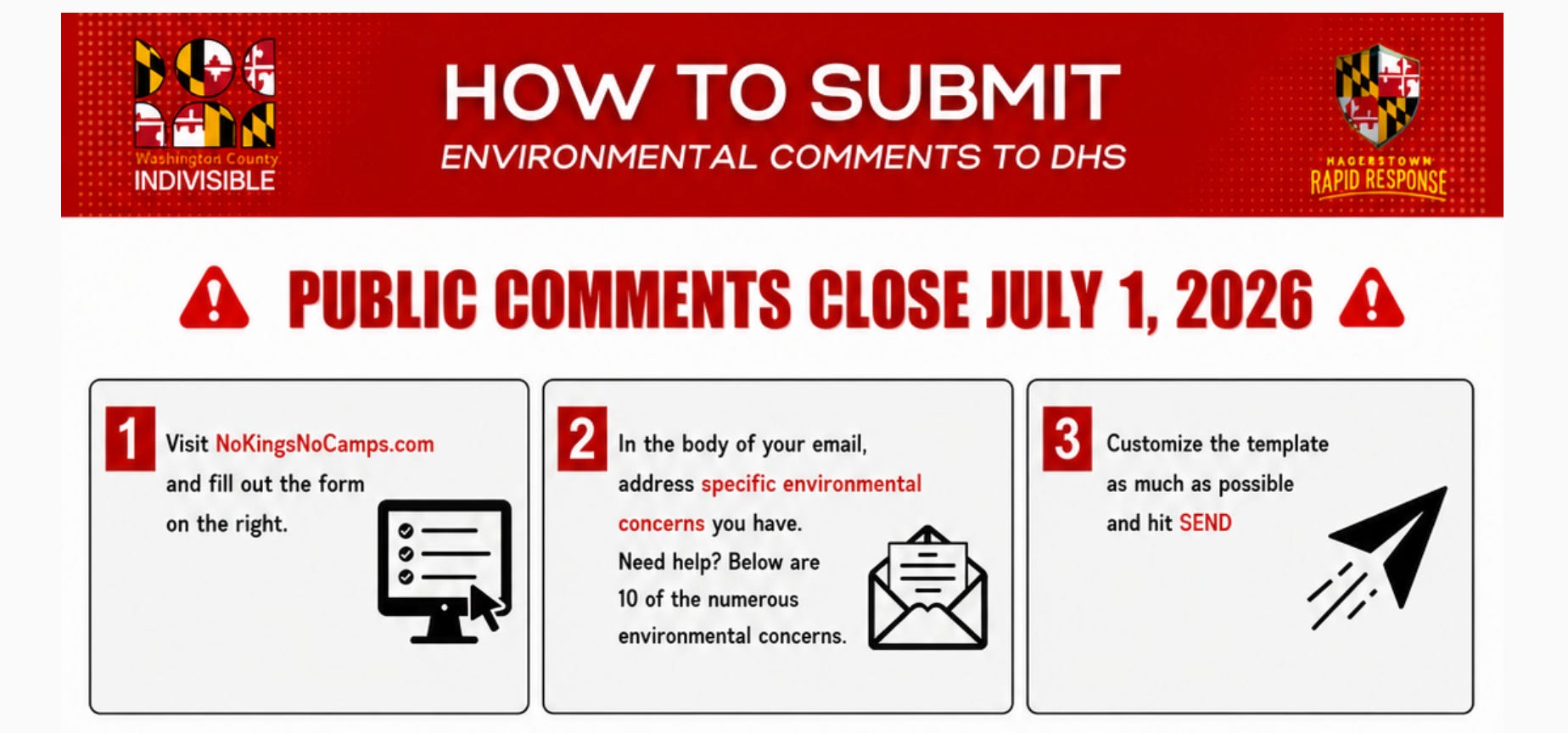
To make participation easier, we at Hagerstown Rapid Response and Washington County Indivisible set up a public comment submission campaign at NoKingsNoCamps.com. The process takes two minutes or less:
Visit NoKingsNoCamps.com and fill out your contact info.
In the body of your email, raise specific environmental concerns you have about the project.
Customize the template as much as possible and hit send.
Your comment will become part of the official administrative record that DHS is required to consider as part of its Environmental Assessment.
July 1 will be here before you know it. Visit NoKingsNoCamps.com and submit your comment today. Once the public comment period closes, the opportunity to have your concerns included in the record closes with it.

⭐ Bonus points for also clicking the orange
button and leaving a comment below ⭐


Considering the Gestapo’s inhumane treatment of people that are sent to these concentration camps, the humanity of it is enough to make it a non-starter to any decent person. The tears of the imprisoned alone would be enough to raise the salinity of the river!
How terribly unfortunate that as Americans -- land of the free-- we are STILL dealing with such racist assaults on innocents. We are all God's children. Stop abusing children and their parents and destroying families. We don't want any more concentration camps in our beautiful country. Why doesn't this administration stop blowing money & take care of the needs of the people? Stop ignoring Americans. And by the way stop destroying our monuments. These are the People's monuments. And by the way, do something about the water and energy problems in Puerto Rico. We don't need a dictator. We need a real president, a real congress and a real supreme court-- checks and balances. And please do stay out of beautiful Maryland.