



There is a particular kind of quiet that signals something is wrong, and in Washington County, Maryland that quiet has become impossible to ignore. For months, we have gathered week after week outside the Board of County Commissioners meetings in Hagerstown, asking basic, reasonable questions about a proposed 1,500 bed immigration detention facility planned just miles away in Williamsport, Maryland. Those questions have not been answered, and in many cases, we have not even been allowed the opportunity to ask them in a public forum.
What has taken shape instead is something more troubling than bureaucratic delay. It is a pattern of silence that follows a very specific timeline. Washington County Commissioners signed non-disclosure agreements tied to a land deal that preceded the announcement of the detention facility, and since then they have refused to explain what those agreements cover or whether they are connected to the ICE project. If those agreements are unrelated, officials could say so clearly and immediately. Their continued refusal to provide that clarity has become one of the central reasons we continue to show up.
We are now at a point where the lack of information is itself the most revealing detail.
This Tuesday, that silence becomes the explicit focus of another weekly protest organized by Hagerstown Rapid Response and Washington County Indivisible. These demonstrations have grown steadily, driven not by new disclosures from county leadership but by the absence of them. We have filed Maryland Public Information Act requests, constructed timelines from scattered records, and attempted to fill in the gaps left by officials who have chosen not to speak publicly. At the same time, we have often been denied the ability to speak at the meetings where these decisions are being discussed, creating a feedback loop in which public participation is both necessary and restricted.
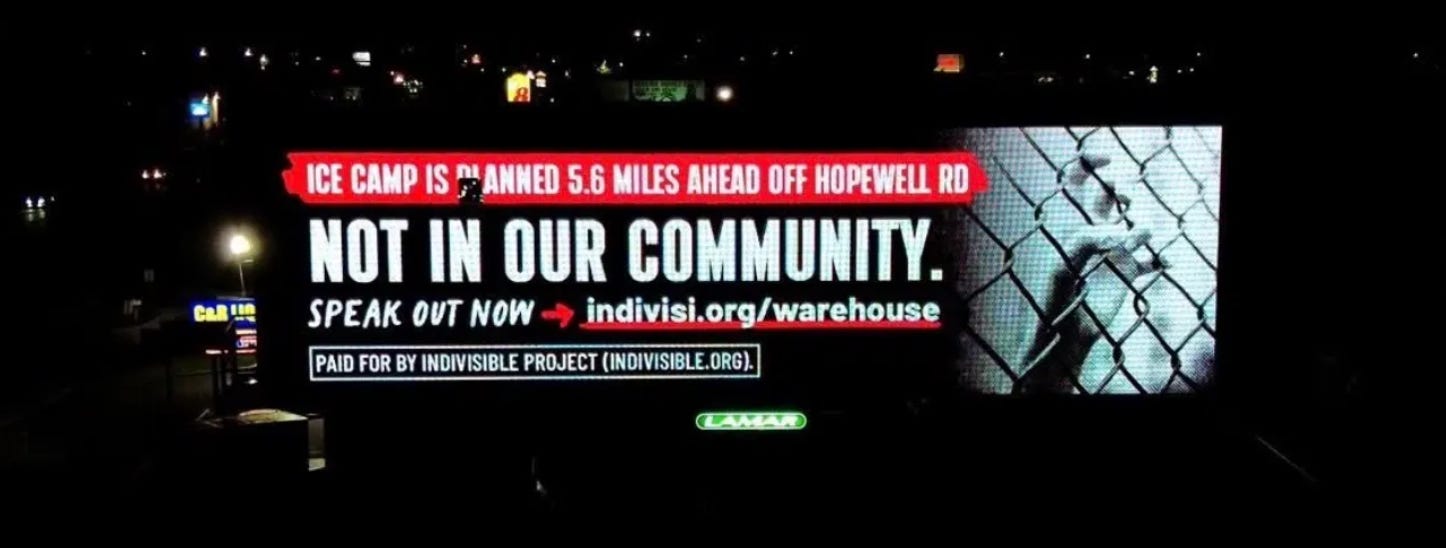
That dynamic has forced us to respond with a strategy that blends investigation, persistence, and visibility. Last week, we escalated our efforts by partnering with the national network Indivisible to install a billboard along Dual Highway that reads, “ICE Camp 5.6 Miles Ahead. Not in Our Community.” The placement is intentional. It ensures that anyone traveling toward the proposed site is confronted with a message that local officials have tried to keep abstract or obscured. What was once confined to meeting rooms, legal documents, and incomplete disclosures is now unavoidable in the daily landscape of the county.
The billboard represents more than a communications tactic. It is the product of months of frustration built on being shut out of the process. We have organized protests, applied public pressure, conducted independent research, filed public records requests, engaged with media, and now turned to physical visibility in the community itself. None of these actions exist in isolation. Together, they are forcing a level of attention that local leadership has not provided on its own.
What makes this moment particularly striking is not just the scale of the proposed facility or the $102 million federal investment behind it. It is the sequence of events that led here. A quiet land transaction. Signed non disclosure agreements. A federal purchase that followed. A public rollout that arrived fully formed, without meaningful opportunity for input. Each step might be defensible on its own, but taken together they create a pattern that is difficult to dismiss and even harder to ignore.
And while this silence has persisted, county leadership has not been inactive. Instead of communicating transparently with the public about a project of enormous consequence, the commissioners chose to vote to approve $118,000 in new riot gear to prepare for civil unrest. That decision makes clear what they are prioritizing. Rather than answering questions, they are preparing for the reaction to not answering them.
We have been left to draw conclusions from a timeline that officials refuse to explain. The result is a growing sense that something significant was set in motion before the public was ever meant to understand it. We do not need definitive proof of what the agreements contain to recognize that the sequence of events raises serious questions. A secretive land deal followed by a massive federal investment in a detention facility is not the kind of development that can or should be insulated from public scrutiny.
For months, we have continued to show up outside Washington County Commissioners meetings, asking basic questions and being denied the chance to participate in the discussion. At the same time, we have been forced to rely on public records requests simply to assemble a partial picture of what officials have not disclosed. The billboard, in that sense, is not an escalation for its own sake. It is a direct response to being excluded from the process. When transparency is denied in official spaces, it reappears in public ones.
What is unfolding in Hagerstown is not just a local dispute over a single project. It is a case study in how decisions of enormous consequence can move forward without meaningful public engagement, and what happens when a community refuses to accept that as normal. We will continue the protests. We will continue filing records requests. We will continue applying pressure. Not because we expect transparency to be offered willingly, but because we have learned that it must be demanded, documented, and, when necessary, made impossible to ignore.
Event Details:
What: Weekly protest opposing a proposed 1,500-bed ICE detention facility that the Department of Homeland Security plans to build near Hagerstown in Williamsport, Maryland and also demanding transparency from Washington County Commissioners surrounding the project.
When: Tuesday, 8:45 AM
Where: 100 W Washington St # 226, Hagerstown, MD 21740
The refusal to even allow public comment says it all silence is being used as a weapon.
When officials sign NDAs tied to projects of this scale, the community deserves answers, not secrecy