



In February, Washington County’s commissioners unanimously endorsed a plan to turn a massive industrial warehouse in Williamsport into an ICE detention center capable of holding up to 2,000 people. They offered the Department of Homeland Security (DHS) their “full support” and pledged not to use their positions as elected officials to oppose or hinder the agency. The commissioners have since gone even further by refusing to allow any public comment about the ICE detention center at their meetings, shutting residents out of the discussion entirely.
County commissioners and DHS have touted the jobs that the proposed ICE detention facility will bring to Washington County, yet neither has informed residents what it could mean for nearby home values, water and sewer systems, roads, emergency services, or the environment. One of those risks could be thousands of dollars stripped from the value of nearby homes.
The impact on local home values
A peer-reviewed national study published by MIT Press in The Review of Economics and Statistics examined 305 prison openings across the United States. The author, economist Janjala Chirakijja, compared communities where prisons opened with similar communities where they did not. The study found that median housing values fell 1.8 percent in the neighborhoods within 2.49 miles of a new prison and 3.4 percent when within 1.24 miles.
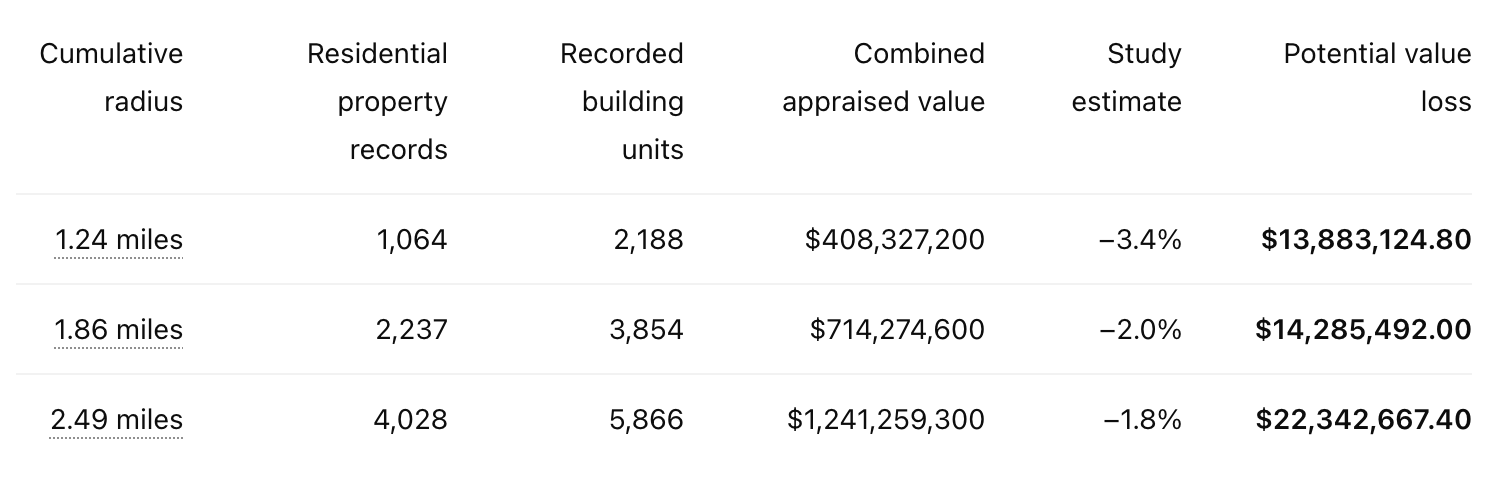
Both broader estimates remained statistically significant, suggesting that the potential impact could reach every home in Williamsport and extend into neighboring towns such as Hagerstown, Halfway, Kemps Mill, Pinesburg and Wilson-Conococheague. Based on the findings of the study, across the full 2.49-mile area, residential property values could decline by as much as $22.3 million. This shows the scale of the risk DHS has failed to analyze publicly: even a modest percentage decline could shift millions of dollars in costs onto nearby property owners.
A separate 2025 working paper from North Carolina State University found even larger reductions. Economist Allyson Emblom-Hooe analyzed repeat sales of single-family homes near correctional and rehabilitation facilities across the southeastern United States and estimated that newly opened detention facilities reduced nearby property values by an average of approximately 20 percent. Because this is a working paper that has not yet been peer-reviewed and it uses different definitions of “nearby” for urban and rural areas, we are not applying its 20 percent estimate to the Williamsport properties. Its findings do, however, provide additional evidence that opening a large detention facility can impose substantial costs on neighboring homeowners and that DHS has no basis for simply assuming those costs will not exist.
They can call it a “processing facility”, but home buyers will still see a jail
DHS and Washington County Commissioners have tried to distance this project from the word “detention” and have publicly referred to the facility as a processing facility, though referring to it as a detention center in internal communications. The plans include holding spaces, perimeter fencing, lighting, cameras, recreation areas, guard shacks, and strangely, a gun range. Just because county and federal officials prefer a softer name for the facility, does not change the optics of what potential homebuyers see when looking where to purchase.
Economists use the term “disamenity” for a nearby feature that makes a location less desirable. The prison study specifically discusses the disamenities associated with correctional facilities and concludes that their negative effects are highly localized and there is no reason to believe that would be different in Williamsport. Whether a prospective buyer calls the Williamsport project a detention center, a processing facility, or an ICE jail, the relevant question is the same: will that buyer be willing to pay as much for a home located next to it versus a home that is not?
DHS must tell residents what this project could cost them
The community risks should have been examined before DHS purchased the warehouse, not discovered by residents after the money was spent. DHS’s own environmental-review manual says the appropriate analysis and documentation should be completed before the agency makes a decision that irretrievably commits resources or limits reasonable alternatives. Instead, a federal judge found that the actual Record of Environmental Consideration for the Williamsport project was only five pages, was signed after 4 PM on January 15, 2026, and was followed by the $102.4 million purchase the next day. This led to the judge granting a preliminary injunction after concluding that DHS failed to comply with the basic requirements of the National Environmental Policy Act (NEPA).
DHS did not stop with the purchase. On March 6, 2026, it awarded KVG LLC a task order worth up to $641.8 million to renovate the ICE-owned warehouse into a processing and detention facility and provide all necessary wraparound services for its operation. Added to the $102.4 million purchase price, however, it means DHS put as much as $744.2 million behind this project without first completing a lawful, site-specific environmental review of what it could cost the surrounding community.
NEPA is supposed to force federal agencies to take a hard look at reasonably foreseeable consequences before committing to a project and to make relevant information available for public scrutiny. That does not necessarily require DHS to predict the exact sale price of every nearby home, and property-value harm alone does not automatically decide whether an Environmental Impact Statement is required. But DHS cannot simply ignore a credible, localized economic effect connected to traffic, noise, pollution, utility demands, emergency-service burdens and a fundamental change in neighborhood character.
DHS has publicly disclosed no analysis of how this proposed jail could affect nearby home values. Now that peer-reviewed national research and Maryland’s own property records identify a specific risk to 4,028 residential properties, the agency’s forthcoming environmental review must confront it. If DHS believes the Williamsport project will not produce the kind of property value decline identified in the study, it should be required to explain why, disclose the evidence supporting that conclusion and give the public a meaningful opportunity to respond.
As part of its environmental review, and before it moves any further toward opening the facility, DHS should be required to analyze and publish the impact this likely will have on nearby home values. DHS should:
Compare sales of the homes nearby the facility with similar Washington County neighborhoods farther from the site.
Measure any change after the facility was announced as well as any projected change after it opens.
Disclose the data, methodology and results to the public before any final decision.
Explain what mitigation or compensation will be available if neighboring property owners are expected to suffer losses.
Washington County residents have already been told this project will bring jobs, but they have not been told what it could subtract from the value of the homes they spent years paying for. Until DHS and the county commissioners can answer that question honestly, they have no business dismissing this risk or telling residents that the proposed ICE jail will be good for the local economy.
Find out what this facility could cost your home, then tell DHS
Potential harm to nearby home values is a legitimate subject for public comments during DHS’s environmental review. The strongest comments connect the financial risk to the facility’s foreseeable effects on traffic, noise, lighting, pollution, water and sewer systems, emergency services and neighborhood character. DHS’s own NEPA instruction manual calls for the agency to consider environmental and socioeconomic consequences, and DHS has addressed property-value concerns in a previous Environmental Impact Statement.
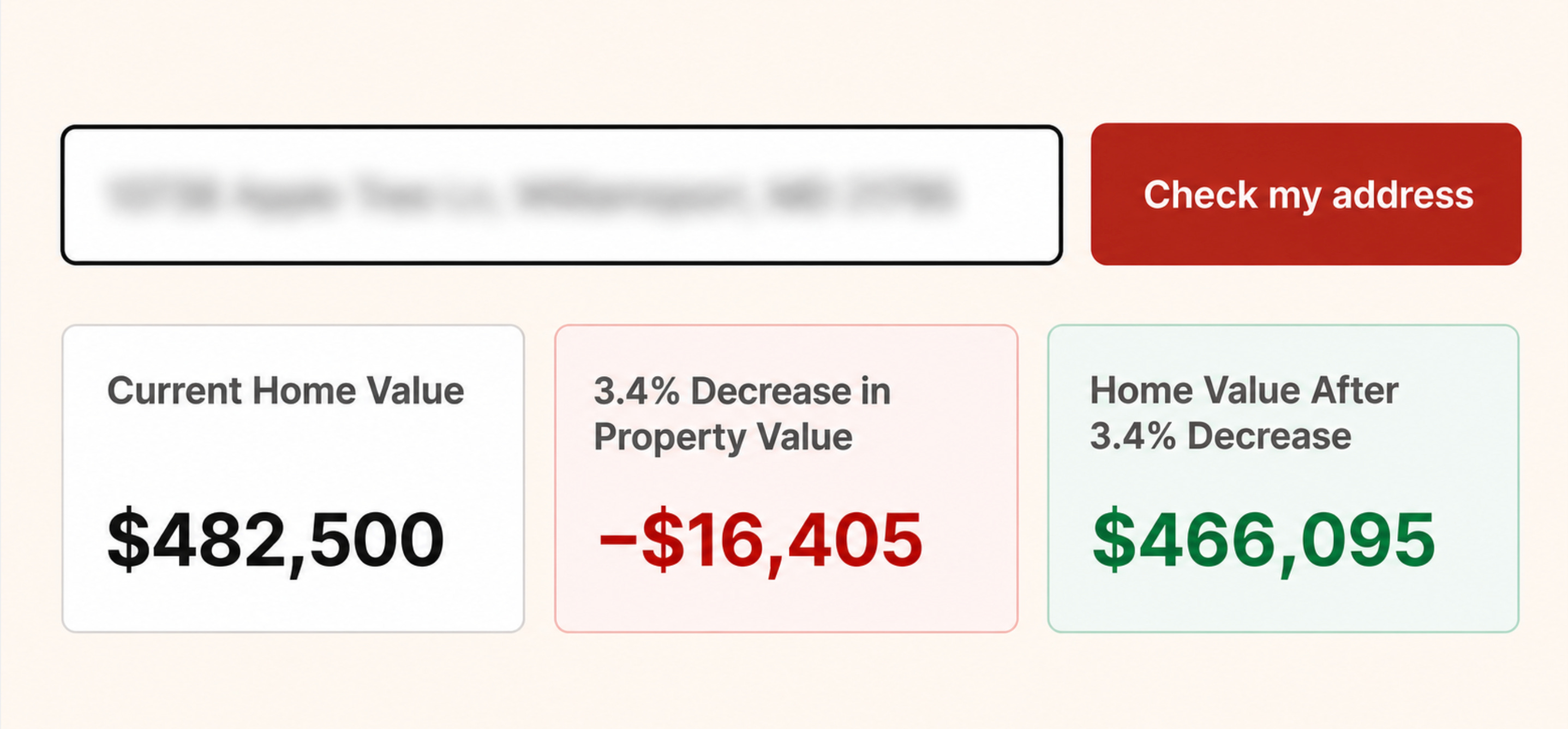
Use our free address checker at ICEJailTax.com to see whether your home is within 2.49 miles of the proposed ICE jail. If it is, the tool will retrieve your home’s current official Maryland SDAT appraised value and show the potential dollar loss and reduced value after applying the peer-reviewed study’s estimated reduction in value. The result is an estimate of potential risk, not a guarantee that every property will lose exactly that amount, but it gives nearby homeowners individualized evidence DHS should be required to confront.
If your address is within the 2.49-mile radius, copy the figures from our home value checker at ICEJailTax.com and then use this information in a public comment to DHS opposing the opening of the ICE jail through our campaign. You can use this language:
My home is located approximately _____ miles from the proposed ICE detention center in Washington County, Maryland. Maryland’s official property records currently appraise it at $_____. A peer-reviewed national study published by MIT Press in The Review of Economics and Statistics estimated that home values declined by 3.4 percent within 1.24 miles of newly opened prisons, 2.0 percent within 1.86 miles and 1.8 percent within 2.49 miles. Based on my home’s distance from the proposed facility, the applicable estimate is _____ percent. For my property, that would represent a potential loss of $ and an estimated reduced value of $_____.
I am concerned that this financial harm could be compounded by increased traffic, noise, lighting, pollution, demands on water and sewer systems, burdens on emergency services and changes to the character of my neighborhood. This facility cannot be opened without DHS conducting and disclosing a site-specific analysis of how this facility could affect nearby residential property values, explain the data and methodology it uses, and identify how any losses would be avoided, mitigated, or compensated.
The federal government has already put as much as $744.2 million behind this project, and the Washington County Commissioners have already pledged their full support. The people who could be left paying the price were never given an equally serious analysis of what the facility could do to their homes, their neighborhood, or the equity they spent years building.
That is what DHS must confront before this project moves forward. Use the checker, tell DHS exactly what this proposed ICE jail could cost your family and demand that the agency select the no-action alternative. Washington County residents should not be forced to gamble millions of dollars in home value on a detention center they never asked for.
🚨 Don’t forget to join us this Tuesday morning! 👇

And this will deplete property tax income which will lower the funding for public schools.
Great job using the studies and making a projection on impact. We can replicate this across sites!! Thanks. Ellis www.noccus.org