



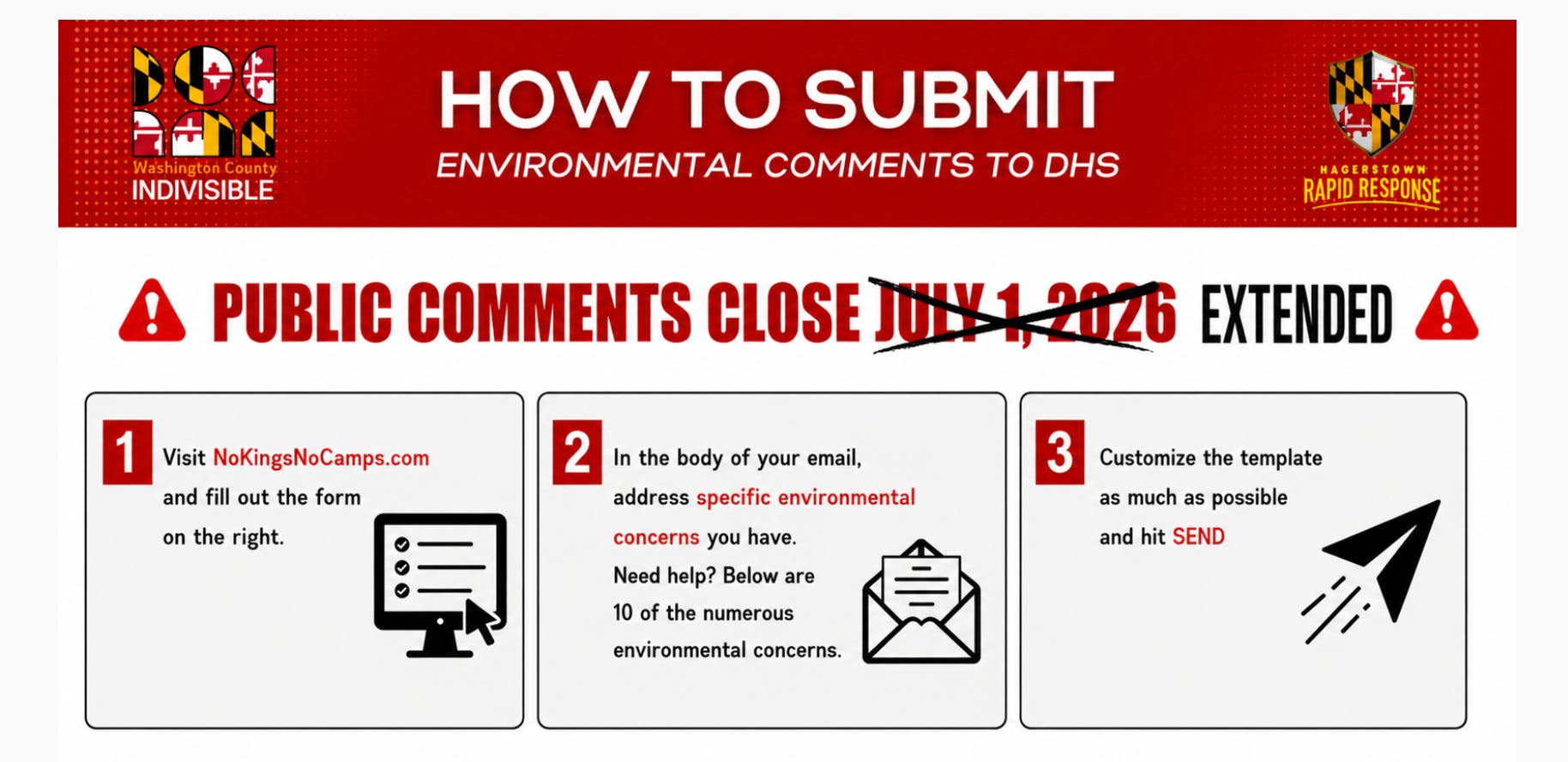
When the Department of Homeland Security’s public comment period closed on June 30, more than 4,300 people had submitted comments through our campaign opposing the agency’s proposal to convert an 825,000-square-foot industrial warehouse in Washington County into a massive ICE detention center. According to DHS, that public comment process is now over. We do not agree, and neither do many of the organizations and public officials who have spent the past month demanding that the agency conduct this process in a transparent and lawful manner.
We at Hagerstown Rapid Response and Washington County Indivisible will continue accepting public comments through NoKingsNoCamps.com and delivering every submission directly to DHS until the agency releases the environmental and infrastructure studies it relied upon and provides the public with a new 30-day opportunity to review and comment on those materials.
The reason is straightforward. DHS asked the public to weigh in on the environmental and infrastructure impacts of this project while refusing to disclose the very reports it relied upon to conclude those impacts either do not exist or are not significant. According to the agency’s own Environmental Assessment, those withheld documents include a Wastewater and Domestic Water Infrastructure Assessment, a third-party Phase I Environmental Site Assessment, a site utilities report, floodplain information, and documentation related to wetlands, water features, cultural resources, and threatened and endangered species. Despite relying on those materials, DHS never released them to the public while simultaneously concluding that it was “not aware of any potential for significant environmental impacts.”
That is not how a meaningful public comment process is supposed to work. Public participation only has value if the public has access to the information the agency itself relied upon in reaching its conclusions. Otherwise, people are not being asked to evaluate evidence. They are being asked to accept the agency’s assurances without seeing the underlying analysis.
It is also important to remember why this public comment period existed in the first place. DHS initially attempted to move forward with the project without conducting the environmental review required under federal law. After the State of Maryland challenged the agency in federal court, DHS was forced to prepare an Environmental Assessment and open a public comment period from June 1 through June 30. Yet even after the litigation, the agency never released the studies and assessments that formed the basis for its conclusions.
That concern was reinforced almost immediately after the comment period ended. Just hours after our campaign closed on June 30, Maryland Attorney General Anthony Brown submitted comments calling on DHS to release the environmental studies underlying its conclusions, provide another public comment period after those materials become available, prepare a full Environmental Impact Statement instead of the more limited Environmental Assessment currently underway, and even consider selling the warehouse rather than converting it into an ICE detention center. We were encouraged to see the Attorney General raise many of the same concerns that thousands of community members had already submitted through our campaign.
Shortly after Attorney General Brown’s comments were submitted and made public, we then saw more come out and oppose the ICE facility, starting with the Piscataway Conoy Tribe.
On behalf of Chief Jesse James Swann Jr and the Piscataway Conoy Tribe, this letter serves as a formal statement of concern and objection regarding reports of a possible proposal to construct an Immigration and Customs Enforcement (ICE) facility in Washington County, MD. We emphasize that neither the Tribe nor Chief Swann were consulted or notified about any such discussions or potential decisions. This absence of government-to-government communication is deeply troubling, particularly given that the proposed location falls within the ancestral homelands of the Piscataway Conoy Tribe, a Maryland State recognized Tribal Nation.
Then, soon after, the Maryland Chapter of Sierra Club submitted their public.
As three Maryland environmental agencies have warned, the impacts of this project would be significant and adverse to Williamsport, Hagerstown, and neighboring areas, and likely catastrophic with regard to its impacts on sewerage infrastructure and surrounding waterways. Given the insurmountable evidence regarding the significant impacts of this site, we urge DHS to immediately cancel its plans for a warehouse immigration detention and processing facility in Williamsport.
The proposed ICE detention center is expected to generate nearly 200,000 gallons of wastewater every day in a community that has already acknowledged significant wastewater infrastructure constraints. The site also sits adjacent to Semple Run, which flows into Conococheague Creek before reaching the Potomac River and ultimately the Chesapeake Bay. If DHS is confident those impacts have been thoroughly evaluated, it should have no hesitation in releasing the reports it relied upon so the public can review them for themselves.
Over the past month, this public comment campaign has received support from the ACLU of Maryland, Detention Watch Network, The Amica Center for Immigrant Rights, the Maryland Coalition to Stop the Camps, the Indivisible Maryland Coalition, Arsenal PAC / ResistMap, Chesapeake Climate Action Network, and many other organizations and community leaders who believe transparency is essential when decisions of this magnitude are being made.
We also designed this campaign to streamline the process and so every submission is delivered directly to DHS. Given the agency’s conduct throughout this process, we believed it was important to create a clear and verifiable record demonstrating both the volume of public opposition and the fact that every comment was delivered.
We are not continuing this campaign because we believe public participation should be endless. We are continuing it because the public has still not been given the information DHS relied upon when it concluded this project would not have significant environmental impacts. If DHS believes those studies support its conclusions, it should release them, allow the public to review them, and provide a meaningful opportunity for informed comment. Until then, we will continue collecting and delivering every public comment submitted through NoKingsNoCamps.com.
You are doing amazing work for democracy. Keep it going.
DHS is a government entity. DHS, as an institution, and every federal and contractor employee at DHS is meant to serve the American public interest. The public citizenry has made their request known during the initial public comment period on this project. DHS MUST RELEASE all of the required documentation and correspondence so that the public is completely informed of all EPA and other statutory regulations which impact the decision to deploy and ICE Immigration facility in Washington County. DHS 0 Please IMMEDIATELY comply with this request. Patricia Heyssel