



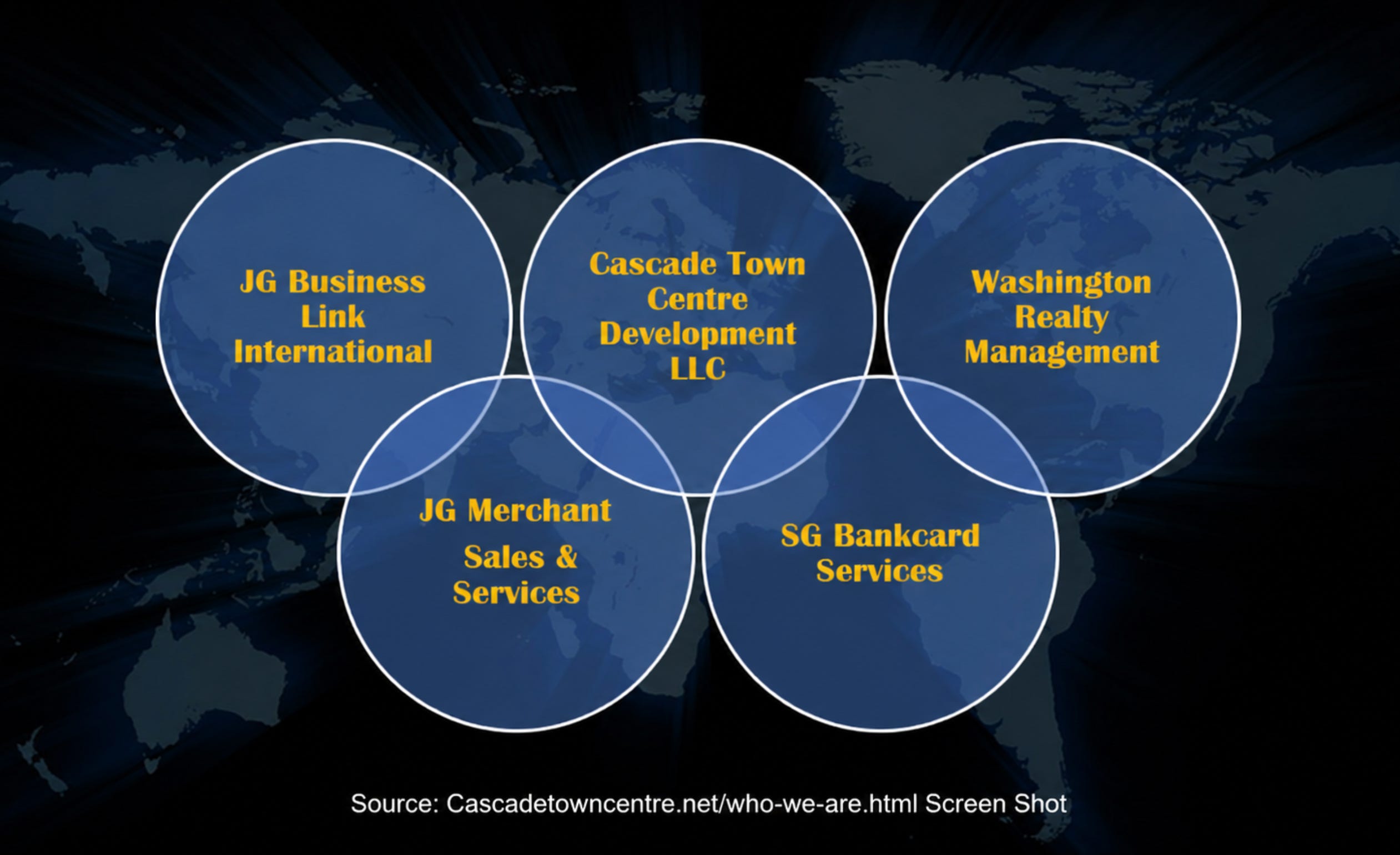
Last Tuesday, Washington County Commissioners voted to seek $1.25 million in state funding for work at Cascade Town Centre, the former Fort Ritchie Army base redevelopment. On the agenda, the company receiving the benefit is called Cascade Town Centre Development LLC, which might make this sound like some new developer that recently entered the picture. It isn’t. Cascade Town Centre Development LLC is the JGBLI-related entity that owns the 63-acre lakefront property at Fort Ritchie, and County records place it within the same JG Group development structure that has been involved with the property for years. JGBLI served as the master developer of Cascade Town Centre, while Cascade Town Centre Development LLC holds the property. In other words, this is not Washington County suddenly helping some unrelated company at Fort Ritchie. This is Washington County once again using government resources to help the same JGBLI development interests it has been supporting for years.
This time, Washington County is applying for $1.25 million on behalf of Cascade Town Centre Development LLC, putting the County between the State and the private developer and assuming the responsibilities that come with being the grant recipient. The money would pay for roadway and parking improvements, replacement of the roof on the MJ Plaza building, and new commercial electrical infrastructure. Cascade Town Centre Development would provide the required 20 percent match, while Washington County would receive the grant from the State and pass the money along to the developer.
That distinction matters because this $1.25 million should not be viewed in isolation. Washington County has already spent years creating financing mechanisms, committing infrastructure, entering agreements, and otherwise using public resources to facilitate JGBLI’s redevelopment of Fort Ritchie. Now the company name on the paperwork may be Cascade Town Centre Development LLC, but the development interests benefiting from the latest round of government assistance lead right back to JGBLI.
The application passed 3-1-1, with Commissioners Jeff Cline, Randall Wagner, and Randal Leatherman voting yes, Neil Parrott voting no, and John Barr abstaining. And JGBLI was not exactly a distant observer to all of this. JGBLI executives were sitting in the audience watching as the Commissioners considered and ultimately approved the application that could deliver another $1.25 million in government funding to their Fort Ritchie redevelopment interests. Barr said he would not participate because the proposed work includes an electrical system and electrical contracting is his business, which is a stunning reversal of how he has treated conflicts of interest in the past.
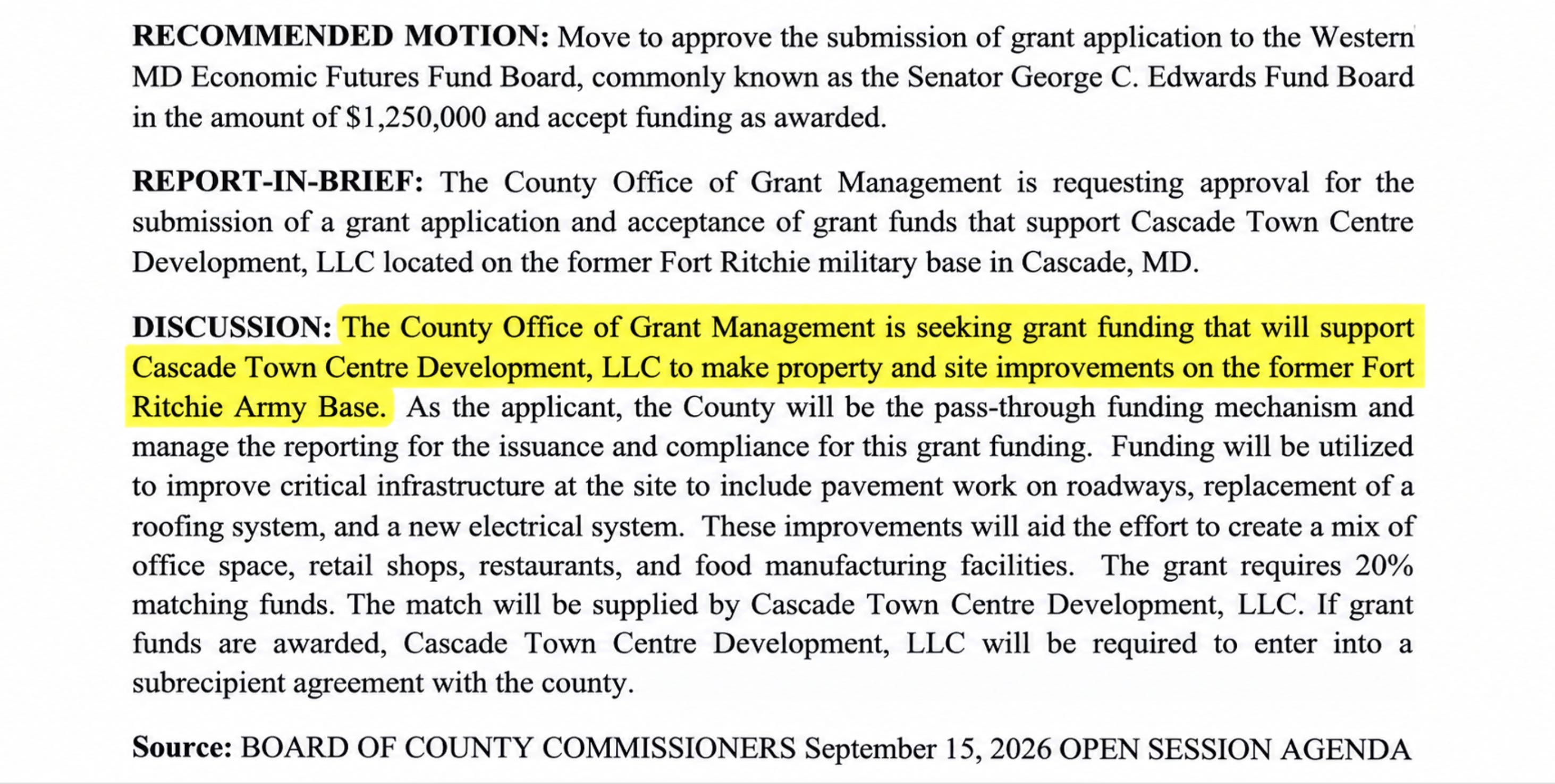
The discussion also established something fairly important that somehow did not stop three commissioners from voting for the arrangement: because Washington County would be the actual grant recipient, the County could potentially face repayment demands if the developer failed to comply with the grant agreement. County officials said they intend to protect the County through a subrecipient agreement.
Cline nevertheless defended the arrangement by explaining that “both sides benefit.” That is certainly one way to describe a deal in which one “side” gets $1.25 million in state-funded improvements benefiting its privately controlled redevelopment project while the other “side” gets to put its name on the application, administer the grant, assume the compliance obligations, and potentially answer to the State if something goes wrong. It is a wonderfully tidy description of the arrangement, provided nobody asks the much less convenient question of why Washington County needs to be standing between JGBLI’s development interests and the State in the first place.
Washington County, not the developer, would answer to the State
The money would come from the Western Maryland Economic Futures Fund, commonly known as the Senator George C. Edwards Fund. Washington County would serve as the “pass-through entity” between the State and Cascade Town Centre Development, according to County Attorney Zachary Kieffer. In practical terms, the State would award the money to Washington County, Washington County would pass it along to the JGBLI-related developer, and the County would be the governmental entity responsible for administering the grant.
Commissioner Parrott apparently committed the radical act of asking why the private developer could not simply apply for the money itself. He opposed the application because he believed the developer should apply directly rather than having County government assume the obligations that come with being the grant recipient. Considering the project is privately controlled and the developer is supplying its own required match, this is not exactly an exotic question. It is probably the first question most taxpayers would ask after hearing how the arrangement works, particularly after learning how much Washington County has already done to facilitate JGBLI’s redevelopment of Fort Ritchie.
Even Commissioner Wagner initially questioned whether the County was treating Cascade Town Centre Development consistently with other businesses seeking economic development assistance. Apparently whatever concern prompted the question was not concerning enough to affect his vote, because Wagner ultimately joined Cline and Leatherman in approving the application anyway.
Jeff Cline has been sitting remarkably close to both sides of this funding process
There is another detail that makes Cline’s enthusiasm for this particular arrangement worth a closer look. Cline previously served as Washington County’s representative on the Western Maryland Economic Future Investment Board, which is associated with the same state funding program Washington County is now asking to tap for the $1.25 million Cascade Town Centre grant.
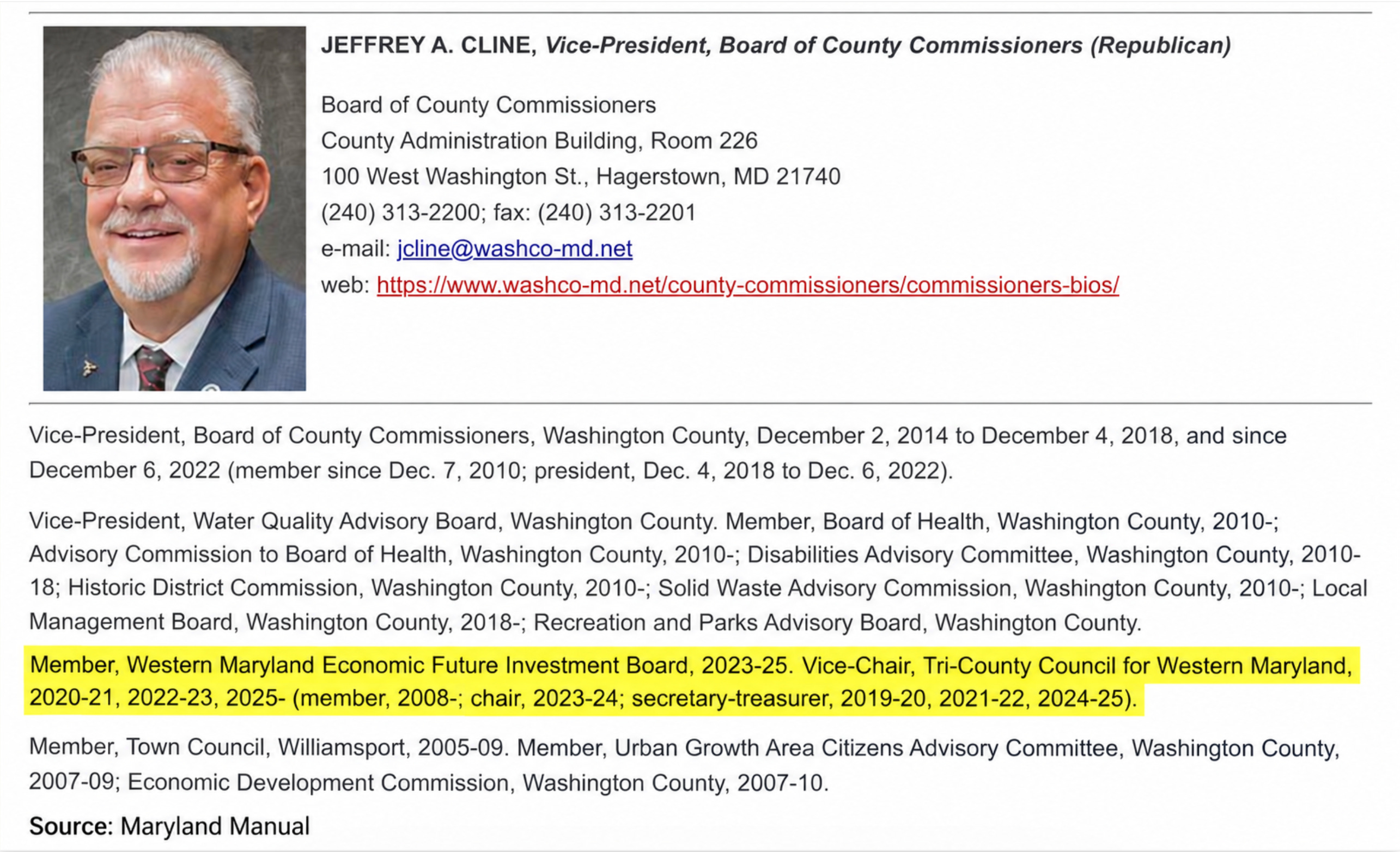
According to his bio on the Maryland Manual, Cline was a member of the Western Maryland Economic Future Investment Board from 2023 through 2025, although his name continued to appear on the fund’s website through at least March 2026. He is also currently Vice Chair of the Tri-County Council for Western Maryland.
That matters because the Western Maryland Economic Future Investment Fund is overseen by the Western Maryland Economic Future Investment Board and administered by the Tri-County Council for Western Maryland.
In other words, Cline previously served on the board connected to the fund and now serves as Vice Chair of the council that administers it. He also just voted for Washington County to apply for $1.25 million from that fund on behalf of a company tied directly to the same JGBLI redevelopment he has repeatedly supported through his position in County government.
This makes Cline’s involvement in this latest round of public funding part of a much larger history that deserves considerably more scrutiny. Cline participated in the County government that established the Cascade Development District and its TIF mechanism. He participated in the County’s earlier Fort Ritchie development arrangements. More recently, he supported the no-bid GDMS consulting agreement and the sewer agreement involving JGBLI property. Now he has voted for Washington County to serve as the pass-through recipient for another $1.25 million benefiting the same redevelopment interests while simultaneously serving as Vice Chair of the council that administers the fund.
At some point, Washington County Government should explain in considerably more detail what Washington County taxpayers are getting in exchange for repeatedly putting their government’s money, staff, administrative capacity, infrastructure responsibilities, and legal obligations behind JGBLI’s redevelopment interests at Fort Ritchie and specifically why JGBLI is the chosen benefactor. After nearly a decade of County involvement, special financing mechanisms, infrastructure commitments, agreements, consultants, grants, and other forms of government assistance, asking why the County needs to keep putting itself in the middle of these deals seems like a pretty reasonable question. And Commissioner Parrott managed to reduce the latest version of that question to its simplest form: why can’t the private developer apply for the money itself?
This is hardly the first time Washington County has put public resources behind JGBLI’s Fort Ritchie redevelopment
Cline was Vice President of the Board of County Commissioners in January 2017 when the Board established the Cascade Development District and Cascade Development District Tax Increment Fund (TIF) at Fort Ritchie. The County had acquired approximately 600 acres of the former military base and then voted to transfer 63 acres of lakefront property at Cascade Town Centre to JG Group.
The Tax Increment Financing structure created a mechanism through which future increases in County property-tax revenue generated inside the district could be used for infrastructure financing. The County minutes explicitly explained that a company interested in locating at Cascade Town Centre could request a TIF bond to pay for public infrastructure improvements, with money from the special fund available to pay the bond’s principal and interest. Then-County Administrator Greg Murray went even further, explaining that the tax revenue placed into the special fund could potentially cover the bond’s entire principal and interest.
So Washington County acquired the former military property, created a special financing district around its redevelopment, worked directly with JGBLI as master developer, transferred the 63-acre lakefront property into the JG Group development structure, and continued making infrastructure and funding decisions affecting development at Fort Ritchie even years after the original master-development agreement collapsed.
That history is precisely why the name “Cascade Town Centre Development LLC” matters. Without explaining the relationship, the latest $1.25 million can look like assistance for an entirely different company. It is not. Cascade Town Centre Development LLC is tied to the same JGBLI development operation that has benefited from years of County involvement at Fort Ritchie. The latest $1.25 million grant application is therefore not some isolated act of economic development assistance that suddenly appeared in 2026. It is another chapter in Washington County’s long-running use of government mechanisms to help JGBLI’s redevelopment interests at Fort Ritchie.
The Commissioners also committed the County to improving sewer infrastructure serving JGBLI property
Earlier this year, Commissioners approved an amended agreement focused on improving sewer infrastructure on approximately 63 acres of JGBLI property at Fort Ritchie. Under that arrangement, Washington County would improve the sewer infrastructure and ultimately take ownership of it. JGBLI, in return, would be responsible for improving North Boyd Street, Cushman Avenue, Hart Avenue, and Lake Wastler Drive to County standards before dedicating those roads to Washington County.
Parrott objected to the sequence of those obligations because the County would perform its sewer work before the developer completed its road improvements. He proposed requiring a bond to protect the County if the developer failed to finish the roads, and that protection was ultimately added. Once again, it took somebody asking what happens if the private party does not fulfill its end of the arrangement before additional protection for the County was added.
That same special meeting produced another remarkable piece of this increasingly tangled story. Washington County hired former County Administrator Greg Murray through a no-bid GDMS consulting agreement to advise the County on water, sewer, infrastructure, and economic development planning. Murray had previously become CEO of a company connected to JGBLI. During the same meeting, Commissioners approved an agreement under which Washington County would improve sewer infrastructure serving JGBLI’s private property. Then, only a few months later, Cline voted for Washington County to put itself between the State and Cascade Town Centre Development LLC, the JGBLI-related entity controlling the 63-acre lakefront property, to obtain another $1.25 million in government funding.
Looking at each of these decisions individually makes it easy to get lost in the government jargon: TIF districts, grant applications, pass-through entities, subrecipient agreements, sewer infrastructure, consulting agreements, development districts, road dedications, state funds. Looking at them together makes the pattern considerably easier to understand. Washington County keeps finding different government mechanisms to put public resources, public infrastructure, public employees, public administrative capacity, and public responsibility behind the same private redevelopment interests at Fort Ritchie.
The company name on the latest application may be Cascade Town Centre Development LLC. The history behind it is JGBLI.
After years of these arrangements, the question is no longer whether Washington County has supported JGBLI’s redevelopment interests at Fort Ritchie. The public record makes clear that it has, repeatedly and through multiple mechanisms. The question now is why County government continues assuming responsibilities and committing resources that the private developer would otherwise have to handle itself, and why Cline remains so consistently willing to put Washington County in that position.
The latest $1.25 million makes that question especially difficult to ignore. Washington County is not simply supporting “economic development” somewhere in the County. It is going back to the same Fort Ritchie redevelopment, involving the same JGBLI development interests, and once again putting government resources behind it. Only this time, Washington County is also volunteering to serve as the middleman so a JGBLI-related company can receive another $1.25 million in government funding.
Which brings us right back to the question another commissioner already asked: if this private development needs another $1.25 million, why can’t the private developer apply for the money itself?
Once these folks are out of power I encourage you to teach a course in an urban planning or political science framework on small town corruption and misfeasance. Maybe even malfeasance