



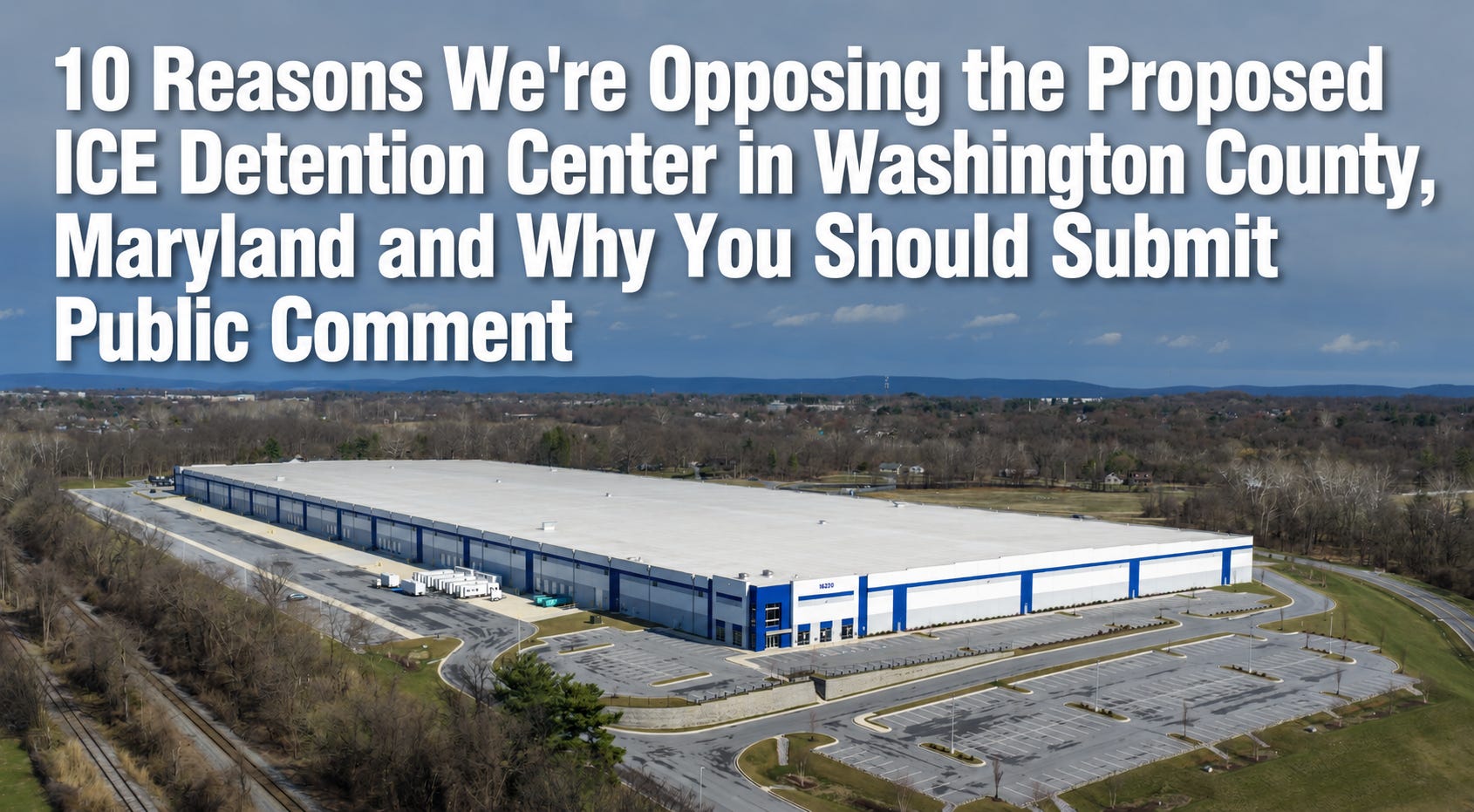
For months, we at Hagerstown Rapid Response and Washington County Indivisible, alongside concerned residents from across the region, have been demanding transparency, accountability, and answers about the proposed ICE detention center in Washington County, Maryland.
Week after week, hundreds of residents have protested, attended meetings, submitted records requests, spoken to reporters, conducted research, and organized their neighbors because we believe a project of this magnitude deserves far more public scrutiny than it has received. As more information has emerged about closed-door discussions, non-disclosure agreements, infrastructure concerns, environmental impacts, and controversial decisions connected to the proposed facility, public trust in the process has continued to erode.
Many people in our community are frustrated. Many are angry. But above all, people are determined not to let a massive detention facility quietly move forward without a full public accounting of its impacts on our county.
Now, residents have an opportunity to put their concerns directly into the federal record.
As part of its environmental review process, the Department of Homeland Security is accepting public comments through July 1 on the proposed ICE detention center. Every submitted comment becomes part of the official review process and helps document the project’s potential impacts on our community, infrastructure, environment, public services, economy, and quality of life.
That is why we are encouraging everyone who cares about the future of Washington County to submit a public comment. If you agree that this project deserves careful scrutiny, you can submit a comment directly through our Action Network campaign here:
👉 https://actionnetwork.org/letters/tell-dhs-stop-the-ice-warehouse-in-washington-county
The federal government is asking for public input. We believe Washington County residents deserve to be heard.
And if you’re not sure what to write, we’ve done the research for you. Below are ten reasons we oppose the proposed ICE detention center and ten concerns you can use, adapt, or build upon when submitting your own public comment to DHS.
1.) Human Rights
For many residents, this is the core issue.
ICE detention facilities across the country have faced years of allegations involving unsafe conditions, inadequate medical care, abuse, neglect, family separation, and violations of detainees’ basic rights. People in Washington County have watched those stories unfold nationally and do not want their own community becoming part of that system.
In March, we wrote about growing concerns from doctors and medical professionals regarding conditions inside ICE detention facilities, including reports involving overcrowding, lack of medical care, unsanitary conditions, preventable deaths, and worsening mental health crises. In many cases, detainees are held in conditions that medical experts and human rights advocates say can have devastating long-term physical and psychological consequences. Why should Washington County help expand that system here in our own backyard?
There is a difference between enforcing immigration law and building large-scale detention infrastructure in local communities. We do not want Washington County becoming nationally associated with confinement, ICE detention expansion, and the warehousing of human beings. Many of us view remaining silent about this as a form of complicity.
2.) Wastewater, Runoff, and Pollution
One of the most serious concerns surrounding the proposed ICE warehouse involves wastewater, pollution, and long-term environmental strain on the region.
Right now, the warehouse receives water from the City of Hagerstown and reportedly has an approved allocation of just 800 gallons per day. That could change dramatically if the facility is converted into a large-scale detention center housing anywhere from 500 to 2,000 detainees. According to findings referenced by the Maryland Department of the Environment, the proposed detention facility could generate at least 187,500 gallons of wastewater per day.
That is an enormous increase, and residents have repeatedly questioned whether local infrastructure can realistically handle that kind of demand without major environmental consequences.
In March, KVG LLC was awarded a three-year, $642 million contract to retrofit the warehouse so it can hold detainees. Maryland Attorney General Anthony Brown later warned in court filings that sediment runoff connected to the construction work is likely to affect Semple Run, the stream that borders the southern and western edges of the property and receives discharges from the site’s existing stormwater management system.
That matters because Semple Run is not an isolated stream. It is an important cool-water tributary of Conococheague Creek, which ultimately feeds into the Potomac River. Pollution entering Semple Run would not simply stay near the warehouse site. It could impact downstream waterways throughout the region.
We are especially concerned because Maryland’s lawsuit argues that federal officials failed to conduct the kind of full environmental review normally required under the National Environmental Policy Act (NEPA) before moving forward with the project. For many people in Washington County, that raises a larger question: if officials are confident the project is safe, why rush past the environmental review process?
Residents are also concerned about stormwater runoff, floodplain impacts, sewer capacity, and what happens if local systems become overloaded over time. People here understand that wastewater systems are not unlimited. They understand that once environmental infrastructure is strained beyond capacity, communities can spend decades paying the price for it.
3.) Public Health
Public health concerns have become one of the biggest reasons residents continue protesting outside the Washington County Commissioners meetings.
In March, we held a protest focused specifically on the public health risks tied to the proposed ICE warehouse project. The demonstration came after dozens of doctors, nurses, therapists, and healthcare professionals signed a public letter warning about the human and medical consequences associated with immigration detention facilities.
In that letter, more than 50 healthcare professionals raised concerns about conditions that have repeatedly been documented inside ICE detention centers across the country, including overcrowding, delayed medical care, lack of adequate mental health treatment, infectious disease risks, poor sanitation, dehydration, malnutrition, and preventable deaths. The signatories warned that detention itself can create severe psychological trauma, particularly for vulnerable populations and people with preexisting medical or mental health conditions.
Residents are also worried about the broader strain a facility of this scale could place on local healthcare infrastructure. This ICE detention center would inevitably create additional demand on emergency medical services, hospitals, ambulances, and healthcare systems that are already overstretched.
At a time when Washington County families already face long waits for healthcare access and increasing pressure on local medical systems, adding a massive detention facility would create even more strain on resources the community already depends on every day. The question is simple: why would Washington County want to become part of expanding a system that medical professionals themselves are warning about?
4.) It Will Hurt Tourism
Washington County has spent years trying to promote itself as a destination for history, outdoor recreation, small businesses, local events, and scenic tourism.
People visit this region for the C&O Canal, Civil War history, hiking trails, wineries, festivals, restaurants, and the overall character of the area. And becoming nationally associated with a massive ICE detention facility would fundamentally damage that image and discourage visitors from wanting to spend time or money here.
Earlier this year, more than 120 civil rights and civil society organizations, including the ACLU and Amnesty International, issued a travel advisory ahead of the 2026 FIFA World Cup warning international visitors about the United States’ expanding immigration enforcement system and conditions inside ICE detention facilities. The advisory warned travelers about risks including detention, racial profiling, aggressive immigration enforcement, and what it described as “cruel, inhuman, or degrading treatment” inside ICE detention facilities.
That kind of international attention matters. Tourism depends heavily on perception, reputation, and whether people view a place as welcoming and safe. Communities do not spend years building tourism economies just to become nationally known for detention infrastructure and political controversy.
Residents are concerned that Washington County could increasingly become associated with ICE expansion, protests, lawsuits, and federal detention operations instead of the things that actually make this region special.
Communities develop reputations that can last for decades. Many people simply do not want Washington County’s identity tied to detention facilities, government secrecy, and national controversy.
5.) It Will Drop Property Values
Residents living near the proposed site have legitimate concerns about property values. Large controversial institutional projects often affect how nearby areas are perceived by homebuyers and investors. Increased traffic, security infrastructure, environmental concerns, industrial activity, and constant controversy can change the character of an area over time.
Recent Zillow housing forecast data suggests those concerns may already be beginning to emerge in Williamsport. While Washington County as a whole is still projected to experience modest home value appreciation, Williamsport appears to be underperforming many surrounding ZIP codes during the same period DHS is attempting to open the massive ICE detention warehouse. The data does not prove the facility is causing this trend, but it raises legitimate questions about whether the proposed detention center and the controversy surrounding it are beginning to affect buyer sentiment locally.
And there is growing research suggesting those concerns are not unfounded. A recent economics study from North Carolina State University examining correctional and rehabilitation facilities found that nearby property values declined by an average of roughly 20 percent after new facilities opened, with larger facilities associated with even greater impacts.
As one Williamsport homeowner who lives directly across the street from the warehouse recently told Tracee Wilkins of NBC 4, after living there for nearly 30 years, she now plans on moving.
For many families, their home is the single largest investment they will ever make. People are understandably worried about decisions that could negatively affect that investment and reshape surrounding neighborhoods.
6.) Increase in Taxes, Reduction in Tax Revenue
Local taxpayers will most likely eventually absorb costs connected to the project, even if the federal government is involved. As we reported in March after filing a Maryland Public Information Act request, Washington County leaders requested up to $386 million from the federal government for infrastructure improvements needed with the opening of the ICE detention center.
Large facilities create additional burdens involving roads, infrastructure upgrades, emergency services, planning, environmental oversight, and legal disputes. Communities are often promised that projects will pay for themselves, but history shows local governments frequently end up carrying unexpected costs years later.
The Department of Homeland Security’s purchase of the warehouse has also removed the property from the local tax base entirely. Once federally owned, the property becomes tax-exempt, meaning Washington County and other local entities no longer collect property tax revenue from one of the largest industrial properties in the region. According to Radio Free Hub City, this equates to the community losing two million dollars in tax revenue in 2026 and $700,000 every year afterward.
That loss matters. Property taxes help fund schools, infrastructure, public services, emergency response systems, and local government operations. When large federally owned facilities become tax-exempt, municipalities and school systems can lose significant long-term revenue while still being expected to handle the indirect impacts and infrastructure demands connected to the project.
At a time when many families are already struggling financially, residents are asking why Washington County should take on additional costs and risks connected to a controversial project that so many people oppose.
7.) Increase in Utility Costs
Water and sewer infrastructure upgrades are expensive, and somebody eventually pays for them. Large-scale facilities place enormous pressure on existing water infrastructure, especially in rural communities that rely on limited municipal systems or private wells. That kind of demand can lower water pressure, strain local supply systems, and require costly infrastructure upgrades that local households ultimately end up paying for through higher utility bills and expanded water and sewer costs.
If local systems require expansion or additional capacity to support the detention facility, those costs will eventually be passed on to ordinary households through higher utility bills.
People throughout Washington County are already dealing with rising costs for basic necessities. We do not want to see utility systems strained further by a massive detention operation.
8.) Overwhelming the Area
One of the biggest concerns is the sheer scale of the proposed project compared to the surrounding area.
Facilities like this do not quietly blend into communities. They change traffic patterns, infrastructure needs, political dynamics, public perception, and the overall character of a region. In smaller communities especially, projects of this size can completely alter the social and economic fabric of daily life.
Many residents fear Washington County could become defined by this facility in ways that would be impossible to reverse.
9.) Strain on Local Resources & Infrastructure
Projects like this place demands on nearly every part of local infrastructure.
Roads, utilities, emergency response systems, healthcare networks, environmental systems, public planning departments, and local services all face additional pressure when large institutional facilities are introduced into a community.
Residents have repeatedly asked whether county officials have honestly accounted for those long-term impacts. Many feel those questions still have not been fully answered.
10.) Safety & Community Disruption
People are also concerned about the broader disruption a facility like this could bring to the area.
That includes concerns about increased traffic, security operations, law enforcement coordination, protests and counterprotests, emergency incidents, and the tension that often follows highly controversial federal projects.
Beyond physical safety concerns, many residents are worried about the emotional impact of normalizing large-scale detention infrastructure in the community. They want Washington County known for families, neighborhoods, parks, local businesses, and opportunity. Not for becoming another detention hub.
Take Action Before July 1
The public comment period is one of the few opportunities residents have to ensure their concerns become part of the official federal record. Whether your concerns are about environmental impacts, wastewater capacity, property values, public health, infrastructure, emergency services, government transparency, or the human consequences of detention, your voice matters.
This is not just a Maryland issue. The proposed ICE detention center sits near the headwaters of waterways that ultimately flow beyond Washington County and Maryland’s borders. Any environmental impacts associated with wastewater overflows, stormwater runoff, or other infrastructure failures could affect communities downstream throughout the broader region, including Maryland, Washington, D.C., Virginia, West Virginia, and Pennsylvania.
DHS is accepting public comments through July 1, but the deadline is approaching quickly.
If you agree that this proposed ICE detention center deserves greater scrutiny, we encourage you to submit a public comment today:
👉 https://actionnetwork.org/letters/tell-dhs-stop-the-ice-warehouse-in-washington-county
It only takes a few minutes, and every comment helps demonstrate the depth of community concern surrounding this project.
Together, we can ensure that Washington County’s voice is heard and that the concerns of communities throughout the region are part of the official record.
What a blight on Maryland to even consider this deadly, environmentally despicable, human rights atrocity warehouse to store, abuse and neglect human beings! There is nothing to recommend it in Maryland or anywhere in society. I wil not step foot anywhere near Washington County again if it goes through? Why would I come to a county that would support a detention disaster for people who are just trying to find a safer life for their families - like EVERY American who came before them?! NO to this further degrading of all of the things our ideals are supposed to stand for in what I hope some day will actually realize the dream of being a safe haven melting pot where everyone is treated with divinity and respect.
I agree with opposition to detention centers! ICE must be stopped now!