



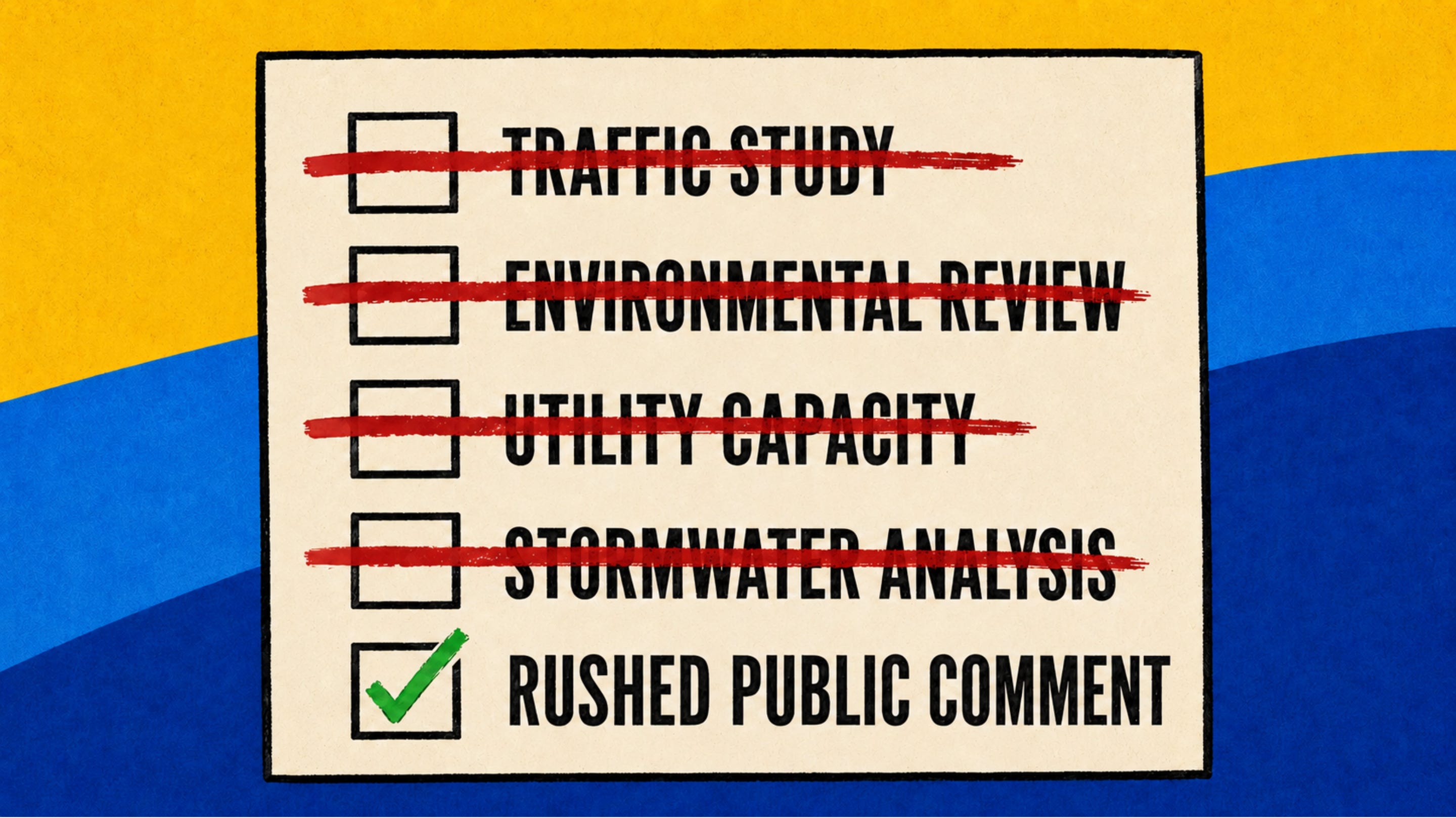
During Tuesday’s Washington County Commissioners meeting, residents will have three separate opportunities to speak about proposed changes involving water and sewer infrastructure, permitted land uses, and commercial zoning. On paper, the three hearings concern different properties and different parts of the county. However, they raise a much larger question: What kind of industrial and commercial development are county officials preparing Washington County to accommodate?
Residents have every reason to examine these proposals closely, especially after how much planning for the proposed ICE detention warehouse occurred outside public view.
In April, we uncovered that in December, 2025, Washington County Commissioners signed a nondisclosure agreement involving a secret land deal. One month later, it was announced that the federal government then purchased an 825,000-square-foot warehouse in Williamsport and began preparing it to hold as many as 1,500 people, even though major questions about wastewater capacity, emergency services, traffic, environmental impacts, and other infrastructure remain unanswered.
We are also deeply skeptical that the Department of Homeland Security intends to limit the facility to 1,500 people over the long term. Before abandoning plans for seven other warehouse detention centers last month, the agency planned to confine far more people inside buildings of comparable size. In Salt Lake City, for example, DHS purchased an approximately 833,000-square-foot warehouse, nearly the same size as the Williamsport building, with plans to detain between 7,500 and 10,000 immigrants there. Salt Lake City and Salt Lake County confirmed those projected numbers when they sued to stop the facility. Given DHS’s record of secrecy, residents have no reason to assume that the publicly stated capacity for Williamsport represents the agency’s ultimate plan.
Viewed in this broader context, county zoning and infrastructure decisions warrant far greater scrutiny. They determine what can be built, where it can be built, and how easily a proposal can move forward once the public finally learns about it.
The irony is impossible to miss. The commissioners are now holding three public hearings and asking residents to participate in decisions involving zoning, infrastructure, and future development. Yet they have repeatedly refused to allow residents to comment on the proposed ICE detention center during their meetings, even as the project raises many of the same questions about water, sewer capacity, emergency services, traffic, environmental effects, and land use.
On February 10, the commissioners unanimously adopted a resolution declaring their full support for DHS and ICE while the detention warehouse was at the center of intense local controversy. They were willing to take an official position supporting the agencies behind the project, but they have refused to provide the public with any forum to challenge the facility itself. Public participation cannot be treated as legitimate when it is offered for some major development decisions but withheld when residents oppose a project the commissioners have already chosen to support.
The Commissioners Have Already Given Residents Reasons to Be Suspicious
The lack of transparency surrounding these hearings is part of a broader pattern. On May 21, the commissioners held a special meeting and approved a consulting contract with GDMS LLC, a company operated by former County Administrator and former Water Quality Director Greg Murray, to study the county’s water and sewer capacity, infrastructure, and future development needs.
Strangely, the contract was not competitively bid. Commissioners Neil Parrott and Randal Leatherman opposed it after raising concerns about the selection process and the appearance of awarding such a consequential contract without seeking competing proposals. Nevertheless, Commissioner President John Barr cast the decisive vote in the 3–2 approval and was designated to sign the contract on the county’s behalf. The county’s official minutes document the vote and Barr’s role as signatory.
The no-bid award also involves a personal and professional relationship that should have been disclosed and discussed publicly. Greg Murray’s wife, Debra Murray, became chief financial officer of Ellsworth Electric, the company founded by John Barr, in 2018. Barr nevertheless cast the decisive vote awarding the consulting contract to Greg Murray’s company and was designated to sign it on the county’s behalf. That relationship does not appear in the county’s agenda report. At a minimum, Barr should publicly disclose the relationship, explain whether he sought an ethics opinion before participating, and release any such opinion. Awarding a no-bid public contract to the company of a person whose spouse held a senior financial position with Barr’s family business creates exactly the appearance of favoritism that transparent procurement and ethics procedures are supposed to prevent.
The materials presented to the public provided remarkably little accountability for such a broad assignment. The agenda report listed the fiscal impact, alternatives, and concurrences as “N/A.” The contract’s examples include reviewing water and sewer capacity, regulatory requirements, growth projections, neighboring utility systems, economic development objectives, service consolidation, joint agreements, and regional infrastructure projects. It also allows GDMS to perform unidentified additional tasks, including work outside utility evaluations, if directed. The initial scope of work did not even have to be developed until after the contract became effective. Those terms appear in the county’s revised meeting packet.
At the same special meeting, the commissioners voted 4–1 to amend an agreement with JG Business Link International Inc. under which the county would undertake improvements to the private sewer system serving approximately 62.9 acres at the former Fort Ritchie property. Now, two months later, the commissioners are holding a public hearing on an amendment that would significantly revise the zoning rules governing the broader Special Economic Development district at Fort Ritchie. Meanwhile, another hearing concerns extending water and sewer service to nearly 1.85 million square feet of proposed warehouse space near the Pennsylvania line.
Hiring a former senior county official through a process that did not include a broader search for consultants raises legitimate questions about favoritism and public accountability. Those concerns are heightened by the county’s agenda report, which listed the contract’s fiscal impact, alternatives, and concurrences only as “N/A,” even though the attached contract established an hourly payment arrangement and permitted additional assignments beyond the specifically identified utility work. When Barr cast the deciding vote despite objections to the selection process, he added another layer of suspicion to decisions involving valuable development rights and major public infrastructure. Residents are justified in asking who is shaping these decisions, which developers or properties could benefit, and how much may already have been decided before the public is invited to comment

A Temporary Moratorium Is Not a Permanent Safeguard
The commissioners recently voted 4–1 to impose a 12-month moratorium on the acceptance, processing, review, and approval of new data-center applications. Although the published meeting packet formally proposed a six-month pause, County Administrator Michelle Gordon said during the hearing that staff’s initial assessment called for 12 to 18 months and that staff recommended 18 months to examine potential effects on residents, the local economy, water and utility resources, infrastructure, and other regulatory concerns. County officials have also explicitly stated that the moratorium is not intended to prohibit data center development permanently. It merely delays the acceptance and review of applications while the county considers new regulations. The county’s moratorium materials also acknowledge that its current zoning ordinance does not specifically address data centers.
The moratorium may offer temporary protection, but it should not be mistaken for a final policy or binding long-term commitment. The same commissioners who enacted it retain the power to amend or repeal it through later official action. They could also adopt weak regulations at the end of the study period and begin accepting applications once the moratorium expires. Without a transparent study, enforceable standards, meaningful public participation, and a clear explanation of which zoning categories could accommodate data centers, the pause risks becoming little more than a dog-and-pony show designed to reassure residents while county officials prepare to permit these projects later.
This distinction is especially important when considering RZ-26-002, one of the projects open for public comment on Tuesday. It is not the county’s promised new data center ordinance, but a narrower amendment to the existing zoning rules governing the former Fort Ritchie property. The amendment would remove “Data Processing Facilities” as an expressly permitted use, but it neither defines nor expressly prohibits “data centers.” Removing that category may eliminate one potential route for approving a data center at Fort Ritchie, but it does not permanently settle whether one could be allowed there.
The county plans to develop separate data center regulations during the temporary moratorium. As part of that process, the commissioners could later decide whether data centers will be permitted at Fort Ritchie or elsewhere in Washington County and under what conditions. Residents should therefore demand clear definitions, binding protections, and meaningful opportunities for public participation before the moratorium expires or any permanent regulations are adopted.
1.) Water and Sewer Plan Amendment WS-25-004
The first hearing, scheduled for 9:30 a.m., concerns approximately 172 acres at 17939 Mason Dixon Road near the Maryland-Pennsylvania line. The company, 2003 Mason Dixon LLC, wants the county to change the property’s water and sewer classification from “planned service” to “programmed service” and formally recognize the Antrim Township Municipal Authority in Pennsylvania as a provider of water and wastewater service to eligible properties in Maryland.
The applicant is planning two warehouse or distribution buildings measuring approximately 1,237,600 and 611,520 square feet, for a combined total of nearly 1.85 million square feet. A site plan for the development, SP-23-004, is already under review by regulatory agencies. The Planning Commission has recommended approval of the amendment. The county’s hearing packet confirms the proposed warehouse sizes and requested utility changes.
The scale of the project alone would be more than twice the size of the 825,000-square-foot warehouse the Department of Homeland Security purchased in Williamsport. A development of that magnitude could generate substantial traffic, stormwater runoff, utility demand, construction disturbance, emergency-service needs, and effects on nearby groundwater and private wells. Its size makes comprehensive environmental, infrastructure, and public-safety studies essential before officials approve the Water and Sewer Plan amendment needed to serve it.
The hearing gives residents an opportunity to ask what these buildings are expected to contain, how much water and electricity they could eventually require, how much wastewater they could generate, and whether the proposed use could change after the infrastructure amendment is approved. Residents should also ask what safeguards would prevent the buildings from being converted into other intensive uses without another meaningful opportunity for public input.
The county’s own records state that the property is located within a wellhead protection area designated by the Maryland Department of the Environment and that individual wells and septic systems would be inadvisable because of the potential for groundwater contamination. County staff have argued that connecting the development to public utilities in Pennsylvania would be preferable to relying on private wells and septic systems and would preserve capacity in Washington County.
Connecting the proposed warehouses to public water and sewer service may be preferable to drilling new wells and installing septic systems on the property, but it does not resolve the potential risk to residents already relying on private wells nearby. Construction and operation of nearly 1.85 million square feet of warehouse space could alter stormwater drainage, increase impervious surfaces, disturb soil, and introduce new sources of contamination within a designated wellhead protection area. Before approving the amendment, officials should identify nearby private wells, establish baseline water-quality data, evaluate the development’s potential effects on groundwater, and explain who would be responsible if neighboring wells are contaminated or otherwise affected.
This hearing also appears to repeat the same basic failure that undermined the Department of Homeland Security’s public comment process for the proposed ICE detention center. DHS asked the public to evaluate its environmental conclusions without releasing the studies and infrastructure assessments underlying them. Now, the Washington County Commissioners are asking residents to comment on a water and sewer amendment without providing other information necessary to understand its potential effects. The county’s own staff report states that the Antrim Township service-area boundaries were not provided and does not identify the number of people currently living within the affected area. The application materials also do not appear to identify how many nearby households rely on private wells and septic systems that could be affected by development within this designated wellhead protection area.
How can the commissioners determine the effects on existing well users when they do not know the boundaries of the proposed service area, the number of people already living within it, or the number of nearby households relying on private wells and septic systems? A public hearing cannot provide meaningful public participation when the public has not been given the information necessary to evaluate what is being proposed.
Because this proposal depends on the Antrim Township Municipal Authority supplying water and wastewater service from Pennsylvania, residents there also deserve to know how much system capacity would be committed to nearly 1.85 million square feet of new warehouse development in Maryland. County documents say the authority has confirmed that capacity is available, but residents should be shown the underlying calculations and told whether the arrangement could affect future capacity, utility rates, infrastructure costs, drought planning, or service reliability for existing Pennsylvania customers. They should also know who will pay for construction, maintenance, treatment upgrades, and emergency repairs associated with extending service across the state line.
The ICE detention controversy has demonstrated why these questions must be asked before a warehouse is built or converted, not after a government agency has purchased it and begun construction.

2.) Zoning Text Amendment RZ-26-002
The second hearing, scheduled for 9:45 a.m., concerns the Special Economic Development district covering the former Fort Ritchie property in Cascade. Cascade Properties LLC is asking the county to amend the zoning rules for the entire district rather than approve one particular building.
The application would revise the uses and development standards governing the former Fort Ritchie property. It is important to read the application’s track-changes formatting carefully. Uses shown in red and underlined would be added, while uses shown in red with a strikethrough would be removed. “Data Processing Facilities” is crossed out, meaning the applicant is proposing to remove that use from the district. “Warehouses” appears in black and would remain an existing permitted use rather than being newly authorized. The full application and proposed changes are available in the county’s hearing packet.
Crossing out “Data Processing Facilities” does not settle whether data centers could be allowed at Fort Ritchie. The county has already acknowledged that its current zoning ordinance does not specifically address data centers, which raises the possibility that officials view “data processing facilities” and “data centers” as legally distinct uses. If that is the county’s position, removing the older term would not necessarily prohibit a modern data center. It could simply leave data centers unaddressed until the commissioners adopt separate regulations after the temporary moratorium.
Commissioners should explain whether a data center could still be approved under another permitted category, through the provision allowing uses deemed “functionally similar,” or through future countywide zoning changes. Until they answer those questions clearly, residents should not assume that crossing out “Data Processing Facilities” protects Fort Ritchie from future data center development.
The importance of this hearing is broader than data centers. The amendment would change which commercial, industrial, residential, and institutional uses can operate at Fort Ritchie and, in some cases, whether those uses require a special exception or can proceed as principally permitted uses. Moving a use from the special-exception process into the list of principally permitted uses can reduce later opportunities for neighbors to object to a specific project. Residents should examine each proposed addition, deletion, and procedural change and ask how it could affect future public oversight.
Warehouses would continue to be permitted at Fort Ritchie, while “Military Communication, Training or Operations Support Facilities” would remain listed as a special-exception use. Commissioners should explain whether any existing or proposed category could encompass immigration detention, federal contracting, or another government institutional use, and what additional public review would be required before such a project could move forward.
This is precisely the moment to clarify those definitions and procedures. Once broad zoning language has been adopted, residents may have far less leverage when a specific proposal arrives.
3.) Zoning Map Amendment RZ-26-003
The third hearing, scheduled for 10 a.m., concerns an application from Michael Godinez and Dominion Realty LLC to rezone two specific parcels from Residential Multifamily to Highway Interchange.
Unlike the Mason Dixon Road application, this request does not approve a specific development. Unlike the Fort Ritchie amendment, it does not change the rules across an entire zoning district. Instead, it would change the zoning designation of two particular parcels, opening them to a broader range of commercial and highway-oriented uses in the future.
Godinez and Dominion Realty argue that the surrounding area has changed and become more commercial, making the current residential zoning inappropriate. If the commissioners agree, a future developer would have more options for using the land, although an actual project could still require site-plan review, permits, and other approvals.
The information gap here is not limited to the water and sewer amendment. In RZ-26-003, residents are being asked to comment on converting two residential properties on Maugans Avenue to Highway Interchange zoning without being told what the contract purchaser intends to build or being given a concept plan showing the size, access, parking, lighting, operating hours, or proximity of any future commercial use to neighboring homes. The hearing packet does not even provide residents with a clear comparison of the uses allowed under the current Residential Multifamily zoning and the much broader Highway Interchange designation.
Godinez and Dominion Realty rely on increased traffic, access to public utilities, future road improvements, and separation from nearby homes to justify the rezoning. Yet the packet contains no traffic-impact study, utility-capacity confirmations, environmental analysis, or stormwater assessment. This is especially concerning because the applicant identifies a perennial stream and a county-owned stormwater facility immediately behind the properties, then claims the rezoning would have “no potential for adverse impacts in the future” without providing a study supporting that conclusion.
Once again, the process looks eerily similar to the public comment period DHS conducted for the proposed ICE detention facility in Washington County. DHS asked residents to evaluate claims about environmental and infrastructure impacts without releasing the studies underlying those claims. Now, the county commissioners are asking residents to evaluate whether this rezoning is compatible with neighboring properties and public infrastructure without disclosing the intended development or providing the traffic, utility, environmental, and stormwater analyses necessary to assess its effects. How can residents provide meaningful comments when they have not been told what may be built and have not been given the information needed to understand its potential impact?
The Larger Issue Is Public Oversight
These three hearings are not identical, and they should not be presented as parts of a single proven plan. One supports two enormous warehouses already under review. Another rewrites the development rules for the former Fort Ritchie property. The third converts residentially zoned land to a commercial highway designation without identifying a particular project.
What connects them is that each decision could expand or alter development rights and infrastructure access before residents fully understand what may eventually be built.
Washington County residents have already seen the consequences of learning about a major project too late. By the time the proposed ICE detention center became public, DHS had already selected and purchased the warehouse, and federal officials had conducted key early steps without meaningful public participation. The deed was executed on January 16, recorded on January 22, and publicly reported on January 27. Maryland later alleged that DHS had failed to conduct the required public environmental review before committing more than $100 million to the property.
Tuesday’s hearings offer something residents were denied during that process: an opportunity to ask questions before the decisions are final. But asking for public comment without giving residents the information needed to understand these proposals makes the hearings look more like a performance than a genuine attempt to hear from the public.
The hearings will take place Tuesday, July 21, at the Washington County Administration Building, 100 West Washington Street in Hagerstown:
9:30 a.m.: WS-25-004, 2003 Mason Dixon LLC
9:45 a.m.: RZ-26-002, Cascade Properties LLC
10 a.m.: RZ-26-003, Michael Godinez and Dominion Realty LLC
Anyone who wants to speak must submit a separate registration for each hearing by noon on Monday. The county’s registration page is available here.
Residents do not need proof of a hidden project to ask what these amendments would allow. The purpose of a public hearing is to examine the consequences before the county acts. After everything Washington County has experienced with the ICE detention warehouse, accepting vague assurances and waiting for answers until after approval would be an indefensible mistake.

Show Up and Make Your Voice Heard
If county officials are going to ask residents to comment without first providing the studies and information needed to evaluate these proposals, the public should not remain silent. Come to Tuesday’s Washington County Commissioners meeting, peacefully protest, speak during the hearings, ask questions, and demand answers before any votes are taken.
Bring signs. Bring neighbors. Bring specific questions. Demand the traffic studies, environmental reviews, stormwater analysis, utility-capacity information, groundwater protections, and other records the public deserves to see.
We’ll see you there.
Are they only allotting 15 minutes per section for public comment??