



On Monday night, Rachel Maddow said on national television what so many of us here in Washington County have known for months: this fight is working because the pressure is working. Her words were not just a recognition of the work Hagerstown Rapid Response, our partners, and you have done on the ground. They were a reminder of something much bigger. What is happening here in Hagerstown is becoming a blueprint for how communities everywhere can fight back when federal agencies attempt to force dangerous and deeply harmful detention infrastructure into their neighborhoods.
Maddow described Hagerstown Rapid Response as “giving a clinic” on how to slow down, problematize, and make it as difficult as possible for the Trump administration to move forward with what she rightly called one of its gigantic new prison camps.
“Hagerstown Rapid Response is giving a clinic in Hagerstown, Maryland on how to slow down, how to problematize, how to just make it as difficult as possible for Trump to try to open up one of his gigantic new prison camps to hold people without trial.” - Rachel Maddow
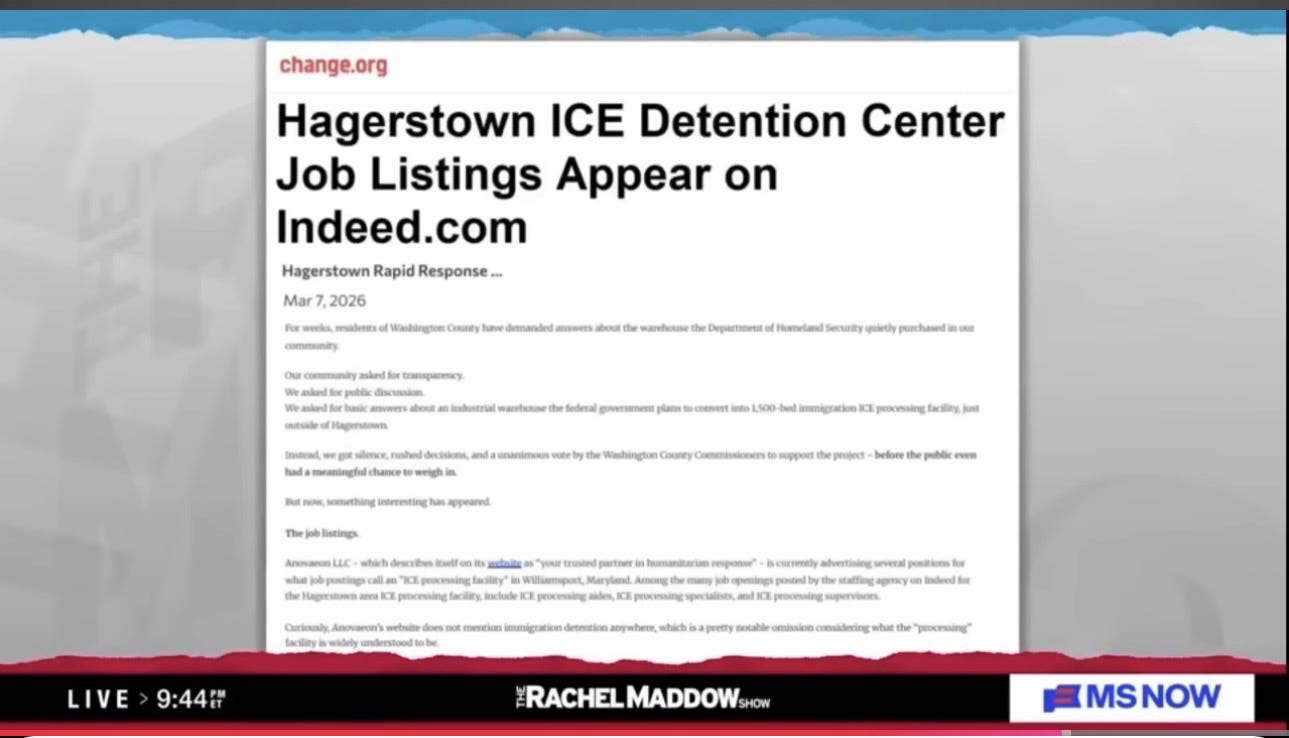
That description landed because it is true. For months, local residents, organizers, doctors, faith leaders, and allied groups have refused to allow this project to move forward in silence. We have joined Washington County Indivisible and protested every single week for months outside County Commissioners meetings. We have filed Maryland Public Information Act requests and exposed communications that officials never intended the public to see. We have obtained drone footage of the site. We have dug through permitting requirements and identified where DHS and ICE appear to have pushed past critical legal and environmental safeguards. We have worked with medical professionals to document the ways this facility could strain an already burdened local health system. We have built a Signal network several hundreds strong, capable of mobilizing in real time whenever new developments emerge. And this couldn’t have happened without you.
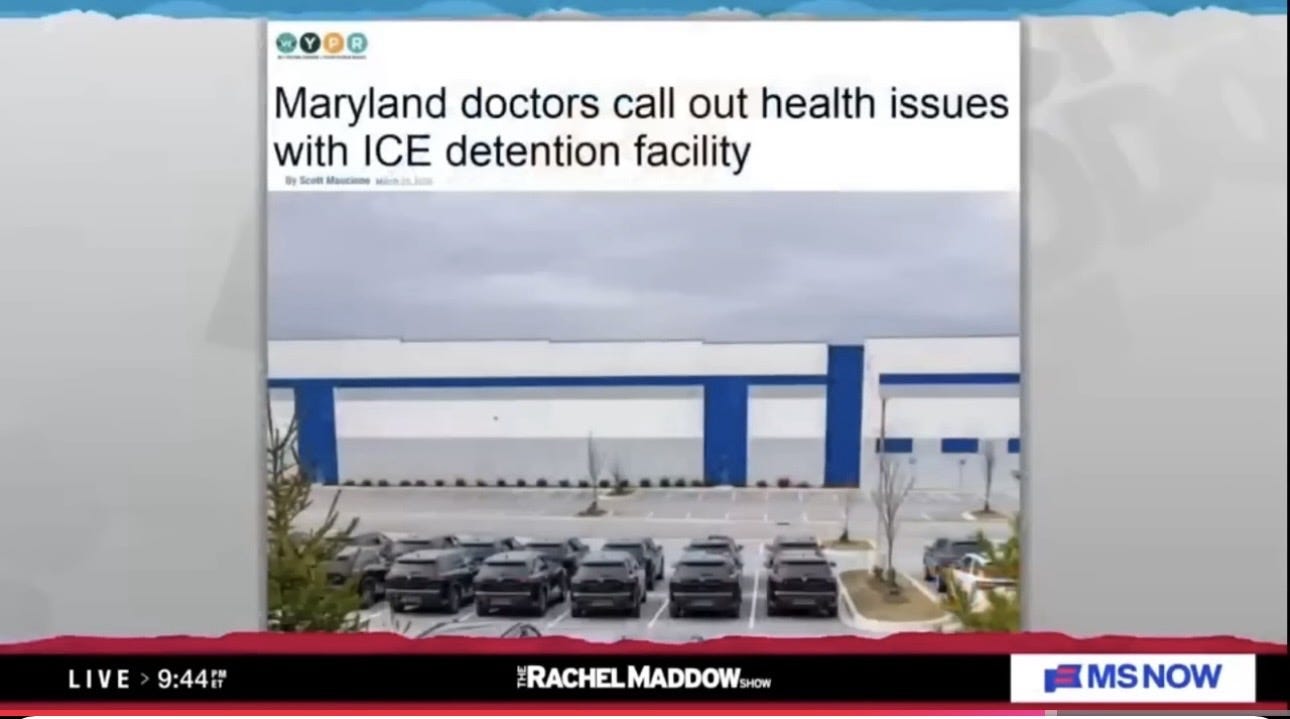
What Maddow captured so clearly is that this has never been a symbolic campaign. This has been a campaign rooted in facts, public records, law, health, and relentless local accountability. The reason this story has continued to gain traction is because people here refused to let it disappear behind bureaucratic language and carefully managed press statements. Every document request, every protest, every drone image, every doctor’s letter, every petition created, every rally outside the Commissioners meetings has served one purpose: to make it impossible for this project to proceed quietly.
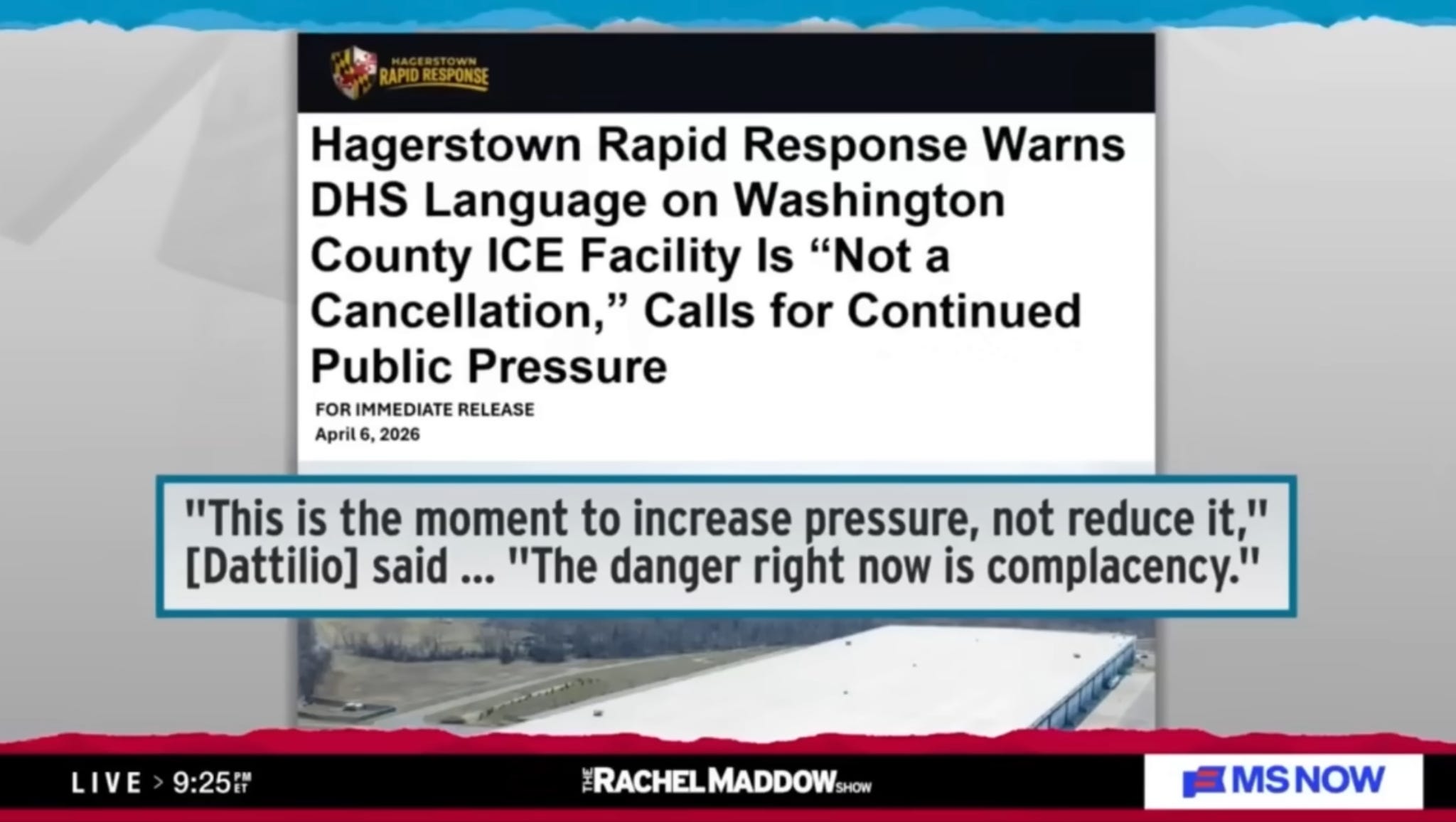
That work matters precisely because this project is not over. In fact, the recent developments in court make this moment more urgent, not less. DHS’s carefully worded claim that it will not “imminently” pursue retrofitting for detention purposes should not be mistaken for a cancellation. It is a litigation tactic, a public relations maneuver, and an attempt to cool the headlines while preserving room to continue the underlying infrastructure work. The danger right now is that people read those headlines and assume the threat has passed. It has not. The warehouse remains at the center of a federal plan that could still move forward unless the legal, political, and public pressure continues to intensify.
That is why Patrick Dattilio’s words, highlighted by Maddow last night, are so important: “This is the moment to increase pressure, not reduce it. The danger right now is complacency.” He is exactly right. This is often the stage where powerful institutions hope movements will exhaust themselves. They soften the language, adjust the timeline, and create the impression of retreat without surrendering the larger objective. If communities interpret a pause as a victory and step back, the machinery begins moving again, often with less public attention than before.

We have seen this playbook before. Agencies facing legal scrutiny or mounting public backlash rarely admit defeat outright. Instead, they recalibrate. They shift the wording. They introduce ambiguity. They say work is being “reconsidered,” “paused,” or not moving forward “imminently,” while leaving the door wide open for the same outcome down the line. The goal is simple: lower the temperature, reduce the pressure, and wait for public outrage to fade. That is exactly why this moment demands the opposite response.
What we have learned in Hagerstown is that local resistance works when it is persistent, scrappy, and deeply informed. This has never been a fight based only on outrage, though the outrage is justified. It has been a fight built on facts, records, legal pressure, public health evidence, and relentless visibility. We have forced this issue into the local press, the Baltimore media market, national outlets, and now onto one of the most watched political programs in the country. That visibility has not happened by accident. It has come from people on the ground doing the slow, difficult work of organizing and refusing to let officials bury the story.
What makes this moment especially significant is that Maddow did not simply report on what is happening here. She recognized that Hagerstown may be offering something larger: a roadmap. Her observation that our work “may help at least show the way in stopping this whole project for the whole damn country” should resonate far beyond Washington County. The federal government is watching what it can get away with here. Other communities are watching how to respond. If this proposed detention warehouse can be stopped through coordinated public pressure, legal action, health advocacy, and relentless scrutiny, then Hagerstown may indeed become the model others follow.
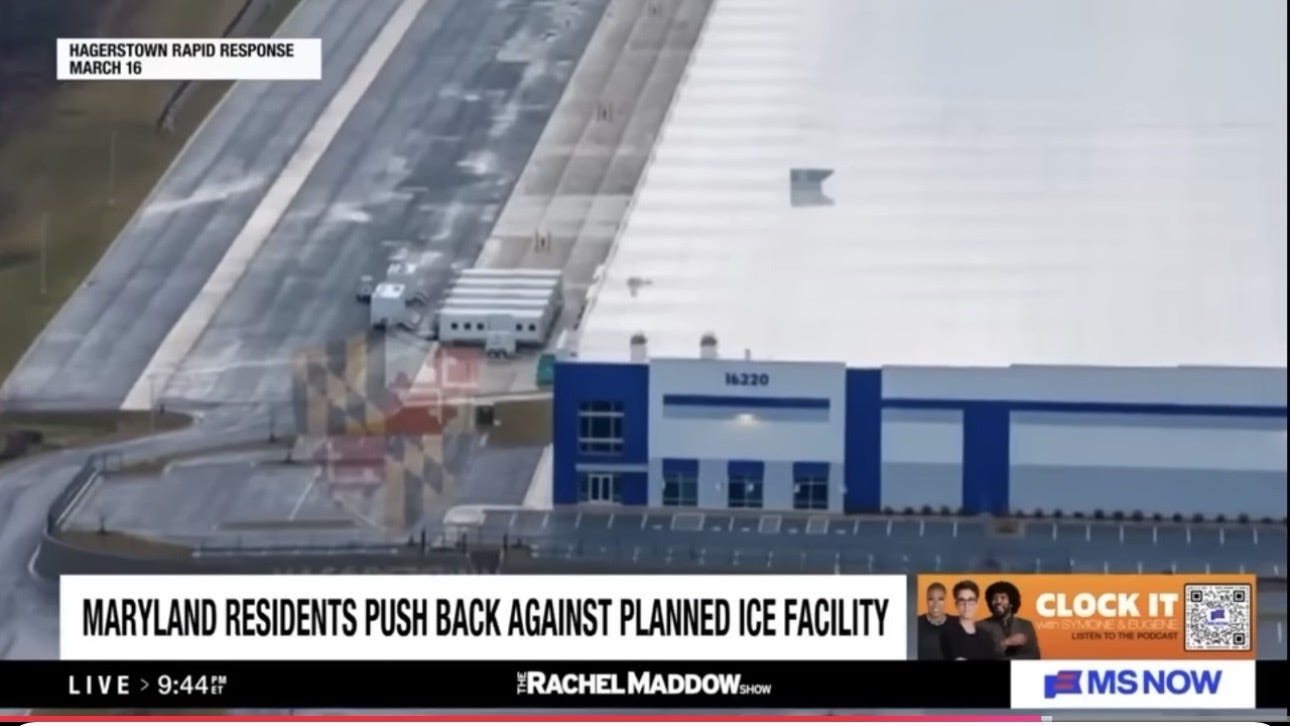
This is about far more than one warehouse in Williamsport. It is about whether communities have the power to stop federal detention infrastructure from being imposed without transparency, without adequate environmental review, and without regard for the human and public health consequences. It is about whether local residents, doctors, organizers, and legal advocates can force institutions to answer for decisions that put entire communities at risk.
The answer, increasingly, appears to be yes.
But only if we keep going.
This is not the moment to ease off the gas. It is the moment to press harder than ever. The legal fight is entering a critical phase, and the public needs to show up in force.
On April 15, a judge will hear Maryland Attorney General Anthony Brown’s landmark lawsuit seeking to stop ICE’s conversion of the 825,000-square-foot Williamsport warehouse into a detention facility. We need the courtroom packed, the courthouse steps filled, and the streets outside impossible to ignore.
Join Hagerstown Rapid Response, Washington County Indivisible, the Maryland Coalition to Stop the Camps, and allies from across the state on April 15 at 9:00 AM for a rally outside the courthouse. At 10:00 AM, supporters can attend the hearing or join the interfaith vigil outside. The rally will take place at George H. Fallon Federal Building and Courthouse, located at 101 West Lombard Street in Baltimore.
“All of this hustle. The protests, the drone footage, the documents, the letter from the doctors...all of this hustle in what really is a pretty Republican part of blue-state Maryland. The work of these local activists has now been incorporated into a lawsuit by the state that’s trying to stop the Hagerstown facility and another one they want to build elsewhere in Maryland...And now after months of effort like that at the local level there are these headlines about the programs potentially stopping nationwide and specific headlines saying that Homeland Security is reconsidering the scope of that Hagerstown ICE prison. Reconsidering the scale of it. Saying “oh the conversion of it to a prison is not imminent after all.” I’ll tell you, nobody in Hagerstown is declaring victory over this, but boy have they thrown a lot of sand in the gears. And in a way that has had some signaled success in Hagerstown, Maryland. And that may help show the way in stopping this whole project for the whole damn county.” - Rachel Maddow
This fight is far from over. If anything, the attention from last night’s Maddow segment confirms that what we are doing here matters, not just for Hagerstown, but for communities across the country facing similar threats. The lesson of the past few months is simple: pressure works.
So now is the time to increase it.
Pack the court. Fill the streets. Stop the camp. Join us on April 15th and RVSP now!

Indivisible is holding a training call for a National Day of Action “No Concentration Camps” this evening, Tuesday, April 14, 2026 starting at 8 PM. You can register at https://act.indivisible.org/go/906812?t=7&akid=125196%2E1398047%2Edg0SCg
The National Day of Action will take place at locations and a start-time TBD on Saturday, April 25, 2026. Hope to see you there too!
And good luck at your Hearing in U.S. District Court today! Yoiur good lawyers will bring you good luck, I have no doubt.