



Earlier today, we published a story about a new confidentiality agreement surfacing inside Washington County government and the increasingly uncomfortable pattern emerging around secrecy, infrastructure planning, and the proposed ICE detention warehouse near Williamsport. The deeper we dig, the more it becomes clear that non-disclosure agreements were not some fringe theory or overblown accusation from activists. They were real, they were being used, and they were tied to discussions happening long before the public fully understood what was coming.
Last month, we broke the story that Washington County Commissioners signed an NDA tied to a major land deal just weeks before the Department of Homeland Security purchased the 54 acre property and the 825,000 square foot industrial warehouse, which they plan to turn into an ICE detention center.
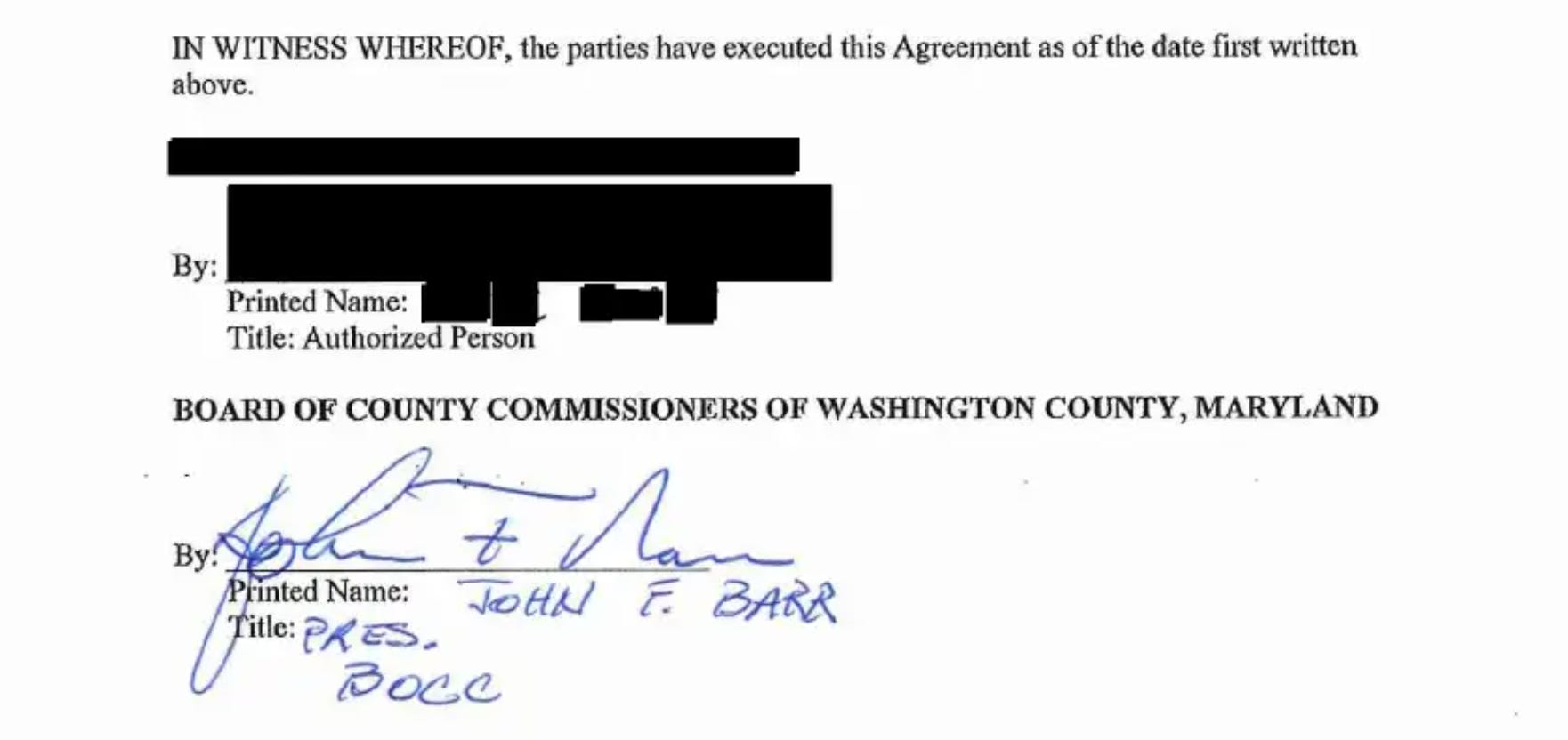
After filing a Maryland Public Information Act request, Hagerstown Rapid Response and Washington County Indivisible obtained a redacted non-disclosure and confidentiality agreement executed in December 2025 between the Washington County Board of County Commissioners and a private Maryland LLC connected to a “project to be located on the Company’s property.” The timing alone is difficult to ignore. The agreement was signed only weeks before DHS ultimately purchased the warehouse property that would later become the center of the proposed ICE detention facility controversy.

For months, local officials insisted there was little to say publicly about the warehouse project while residents, journalists, and community groups were left trying to piece together what was happening through court filings, scattered meeting records, environmental notices, and public records requests. This document shows that while the public remained largely in the dark, formal confidentiality agreements were already in place behind the scenes.
What stands out most is how expansive the agreement actually is. This is not narrowly drafted language limited to a simple land transaction or preliminary business conversation. The NDA specifically defines confidential information to include discussions involving “facility network strategy,” “location strategy,” “economic development incentives,” and even the “existence and progress” of such plans. Those are not ordinary phrases people associate with a routine warehouse purchase. They sound like the kinds of discussions that happen when governments and private entities are coordinating around a major operational project with long-term regional implications. The agreement also prohibited disclosure of information to third parties without written permission while allowing information to be shared internally with consultants, subcontractors, advisors, agents, and others deemed to have a “legitimate need to know.” In practice, that meant conversations about the project could quietly circulate among insiders and outside consultants while the public remained excluded from the process entirely.
The signature page shows the agreement was signed on behalf of Washington County by then-BOCC President John Barr. That matters because Barr has repeatedly been one of the most visible county officials connected to the warehouse controversy and the broader handling of the project. It also matters because county leadership spent months publicly downplaying concerns about secrecy surrounding the warehouse while residents continued uncovering more evidence that significant discussions and planning efforts had already been underway long before the public was meaningfully informed. The existence of this NDA directly undercuts the idea that there was little or nothing happening behind closed doors.
To be clear, governments sometimes use NDAs during economic development negotiations or property transactions. On its own, an NDA is not proof of wrongdoing. But context matters, and the context here is extraordinary. This was not a proposal for a shopping center, distribution hub, or office park. This ultimately became a plan tied to a massive federally connected detention operation that Maryland Attorney General Anthony Brown later argued in court could overwhelm existing sewer infrastructure, strain local systems, and carry substantial environmental and community impacts. Since then, the project has triggered lawsuits, protests, federal scrutiny, environmental concerns, and growing outrage over the lack of transparency surrounding how this all unfolded.
That is why this document is significant. It adds another piece to a timeline that increasingly suggests far more coordination and planning may have been happening privately than the public was led to believe at the time. The agreement itself never explicitly says “ICE” or “detention center,” and we are not claiming otherwise. But when an NDA discussing “facility network strategy” and “location strategy” is signed shortly before DHS acquires the exact warehouse property that later becomes the centerpiece of a detention center battle, people are naturally going to ask questions about what officials knew and when they knew it.
This is also why today’s earlier story about additional NDAs surfacing inside county government matters. Viewed individually, officials may try to characterize each agreement as routine or unrelated. Viewed together, they begin to paint a broader picture of a county government increasingly comfortable operating behind confidentiality walls while the public struggled to get basic answers about one of the largest and most controversial projects Washington County has faced in years.
The public still deserves straightforward answers about who requested these agreements, what discussions were taking place at the time, what role county officials played in facilitating the project, and whether the public was intentionally kept in the dark while key decisions and planning conversations were already moving forward. Because at this point, the issue is no longer just the warehouse itself. It is the growing sense that residents were never given the transparency they should have received from the very beginning.
Recommended reading
Washington County, Maryland, Commissioners Signed Non-Disclosure Agreements on a Secret Land Deal. Weeks Later, an ICE Facility Was Revealed

There is a difference between protecting sensitive information and deliberately keeping the public in the dark. What we have uncovered in Washington County could point squarely to the latter.